Archive for the '17th century accessions' Category

An astrological calendar

2 March 2025

I’m not sure if it’s good (or at least acceptable) practice to rename and rewrite blog entries that have already been published, but I’ve just done so. So much information about the Stuttgart calendar came to light following my original posting that I’ve decided to rewrite my account of it and give it its own new entry, removing it from my previous entry which is now only concerned with the recently discovered Shuihu fragment.

The story began in November 2023, when Marcel Thoms, Head of Acquisitions & Cataloguing at the Württembergische Landesbibliothek told me about a calendar that had been discovered by accident while the Library was preparing an exhibition on time division. Although there is no absolute guarantee that the calendar came to Europe in the 17th century, in its subject matter and physical appearance it is of a piece with the rest of what I call the “seventeenth-century corpus”, and Marcel has told me that its shelfmark (Cod. or. 4° 4, especially the low number 4), indicates that it was part of the founding collection of the Library’s predecessor, the Herzogliche Öffentliche Bibliothek. This had been founded in Ludwigsburg in 1765 by Duke Carl Eugen (and most unusually it was open to the public from the start, as its name suggests). At that time it would have been quite normal for figures such as Duke Carl to have possessed a fragment of one of the Chinese books that came to Europe in the 17th century, as a glance at my list will confirm.

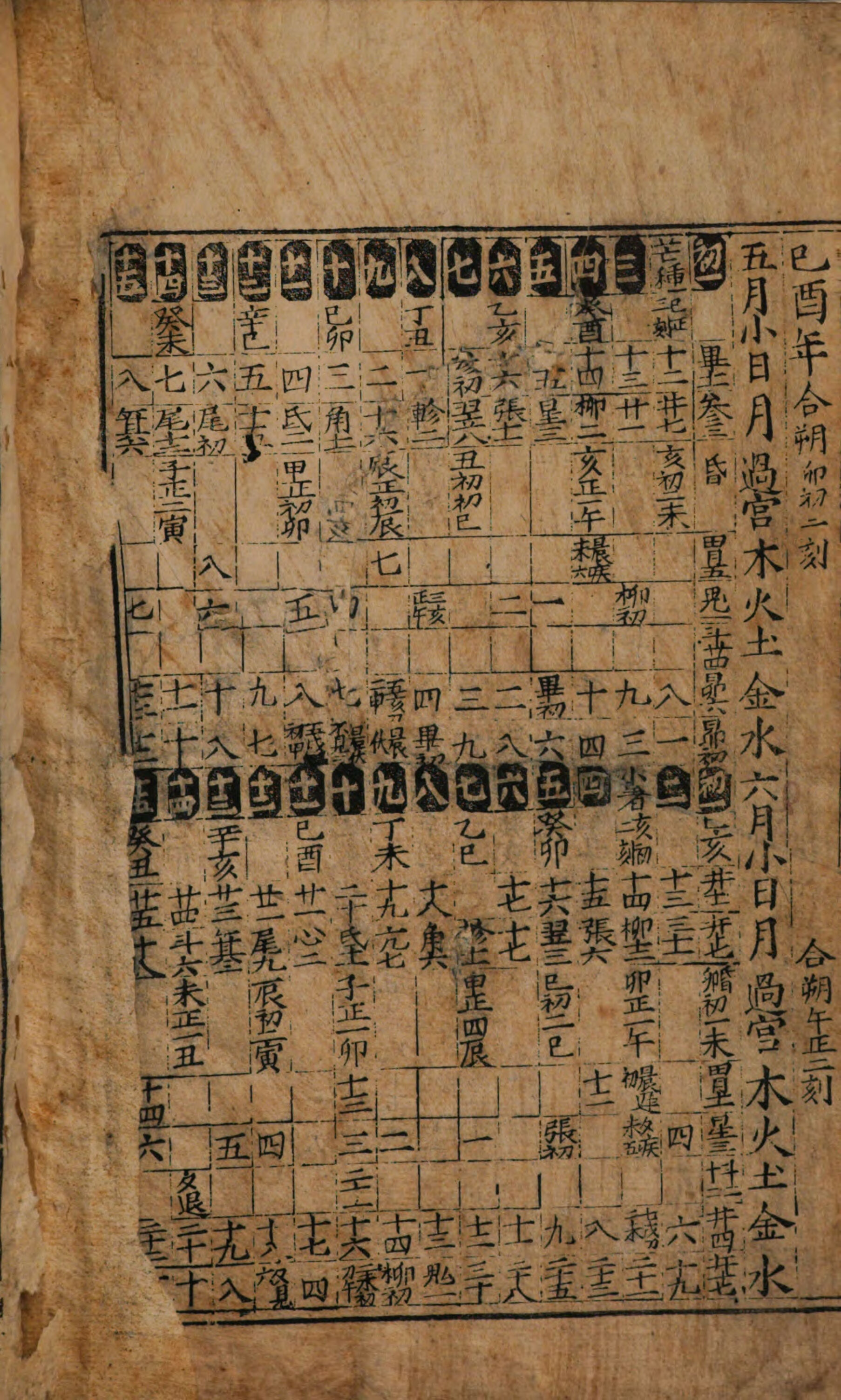
The Stuttgart volume is only a fragment of the complete work, whose full extent is unknown. The surviving leaves are all from juan 卷 7: 2-60上 (the first and last of these leaves are badly damaged in the area of the banxin 版心) and cover the years 1559-1568 (嘉靖己未年一、二月~嘉靖戊辰年三、四月). Here is the front cover and a specimen page from the calendar, which has been digitised:

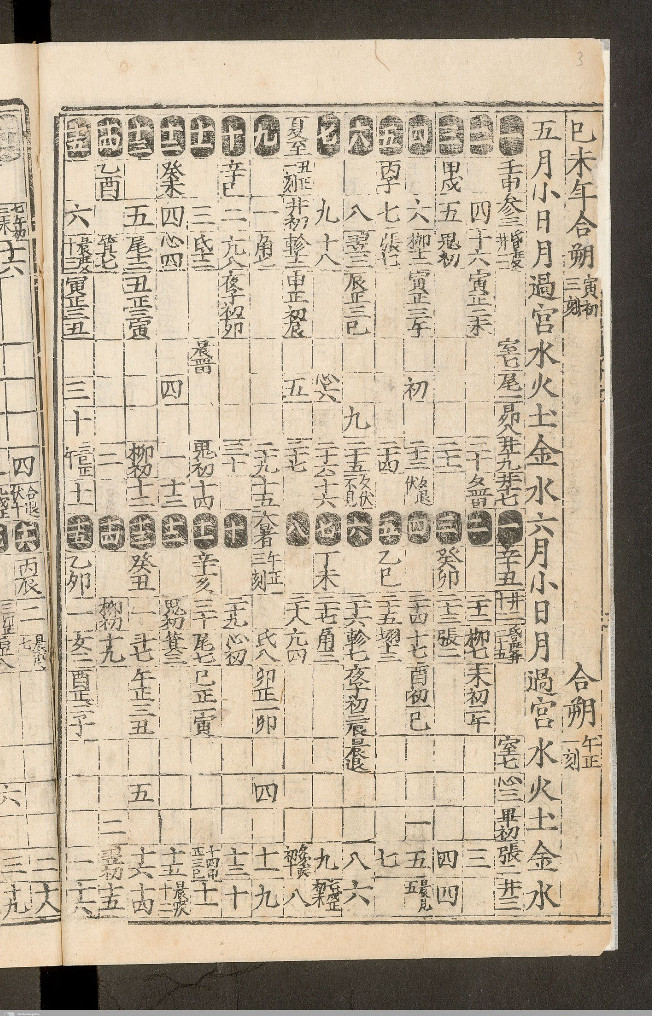
I had no clear idea of why calendars of the lucky days in years gone by should have been published, so again I went to my friend Zheng Cheng 郑诚, who as expected told me exactly why. They were produced to enable fortune-tellers to calculate the best date for marriages, funerals, or other important events on the basis of the subjects’ birthday information; that is, their shengchen bazi 生辰八字, or “eight birthday characters”, namely the year, month, date, and hour of their birth each expressed in two characters from the sexagenary “heavenly stems and branches” (干支) system. Although people would remember these dates, they would not know the astrological details associated with them.

Pursuing his enquiries, Zheng Cheng got in touch with the scholar Zhao Jianghong 赵江红 who has written a number of articles on the subject, and she informed him that there is another fragment of the same copy of this calendar in the Österreichische Nationalbibliothek (shelfmarked Sin 133-C ALT SIN). This fragment has also been digitised. It contains most of juan 卷 6 (unfortunately the pagination is not visible in the digitisation) covering the years 1549-1558 (嘉靖己酉年五、六月~嘉靖戊午年十二月), and most importantly the first half-leaf of juan 卷 7, which is missing in the Stuttgart fragment.

Not only does this indicate that the Vienna and Stuttgart fragments are consecutive parts of the same copy, but it also provides us with an exact title for the work as well as other bibliographical details.
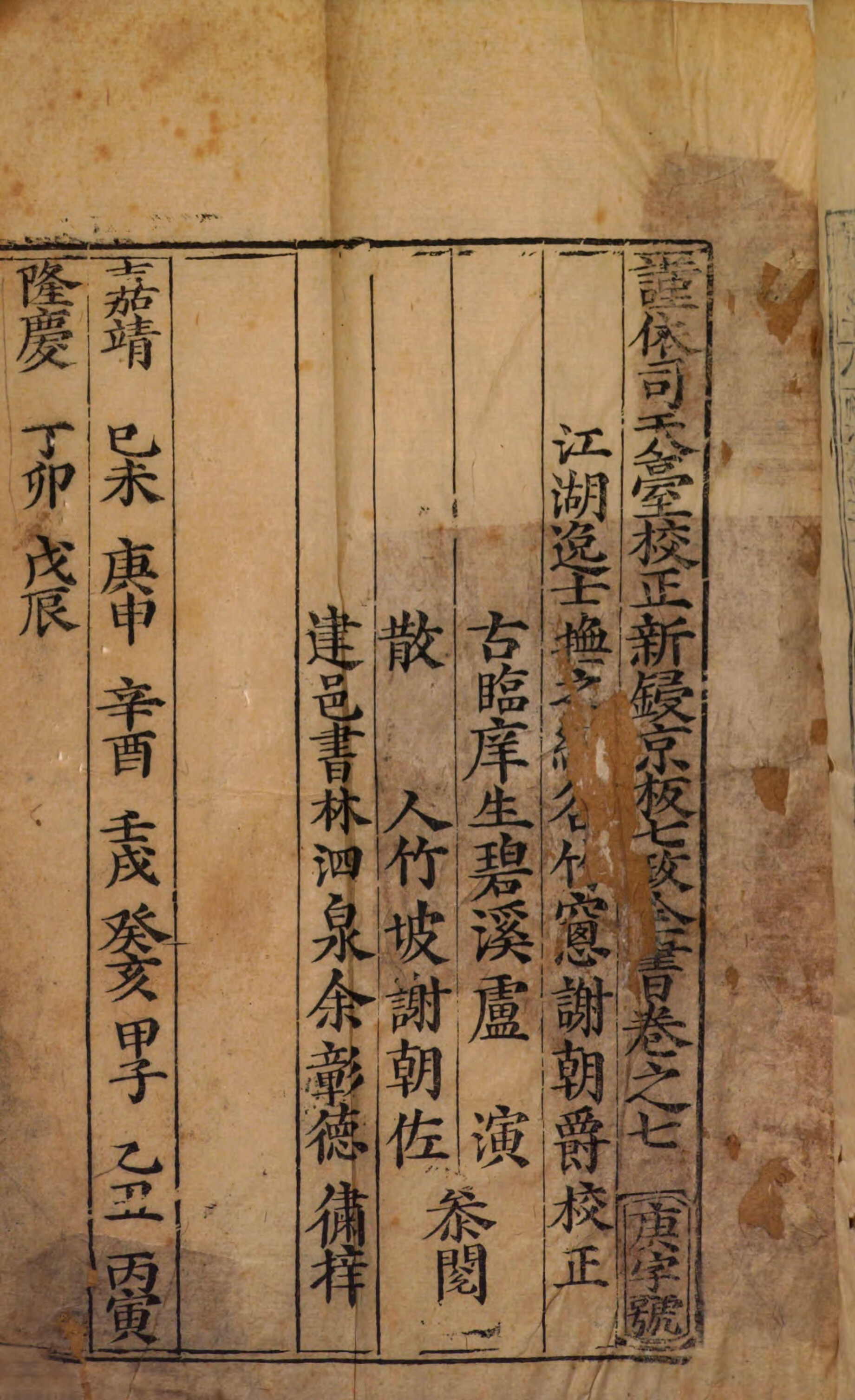
So the title of the work is 《謹依司天臺校正新鋟京板七政全書》 jin yi si tian tai jiao zheng xin qin jing ban qi zheng quan shu, and it was edited by 謝朝爵 Xie Chaojue and published by 余彰德 Yu Zhangde, a member of the famous Yu family of Jianyang 建陽 publishers, making the edition of a piece with other parts if the 17th century European corpus.

When I originally posted my account of this calendar I had already learned from Zheng Cheng that the qizheng 七政 referred to in the title are the “seven ruling powers” (for want of a better translation) of the Sun, Moon, Jupiter, Mars, Venus, Mercury, and Saturn, which are all used in astrology and prognostication. But I had no idea of how the calendar was structured until Edward White posted a very informative comment, as follows:

“The page of the Stuttgart calendar you showed [and presumably this also applies to the page from the Vienna fragment] is a tabulation of the places of the planets in the sky. The top half of the page shows the data for the 6th month, and the bottom for the 7th. Each column represents a day of the month, and each row shows (from top to bottom):

1- The date of the month (in white on black lettering)
2- The sexagenary cycle of the day
3- The sun’s position
4- The moon’s position
5- The time of day the moon changes zodiac sign
6- Jupiter’s position: (水 is probably an error for 木)
7- Mars’ position (Mars seems to be in retrograde motion in this period, that’s why the numbers go backwards)
8- Saturn’s position
9- Venus’ position
10-Mercury’s position

All the positions from 3-10 (except 4) are stated in terms of the 28 lunar mansions or 宿. Additionally, it seems publishers only noted the days when the planet moved a degree and did not provide entries for the intermediate days. This is especially apparent in the rows of the slow-moving planets Mars, Jupiter and Saturn.”

In a subsequent e-mail message, Edward also points out that in addition to the “Seven Governors” 七政, the almanac also tabulates the “Four Remainders” 四餘. These are four mathematically determined points which are also considered significant in astrology: Ziqi 紫炁, Yuebei 月孛, Rahu 羅㬋 and Ketu 計都, the last two being adapted from Indian astrology. The positions of these points are tabulated in the final columns of each month in both the Stuttgart and Vienna fragments; their names are abbreviated to 炁、孛、羅、計.

Zheng Cheng has located a few similar calendars in Japan, one in the Fu Ssu-nian Library 傅斯年圖書館 in Taipei, and one in the Palace Museum Library in Beijing. This last one is presented in almost exactly the same format as the Stuttgart edition, and has been reproduced twice:
1. 续修四库全书, 第1040册 (上海: 上海古籍出版社, [1996])
2. 故宫珍本丛刊, 第388册 (海口: 海南出版社, 2000)

Both the Palace Museum edition and all the others have later date ranges than the edition in Vienna and Stuttgart, which might well be the earliest in existence.

There are later, even relatively modern examples of this type of calendar, and there is one in the Bodleian which I bought in Yamada Shoten in Tokyo in 1981:

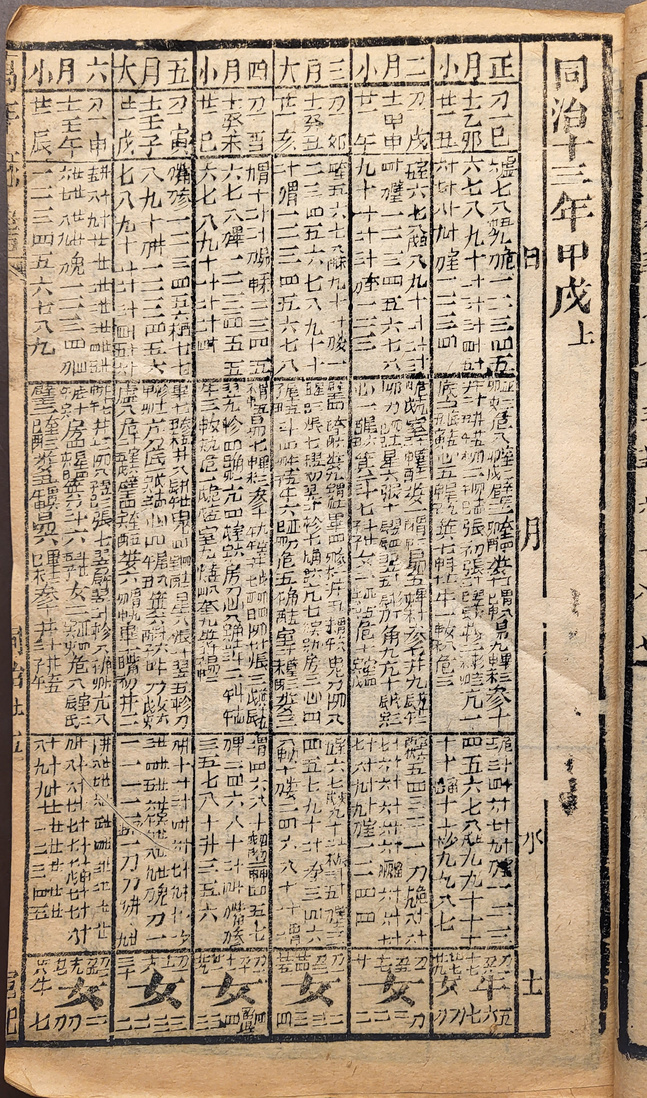
重訂七政臺歷萬年書 : 不分卷 / (清)欽天監修
民國十二年[1923]富記書局刊本
線裝1冊 ; 25公分
同治十三年甲戌[1874]至光緒三十四年戊申[1908]
Sinica 2666

Of this, Edward White says:

“The 重訂七政臺歷萬年書 is published in an even more compact format. In the case of the Sun, Moon and Mercury The publishers dispensed with numbering the days individually, and instead formatted the entries for each month as a 10×3 grid; the reader was expected to find the relevant data for a given date based on its position in the grid. (eg: the 5th box of the right column of the grid = 5th day of the month). The bottommost row shows the dates Saturn changes degree.

I should also note that some modern Chinese almanacs still publish the planetary coordinates: Examples include 正福堂、繼福堂、真步堂.”

Another Shuihu fragment

31 January 2025

This is my eleventh blog entry on the subject of the Chinese books that came to Europe in the 17th century. I have now tagged them all as “17th century accessions” (in the “Categories” list at the bottom left of the screen) so that they can be conveniently located. As indicated in my last entry on this subject, which I’m astonished to see was written over four years ago, if I can I like to say more about them than it would be appropriate to put in my simple list. And as in this entry, that often amounts to little more than repeating what others have told me.

Two recent finds are of unusual interest, and both involve Stuttgart in one way or another. I will deal with them separately in this and my next blog entry.

When books that came to Europe in the seventeenth century are discovered, they are usually found in older libraries where they have often lain unidentified for centuries, or in newer libraries that house older collections. Of all the places that one might look for them, China would be the last.

Yet the latest discovery was indeed made in China. It was brought to my attention by Zheng Cheng, who e-mailed me in August last year to say that while reading an issue of Huaxi yuwen xuekan 华西语文学刊 he had come across an article by the scholar Ai Junchuan 艾俊川 in which he reproduces, with a very informative introduction, 23 half-leaves from an edition of the Shuihuzhuan 水滸傳 which he bought from an English dealer on eBay in December 2007 for the sum of £26. [1]

In his article, Ai establishes that the half-leaves in his possession are not only from the same edition, but from the same copy of the well-known fragments preserved elsewhere, as documented in my list. It is extraordinary that this is the second fragement of that copy to have been found on eBay – I documented the discovery of the earlier, much larger one in my blog entry of November 2020.

Furthermore, Ai has also established that they dovetail precisely with not only the missing leaves, but also the missing half-leaves of the Stuttgart fragment. Unfortunately owing to the trimming, the pagination of these half-leaves is missing, but on the basis of their content, it should be possible for someone with a detailed knowledge of the Shuihu text to figure it out.

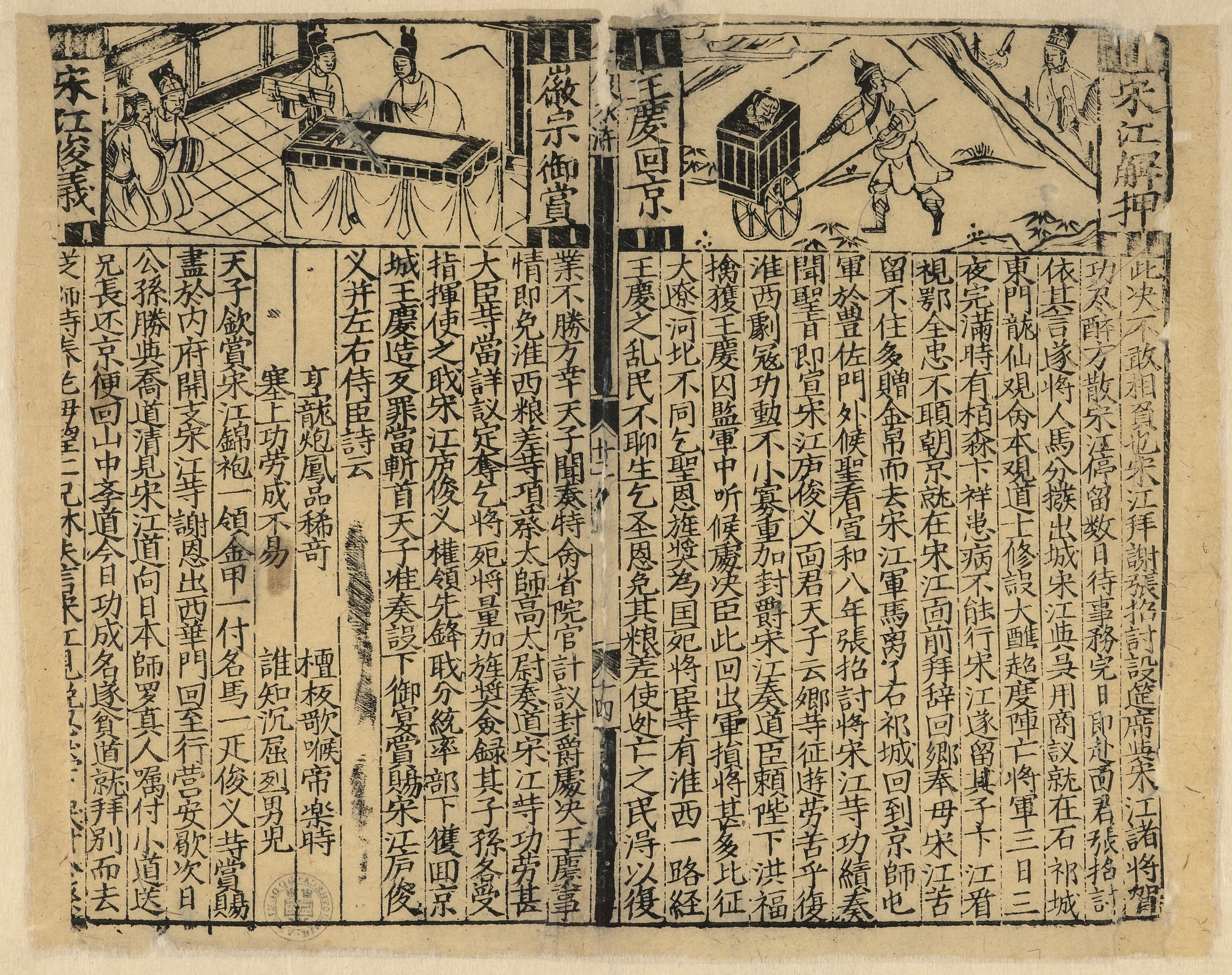
The reason why I’m referring to “half-leaves” is because a previous owner has cut the two panels of text out of each leaf (sacrificing the banxin 版心 in the process), and mounted them individually as shown in this image, which Ai Junchuan has very kindly sent me:

This is the first half-leaf of juan 卷 3; for comparison, here is the first half-leaf of juan 卷 4 in the Stuttgart copy:

Although I first encountered the single leaf preserved in the Bodleian (Sinica 121) almost fifty years ago, I never took the trouble to find out exactly what it is, and why it is significant. In fact I didn’t even know that there is no standard version of the Shuihuzhuan despite its status as one of the “four great works” 四大名著 of Chinese fiction.

Ma Youyuan 馬幼垣 has written two lengthy monographs on its extraordinarly complicated textual history [2]. There are many quite different versions which fall into two groups, “complex” 繁 and “simple” 簡; the “simple” versions narrate the events in less detail, and are intended for less sophisticated readers. And whether simple or complex, some editions may be “augmented by the insertion of the tales of Tian Hu and Wang Qing” 插增田虎王慶.

As indicated by its title 《新刻京本全像插增田虎王慶忠義水滸全傳》 the European fragments are from a copy of the “augmented” version, which is also “simple”. In fact it is believed to be the earliest extant example of such an edition.


1. 艾俊川: 从欧洲回流的插增本《水浒传》残叶 (华西语文学刊第十一辑, 2015, 217-226); the article can also be found here.
2. 水滸論衡 (台北: 聯經出版事業公司, 1992, ISBN 957-08-0794-6); 水滸二論 (台北: 聯經出版事業公司, 2005, ISBN 957-08-2887-0).

More seventeenth-century finds

28 November 2020

Most of my latest blog entries have been concerned with the Chinese books that came to Europe in the 17th century, and so is this one. It’s beyond my control. People keep finding them, and when they do, if I can I like to provide some background information about them that it would be inappropriate to put in my simple list.

Pembroke College Cambridge

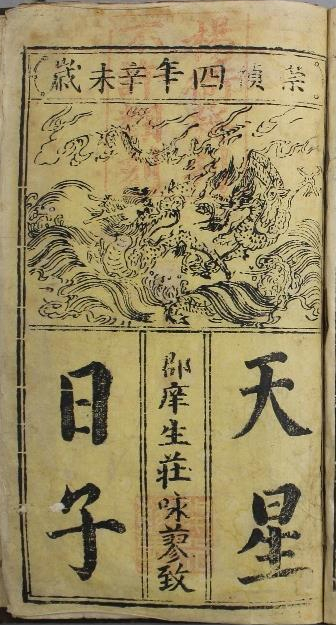
News of the first one came from Will Poole. Noel Malcolm had drawn his attention to an entry in the Benefactors’ Book of Pembroke College, Cambridge recording the donation of a Qu’ran by the London merchant Edward Tines, probably in the early 1630s, followed by a Chinese book in 1633. The Chinese book is an almanac for the year 1631. When I saw an image of it, I recognised it immediately because by a strange coincidence, earlier this year I’d re-examined another copy of the same work in Corpus Christi College in Oxford, which I catalogue as follows:

天星日子 不分卷有缺
明崇禎中刊本
洋裝(原線裝)1冊 ; 28公分
書名據封面題
封面有「郡庠生莊咏蓼致」字樣
本書爲崇禎四年辛未[1631]通書
Corpus Christi College MS 216

The discovery of the Pembroke copy is particularly fortunate, as its title-page (to use a misleading word, as there is no real English equivalent of the Chinese term fengmian 封面) is complete, whereas that of the Corpus copy lacks the top portion which bears the date of the almanac: 崇禎四年辛未歲 “4th year of the Chongzhen emperor, the year xinwei“, that is, 1631. I’d already established the date of the Corpus copy from the text, but to see it so prominently displayed on the title-page was nevertheless reassuring.

Something worth noting is that there are editions in the 17th century corpus that date to well before the first Dutch East India Company voyages. For example, several of the medical works date to the first decade or so of the Wanli 萬暦 period, so does the edition of the word-book described below. So they could have been bought at any time from the first voyage onwards, as works like these are permanently in demand and would have been available from booksellers at any time.

Almanacs on the other hand are very ephemeral, and would only have been sold around the time of the Chinese new year, which in 1631 fell on Saturday 1 February, if the website from which I found this out is any good. And the fact that at least two copies of this almanac came to Europe suggest that they were indeed bought at this time, when multiple copies were on sale. So it may be possible for somebody with a detailed knowledge of the early VOC voyages to identify the sailing on which these two almanacs – and maybe even more – came to Europe.

Universiteitsbibliotheek Utrecht

The second find was made by Koos Kuiper. It’s actually three finds, in Utrecht University Library. Koos told me about them last year, but I didn’t put them into my list until he reminded me about them a couple of weeks ago. Inexcusable.

1

Two of the finds clearly belong to editions which are already in the list. The first is four more juan 卷 of Zhou Shixian’s 周士顯 edition of the Four books 周會魁校正四書大全: 2, 4, and two copies of 10 (V OCT 855). They were given to the library by Willem van Cleeff in 1719, who Koos thinks is probably the Gulielmus van Cleeff who obtained a doctorate in Utrecht in 1706.

This work has 18 juan altogether. Most of the surviving examples are in Oxford, and apart from the recently discovered juan in Utrecht there are a few leaves from juan 18 in Trinity College Dublin on which I posted a blog entry at the beginning of last year, telling all that I know about the edition and its distribution. I have nothing to add to that, except to point out that as my catalogue aims to record all Chinese books in Oxford, not just those in the Bodleian, I have added the juan in Corpus Christi College to my catalogue entry – it was already in the list – so that the entry now reads as follows:

周會魁校正四書大全 殘十六卷 / (明)胡廣, (明)楊榮奉敕纂修 ; (明)周士顯校正
明萬曆中坊刊本
線裝18冊 ; 27公分
一名《周會魁刪定四書大全》
全書十八卷, 殘卷一~六﹑八﹑九﹑十一~十八, 有缺
Sinica 68
Sinica 69 殘卷一﹑三﹑十二﹑十四﹑十五﹑十八, 有缺. – 線裝6冊
Sinica 52 殘卷十二. – 洋裝(原線裝)1冊 ; 28公分
Sinica 43 殘卷十四. – 線裝1冊 ; 25公分
CCC MS 205 殘卷十七. – 洋裝(原線裝)1冊 ; 27公分

From this it can be deduced that Oxford has fascicles from at least three different copies (there are three copies of juan 14). But we have no copies of juan 10 – they went to Utrecht. The only part of this work of which no example has yet been found in Europe is juan 7.

2

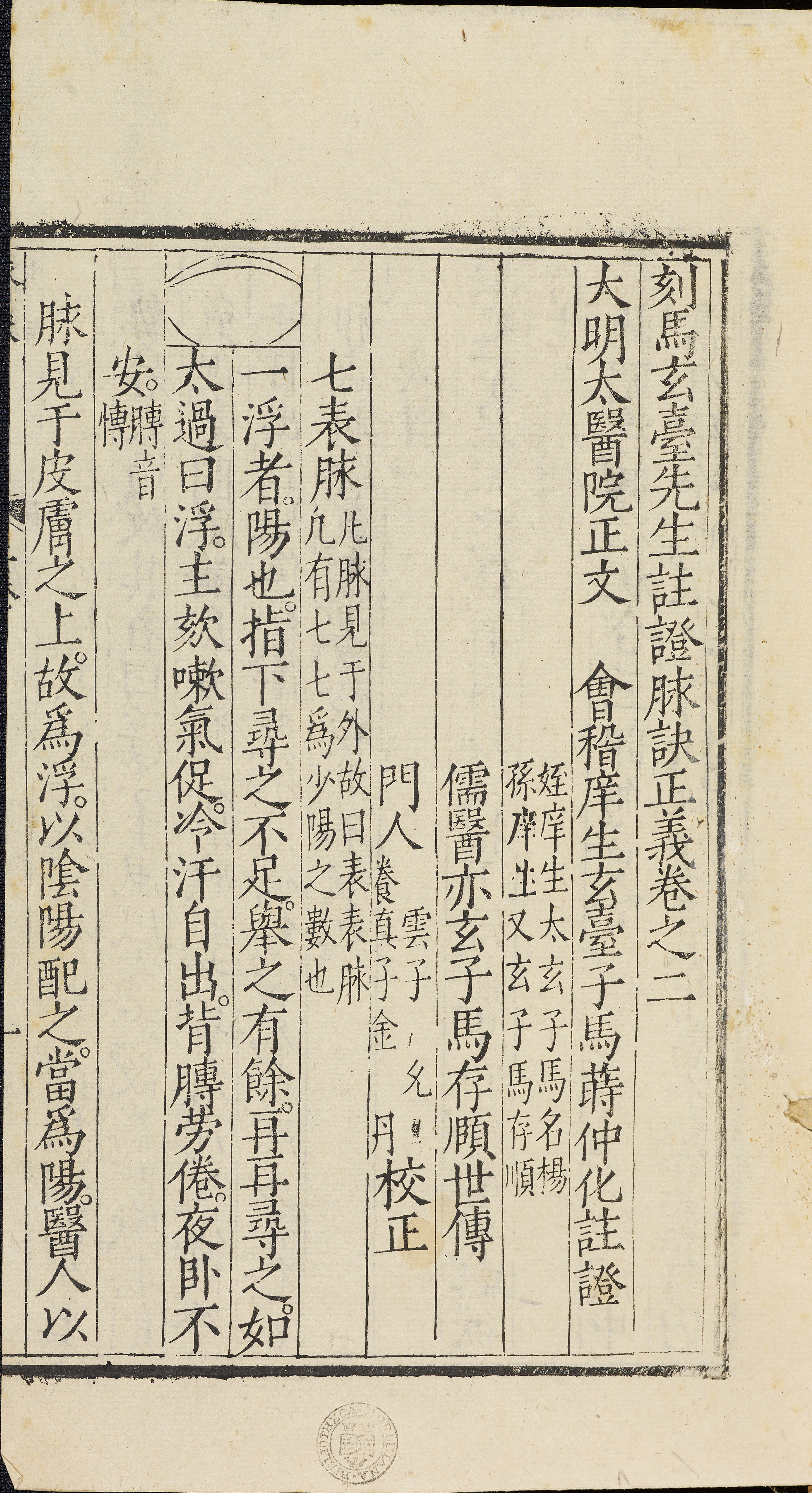
The next Utrecht find is some leaves from a medical text of which the first three juan are in the Bodleian, and which someone told me is a unique survival; indeed, I’ve failed to find it in any catalogue whether printed or online, and a Google search for this title or even part of it will currently only lead to its entry in the Serica Project website. I catalogue it as follows:

刻馬玄臺先生註證脈訣正義 殘三卷 / (明)馬蒔撰
明嘉靖中(?)坊刊本
線裝2冊 ; 28公分
殘卷一~三(有缺)
書名據卷二題
卷三題名《刊馬玄臺先生註釋脉訣正義》
Sinica 11

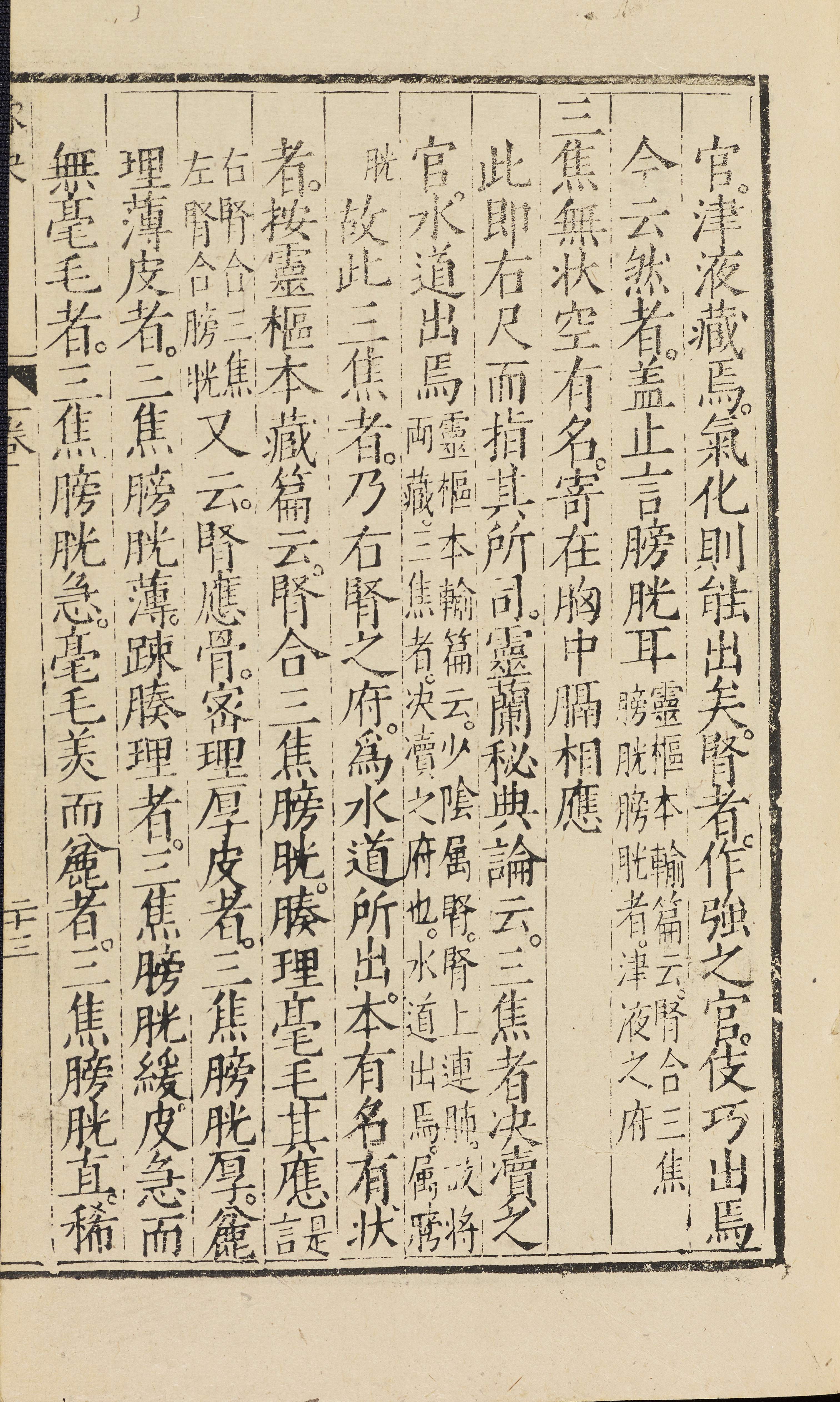
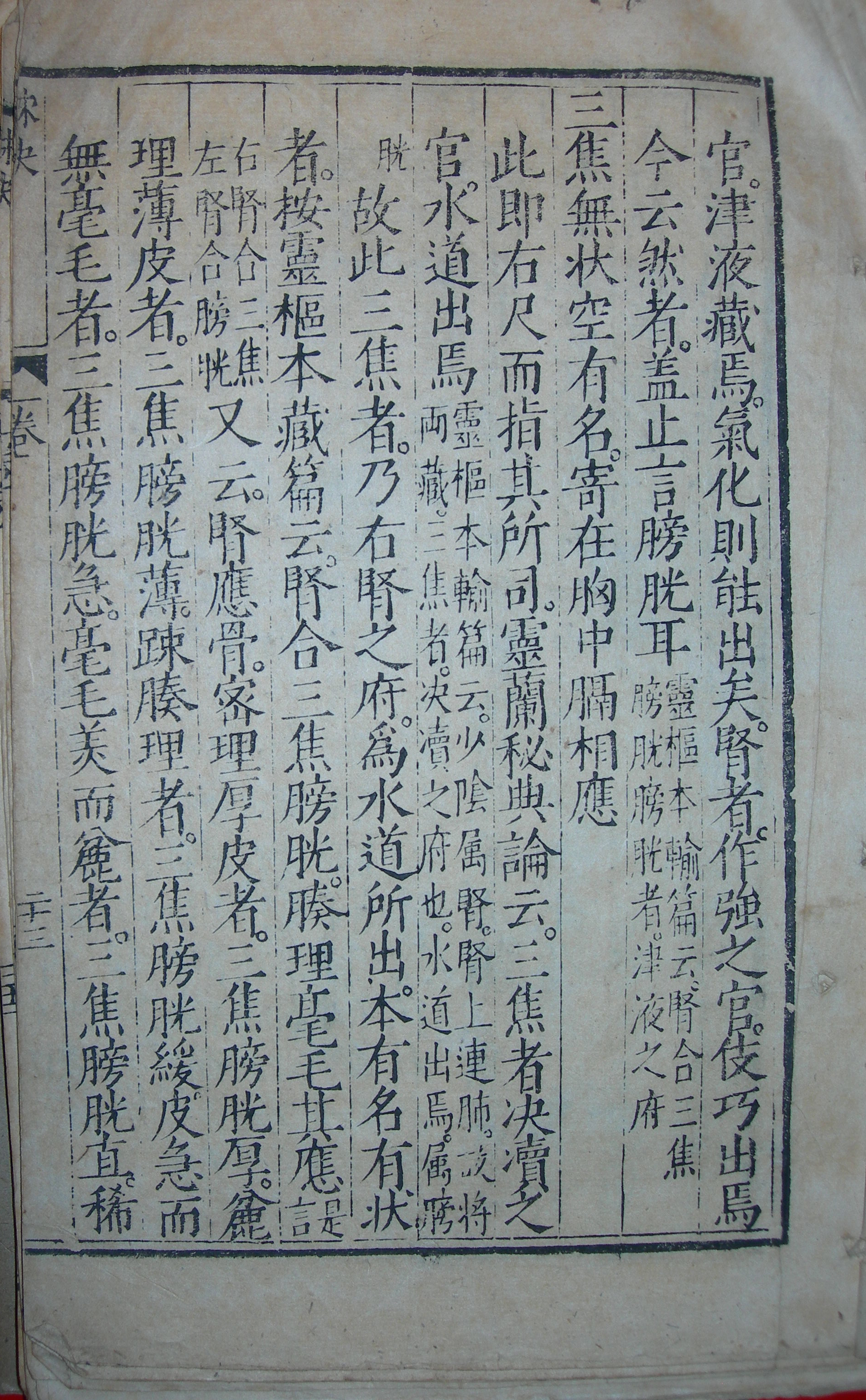
But the discovery of the Utrecht fragment shows that at least a second copy must have come to Europe, as it duplicates the first of the Bodleian fascicles:


The only difference is that the Bodleian fascicle (left) preserves p.22-54, and the Utrecht fascicle (right) p.21-53. It is possible that owing to its length, the first juan may have been bound in two fascicles, but it is a strange coincidence that only the second of the two should have been preserved in both Oxford and Utrecht.

This, together with the fact that almost all of the European 17th-century acquisitions are incomplete, makes me think that the complete books may never have been brought to Europe. The VOC merchants had no idea what they were buying, only that whatever it was, it had a curiousity value once it reached Amsterdam. So they might simply have bought (or been given) odds and ends by the Chinese they were trading with.

3

The third Utrecht find was at first rather difficult to identify, because the surviving leaves lack the juan 卷 beginnings and endings where a title would normally be found, nor is there a title in the banxin 版心, the central column of the block. Koos had studied the text and established that whereas it was clearly a word-book with phonetic glosses arranged according to radicals, the radicals were not in the familiar order of any of the well-known dictionaries such as the Shuowen 說文 or Zihui 字彙. As in the Yupian 玉篇, the radicals were arranged in categories denoting similar things, not in the order of their stroke count.

He then sent me some images, so that I was able to compare them with word-books in our own collection. The most promising was one having twenty juan, which I would have catalogued as follows if complete:

翰林重考字義韻律大板海篇心鏡 二十卷 / (明)劉孔當校
明萬曆二十四年[1596]建陽書林葉天熹刊本

There are 6 fascicles of this work in the Bodleian representing three distinct printings.

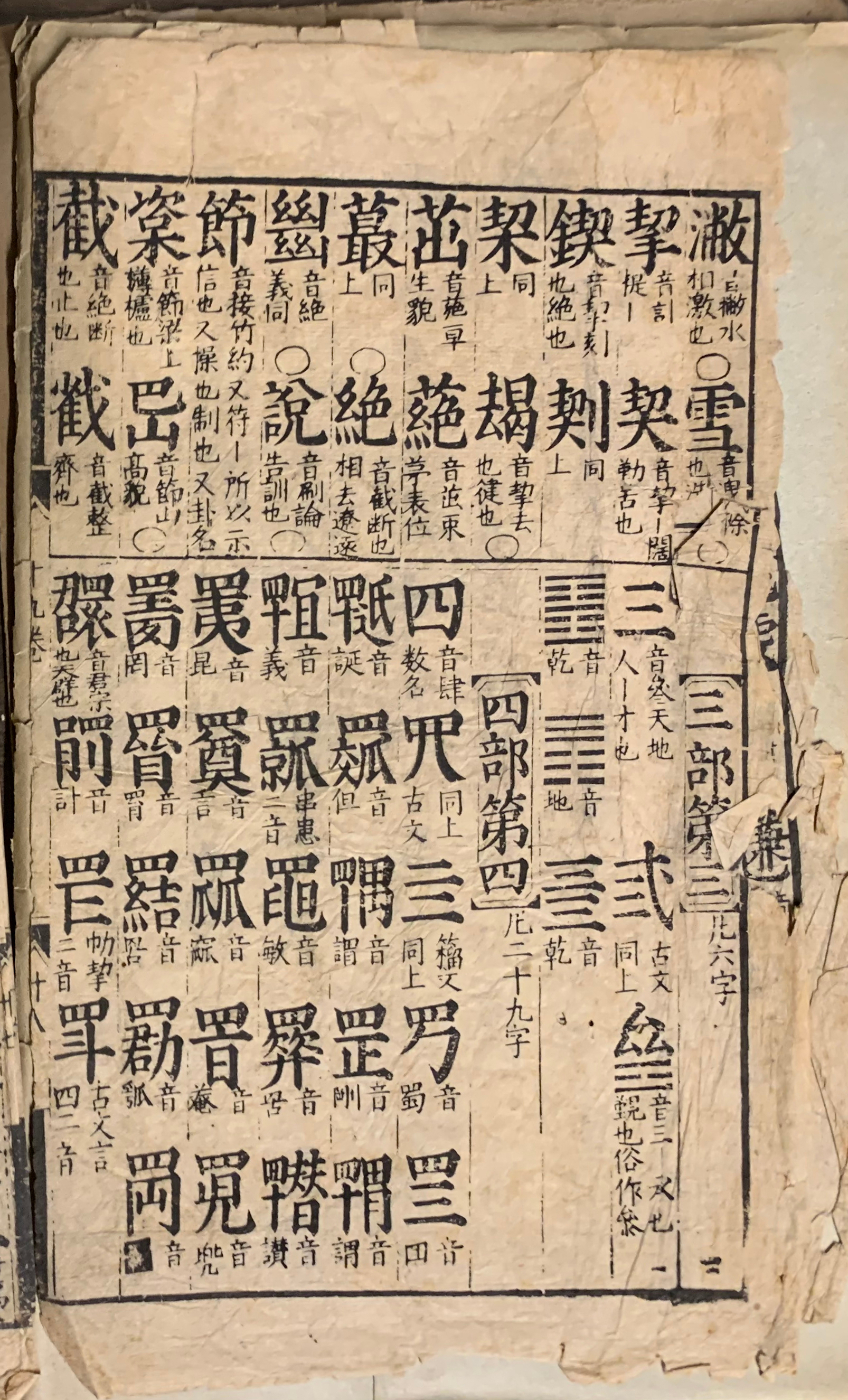
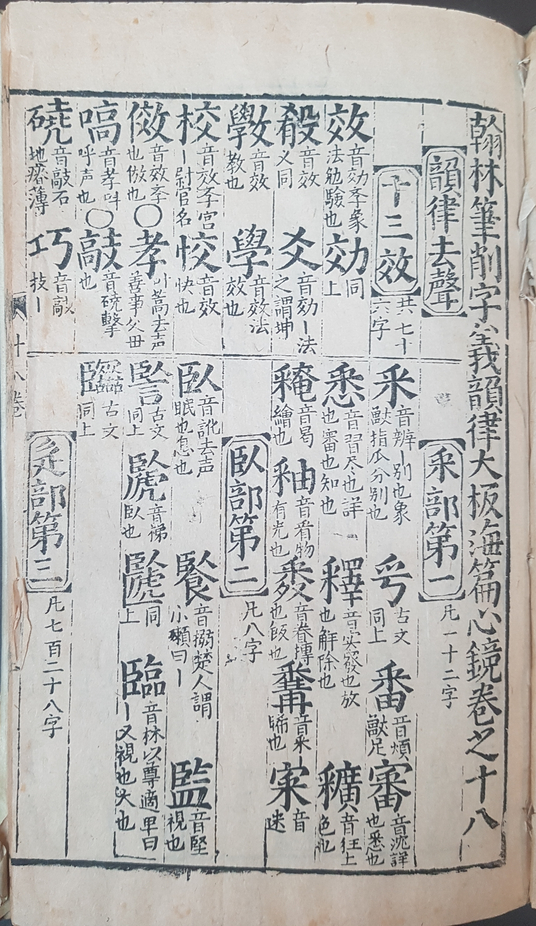
Sinica 14 is the earliest printing, and the blocks have a so called heikou 黑口 or “black mouth”, that is, the central column of the block is uncarved, so that a thick black band runs down the centre of the leaf. (The word “mouth” is used because when the leaves are bound, that column is at the point where the book opens.) There are two fascicles of this printing, in which juan 2, 3, and 18 are preserved (below left).

There are two fascicles in Utrecht, and they are clearly of a piece with this edition (below right). The fascicles are both incomplete copies of juan 19 (pp.2b-30a and pp.1b-28a, 29a). It’s rather strange that again, Utrecht should have two copies of a juan which is not represented in a work of which the Bodleian has more extensive holdings.

In Sinica 15, the “black mouth” has been excised, so that the blocks now have a baikou 白口, or “white mouth”. This copy also has two fascicles, preserving juan 18 and 20. This is most fortunate, as juan 18 can be compared with the juan 18 in Sinica 14, showing that it is indeed from the same blocks; and juan 20 is the last fascicle, at the end of which there is a magnificent paizi 牌子 which tells us all we need to know about the edition:

The Bodleian also has two fascicles from what appears to be a third distinct printing, Sinica 73, preserving juan 13 and 14. This may be a later printing from the “black mouth” version before the central column was excised, but as these juan are not represented in the other copies, it can’t be proved one way or the other.

That three printings of this edition should have been on sale when the Dutch merchants picked them up is scarcely surprising. The nature of the Chinese script is such that anyone who can read it needs a dictionary by their side at all times. My colleagues and I have worn out several copies of Xinhua zidian 新华字典 during the course of our careers, and someone once told me that this dictionary is the best selling book of all time, including the Bible.

eBay

I’ve long thought that the most obvious places to look for other parts of the European 17th century corpus would be the smaller old-established libraries, which in England would be the libraries of Oxbridge colleges, cathedrals, country houses, or perhaps of the older private schools such as Eton College. The Pembroke almanac is a case in point.

It would never have occurred to me to look on eBay, but that is exactly where the last and probably most significant of the finds I’m describing was made last year. Andrew West told me about it.

It is a mid-19th century western leather binding containing juan 9-13 of the well-known and presumably unique surviving edition of the Shuihuzhuan which is already in my list, and of which other parts are in Copenhagen, the Bibliothèque Nationale de France, Stuttgart, and Oxford, where there is a single leaf:

There isn’t enough of the copy preserved to enable more than a rather vague description of the edition to be made: the opening juan and prefatory material are missing, as is the last juan, which may have had a paizi 牌子 at the end. So it isn’t even possible to say how many juan the complete edition would have had. But juan 21 (in Paris, the last of the preserved juan) begins with hui 回 102, so I reckon 120 hui in 24 juan might be a reasonable guess, and would tentatively catalogue the edition as follows:

新刻京本全像插增田虎王慶忠義水滸全傳 二十四卷一百二十回 / (明)施耐庵撰 ; (明)羅本編
明萬曆中建陽書林刊本

The eBay volume was offered for sale by a bookseller in Winchester who had no idea what it was or what it was worth. It was eventually sold for the sum of £18,100, and has been taken abroad. Although this is currently the only part of the 17th century corpus to be in private hands and therefore not able to be freely examined, it is apparently going to be published in facsimile next year. All the other extant parts of the copy have already been published either in print or online.

I don’t know why the fact that part of the 17th century corpus turned up on eBay amuses me, but it does. Illogical, because I’ve found equally recherché, if less valuable things on eBay myself. In fact I found a Chinese printing block there only a few weeks ago, which will be the subject of a future blog entry.


Praetermissum

12 March 2019

In my previous blog entry (which I partly wrote as a mise-en-scène for this one), I confessed to having left our albums of model calligraphy (fatie 法帖) until last because they were difficult. This, of course, is what librarians do: shove anything difficult into a cupboard and forget about it – my own cupboard was pretty full when I was dismissed eighteen months ago.

It’s some consolation to find that even Thomas Hyde wasn’t above doing this sort of thing. In his manuscript notes of our Chinese holdings (British Library Sloane Or.853, increasingly quoted in my blog) he has a section headed Praetermissa in Arch. A, literally “Things put aside in Arch[ivum] A” (I won’t repeat the facts about the storage and handling of our earliest Chinese accessions – it’s all explained in an earlier blog entry). I think it’s pretty clear what he meant by “put aside” – one of the items is Sinica 91, something I have put aside these past forty years.

In his notes, Hyde describes the item as follows:

Praetermissa in Arch. A …
182. Liber Fa-tie, continens Calligraphiae exemplaria nitida pro addiscentibus scribere linguam Sinensem.

Things put aside in Arch[ivum] A …
182. A Fa-tie, containing fine examples of calligraphy for those who are learning to write the Chinese language.

In the Bernard catalogue (p.152), we learn a little more about it; it is a roll, and the text appears as white on black:

Rotulae in Archivo A …
2969.18 Liber Sinensis impressus Characteribus albis in charta nigra, continens exemplaria Calligraphiae nitida pro addiscentibus scribere linguam Sinensem.

Rolls in Archivum A …
2969.18 A Chinese printed book with white characters on a black background, containing fine examples of calligraphy for those who are learning to write the Chinese language.

Here is the item as it is currently preserved:

Sinica_91-2

It is bound in a codex, probably by Nicholson. The composition of the codex and the order in which the leaves are presented suggest that in Hyde’s time the Chinese leaves were rolled up in a protective sheet of western paper, and that the whole thing was then rolled in a piece of limp vellum inscribed by Shen and Hyde in the usual way. The inscription is for the most part illegible, that is unless you are Will Poole, for it is he who kindly transcribed and translated it for me within minutes of receiving my e-mail:

Sinica_91-1

A 182
fa Formularius
tie Libellus seu charta
Est libellus pro Institutione eorum qui / primò addiscunt scribere linguam Chinensem, / continens varia Exemplaria rariores / Scripturae tam quadratae quam cursivae. / Anglicè A China Copy-booke.

A 182
法 fa A model
帖 tie album
This is a book for teaching those who are first gaining knowledge of how to write the Chinese language, containing various uncommon examples of writing both squared and cursive. In English: A Chinese copy-book.

The codex contains the first 17 pages of the fatie, but they are not bound in order. Here is the first, which clearly bears its title, Mingshu jixuan fatie 名書集選法帖 (“An album of collected works by famous calligraphers”), and appropriately the very first example is by Wang Xizhi 王羲之 (see my previous blog entry):

Sinica_91-3

The leaf, like all the others, is clearly divided into three panels, with pagination in the lower right corner. Originally they would have been pasted together and folded to make an “accordion” binding (zhezhuang 折裝).

According to Madan and Craster’s Summary catalogue [1], the item was “acquired about 1618”, but I don’t know where this information came from. This means that it must have been printed during the Wanli period at the latest, so I have described it thus in my catalogue:

名書集選法帖 不分卷殘十七葉
明萬暦中(?)刊
洋裝1冊(原活葉) ; 60 x 30公分
Sinica 91

I can find no record of the title in any catalogue, whether printed or online. A Google search for “名書集選法帖” will at the time of writing find only two things: this text in my online list Chinese books in Europe in the 17th century, and a work entitled Mingshu jixuan fatie qianzi wen 名書集選法帖千字文 (the “Thousand character classic”) by the Tang dynasty monk and calligrapher Huaisu 懷素 (737–799) in Osaka Prefectural Nakanoshima Library 大阪府立中之島圖書館 in Japan.

This can only mean either that Sinica 91 is of exceptional rarity, or it isn’t a discrete work, but part of another which I have failed to identify. Either way, it is extraordinary that a work of such quality should have arrived along with the rather cheaper productions of the Jianyang and Jinling commercial printers, and it must surely be the very first calligraphic manual to reach Europe.


1. Summary catalogue of Western manuscripts in the Bodleian Library at Oxford, vol.2 pt.1 (Oxford, 1922), p.558.

Chinese leaves in Trinity College Dublin

4 February 2019

In my last blog entry but one, posted in November, I referred to some printed Chinese leaves that Peter Kornicki had found in Trinity College Dublin. They are bound with the Japanese historical text Azuma kagami 吾妻鏡 in a volume shelfmarked MS 1645.

In the hope of being able to indentify them, I ordered scans from TCD, and received them on 3 January – a very good start to the new year.

It turns out that they are from the same edition, and perhaps even from one of the copies of the biggest single Chinese work (that is, having the most fascicles) that the Bodleian acquired in the 17th century, which I catalogue as follows:

周會魁校正四書大全 殘卷一~六﹑八﹑九﹑十一~十八, 有缺 / (明)胡廣, (明)楊榮奉敕纂修 ; (明)周士顯校正
明萬曆中坊刊本
線裝18冊 ; 27公分
全書十八卷
Sinica 68
Sinica 69 殘卷一﹑三﹑十二﹑十四﹑十五﹑十八, 有缺. – 線裝6冊
Sinica 52 殘卷十二. – 洋裝(原線裝)1冊 ; 28公分
Sinica 43 殘卷十四. – 線裝1冊 ; 25公分

s03299

The copy in TCD preserves the following leaves, all from juan 18 (the TCD foliation is given in the first column):

73r = 18:92b
73v = 18:92a
74r = 18:43a reverse side
74v = 18:43a
75r = 18:31b
75v = 18:31a
76r = 18:26a reverse side
76v = 18:26a
77r = 18:24b
77v = 18:24a
78r = 18:36a reverse side
78v = 18:36a
79r = 18:22b
79v = 18:22a
80r = 18:38b
80v = 18:38a

As noted, the left-hand side of the leaf is missing from leaves 43, 26, and 36.

Juan 18 is the section of the work entitled Zhongyong huowen 中庸或問, and here is an image of the first page of the juan taken from the Bodleian’s Sinica 68:

s03300

The logic of the surviving portions shows that at least three different copies of this work are represented by what is in the Bodleian and TCD. I think Sinica 52 and Sinica 43 are from the same copy, although of a different immediate provenance, as their cover paper is the same; but there is no way of knowing whether the TCD leaves are also from this copy or from a fourth copy.

The original edition on which the present edition is based is an exposition of the Five Classics and Four Books (五經四書) of Confucianism compiled at imperial behest by Hu Guang and others in the Yongle period. According to Wang Zhongmin 王重民 (中國善本書提要, 35), it was compiled over a period of three years, starting with the Four Books; the works were originally circulated separately as they were printed, and were only later issued as sets, with varying titles. Detailed information about the edition, as well as examples of the complete set, are very difficult to find. The preface to the Four Books is dated 1415 (永樂十三年).

The present edition was produced in the late Ming, and is attributed to the scholar Zhou Shixian 周士顯, both at the beginning of the text and also in the title. Zhou Shixian was a jinshi 進士 of 1601 (萬曆二十九年), but apart from that I was at first unable to find out anything about him. Then Soeren Edgren told me that he is best known for his edition of Gujin yunhui juyao xiaobu 古今韻會舉要小補 [1] published in Jianyang in 1606, and that from the prefaces to that edition we learn that he served as District Magistrate at Jianyang from 1603-1607. As he also published an Yijing daquan 易經大全 there in 1605, it is reasonable to assume that our edition of the Four Books, too, was published in Jianyang sometime during his period of office, all of which is corroborated by the provenance of our seventeenth-century acquisitions.

The distribution of surviving copies of Zhou’s edition is worth noting. According to the union catalogue Xueyuan jigu 學苑汲古 there are only four copies in Chinese higher educational establishments (and don’t look too closely at the cataloguing – two of them are given imprints of the early 15th century, which would have made Zhou a very old man indeed by the time he graduated), and there is a fifth copy in the National Library of China. As we have seen, at least three copies came to Europe, and there are copies in Harvard and the Australian National University. The union catalogue Zenkoku kanseki deetabeesu 全國漢籍データベース records at least eight copies in Japan, as well as a couple of locally produced re-editions. So there are more than twice as many copies outside China as in China itself.

This is because for Chinese scholars, as a product of the commercial printers of Jianyang or Jinling (which is what it undoubtedly is), the edition was worthless. But such editions poured into Japan through traders in Nagasaki in response to an increased interest in Chinese learning under the first Tokugawa shoguns; and to a lesser extent they were taken to Europe by Dutch traders to satisfy the curiosity market.

The book into which the TCD leaves are bound was presented by Archbishop John Parker of Dublin, who was translated there in 1679 and died in 1681.

Sinica 68 and 69 came from the collection of the famous Dutch scholar Golius (Jacob Gool, 1596-1667). When his library was auctioned by his heirs in Amsterdam in 1696, almost thirty years after his death, the larger part was acquired by Archbishop Narcissus Marsh of Dublin. Marsh died in 1713, and bequeathed all his books to the Bodleian; they arrived on 12th August 1714.

That the only copies in Europe should both have been owned by Archbishops of Dublin is a most extraordinary coincidence; there cannot possibly be any connection, as Marsh only acquired his copies from Amsterdam fifteen years after Parker’s death.

Just as I was about to post this blog entry, I remembered that I had failed to follow my own advice: never suppose that you have identified a Chinese edition until you have examined every single leaf, however large the work. Actually, in this case it wasn’t too difficult, as there are only eight of them in TCD’s MS 1645.

The leaves of seven of them are indeed from the same blocks as their equivalents in Sinica 68 and 69. But on closer examination, one (18:43) is quite clearly from a different block:

TCD18-43a  BOD18-43

The TCD leaf (left) has the same double-line frame borders throughout. But in the Bodleian leaf (right) of Sinica 68, as well as Sinica 69, the horizontal borders have been reduced to a single line, the only leaf in the copy to be so treated. Furthermore, the Bodleian block is very slightly larger, and a close examination of the text will show that it is indeed an impression from a different block.

So although the editions are the same, the printings are clearly different. The most likely explanation is that the block of leaf 18:43 got damaged and had to be replaced, indicating that the TCD impression must be earlier than the Bodleian ones.


1. This text is based on Gujin yunhui 古今韻會, a rhyming dictionary written by the scholar Huang Gongshao 黃公紹 in 1292. It was re-organised and simplified by his friend Xiong Zhong 熊忠 in 1297 and accordingly renamed Gujin yunhui juyao 古今韻會舉要. It was again revised in the late Ming by Fang Risheng 方日升 and Li Weizhen 李維楨 and renamed Gujin yunhui juyao xiaobu 古今韻會舉要小補. Both Huang Gongshao and Xiong Zhong were natives of Shaowu 邵武 in Fujian province, and Li Weizhen held office there when he edited Fang’s revision.