Archive for the 'Uncategorized' Category

The Red Decree – postscript

8 December 2025

It will soon be fifty years since I began to study the pre-modern Chinese materials in the Bodleian Library, during which time I’ve learned a little about everything and a lot about nothing. But that hasn’t prevented people from regarding me as an authority on the earliest acquisitions of Chinese books in Europe, the Yongle Dadian, the Red Decree, and much else. In fact only a few of days ago I was asked to speak about the Laud Rutter for a Chinese documentary on Diaoyu (the Senkaku Islands), an invitation which I had to decline: my knowledge of this subject, like all the others, goes no further than what is contained in my blog entry.

The same certainly goes for the Red Decree, of which I gave an account in my second blog entry, published over fourteen years ago in November 2011. But that notwithstanding, a couple of years ago my former colleague Cordula Gumbrecht (Staatsbibliothek zu Berlin – Preußischer Kulturbesitz) invited me to write a short essay on the Berlin copy of this remarkable document for the publication Sammellust und Wissensdrang : vier Jahrhunderte Asiatica in Berlin. [1] This beautifully produced volume contains accounts of forty-two of Berlin’s East Asian treasures, and its contents are also available online. I think it is essential reading for anyone with an interest in old Chinese books in general and the development of European collections in particular.

The three works in the Bibliography / Further Reading section of my contribution were provided by the editors. But in the same year as the Berlin volume was published, there appeared a substantial monograph on the Red Decree written by Sun Litian. [2] Last month, YS drew attention to Sun’s work in a comment on my original blog entry, but this was followed by a further comment from Manuel Sassman pointing to an excoriating review of it.

At the beginning of his preface, Sun reproduces my list of all the known surviving copies of the Red Decree. When both Sun and I were writing our respective contributions, these numbered eighteen. But in only a few weeks after our work had been submitted to the editors, in November 2023 a nineteenth copy was found by Chris Boobier in the Kent History and Library Centre in Maidstone. Of course I have been able to add this to my original blog entry, but unfortunately the published lists are already out of date. Perhaps (like the 17th-century acquisitions), even more copies are awaiting discovery.


1. Sammellust und Wissensdrang : vier Jahrhunderte Asiatica in Berlin = A passion for collecting, a thirst for knowledge : four centuries of asiatica in Berlin / herausgegeben von Achim Bonte. – [Berlin] : Staatsbibliothek zu Berlin – Preußischer Kulturbesitz, 2024. – (Beiträge aus der Staatsbibliothek zu Berlin – Preussischer Kulturbesitz ; Band 53). – 200 p. ; 22 x 30cm. – ISBN 978-3-88053-223-6
2. 康熙的红票 : 全球化中的清朝 / 孙立天著. – 北京 : 商务印书馆, 2024. – 精裝1冊(383頁) ; 22公分. – ISBN 978-7-100-23424-5

Chinese Bibles

30 November 2024

When I made my first posting to this blog in November 2011, I described it as the waizhuan 外傳 (“outer chapter”) to the neizhuan 內傳 (“inner chapter”) of the Serica Project, whose aim was to locate, identify, and list all the pre-modern Chinese materials in the Bodleian and other Oxford libraries; it was designed to answer the question that library catalogues can’t, that is, what have you got. (The “inner chapters” in Chinese thinking are the official, orthodox accounts; the “outer chapters” are where writers express their own freer accounts, untrammelled by convention.)

At an early stage of the project the Library offered to host the blog on its own server. I declined the invitation for reasons which will soon become apparent.

The Serica Project: its current state

The Serica Project had been primed by a generous donation from Nicholas Coulson, following which further substantial funding was obtained from the Tan Chin Tuan foundation in Singapore. By the time of my dismissal at the end of September 2017, although I had not only fulfilled but substantially exceeded what had been required of me under the terms of the funding, much work remained to be done. So in time-honoured fashion I continued to work on my project in retirement. Between then and the time the allegro catalogue was closed at the end of February 2020, I had added a further 6376 records to the database, mostly the contents of the collectanea (congshu 叢書) that Joshua Seufert had transferred from the China Centre Library before going to Princeton in 2018.

What I had failed to realise is that times had changed. Working on the Library’s collections in retirement was now not only discouraged, but was soon not even to be tolerated. My first intimation of this came from Bodley’s Librarian’s deputy, now in charge of her own university library, who told me to forget everything I ever knew about my subject and spend more time with my grandchildren. I got the impression that she considered a librarian whose interest in his work persisted after he ceased to be paid for it must be mentally ill.

The final blow came in November 2021, when the Library suspended the updating of the Serica database without a word of warning or explanation either to me, the wider academic community, or the donors. I simply discovered one day that I could no longer upload a quantity of new work. My access to the server had been terminated.

The Serica database however continued to be accessible on the Library’s website until last month (October 2024), but only as a crippled relic of its former self: incomplete, occasionally inaccurate, and failing to give access to everything that has now been digitised. Moreover, the specimen pages (shuying 書影), invaluable to Chinese bibliographers and numbering several thousand, had for some reason been discarded in their entirety.

One wonders what sort of library it is that receives over a quarter of a million pounds to set up a bibliographical research tool one minute, and then trashes it the next.

Fortunately, I had long been acting on the advice of a colleague to download everything I could from the servers to which I had access before I became the inevitable victim of managerial high-handedness. This I did regularly, backing up my work after every session, so that with my limited programming knowledge I have been able to recreate a simplified but workable version of Serica and its infrastructure on my own server, which is now safely out of harm’s way. I’m thus able to continue working towards the completion of the project (and in doing so, honour the generosity of the donors), and this account of the Bodleian’s collection of Chinese Bibles is another step on the way.

The Bodleian’s Chinese Bible collection

Until I completed my listing of our Bibles just over a year ago, I had only catalogued the editions with Sinica shelfmarks. I had lost sight of more than two hundred editions in the Library’s classified collection, which was the work of Edward Williams Byron Nicholson (1849-1912) who was Bodley’s Librarian from 1882 until his death in 1912. [1]

Nicholson devised his classification during the very first year of his appointment, and it was implemented immediately in 1883. His scheme was numerical, and evolved from earlier schemes that had been in use in the Library since the time of its foundation. [2] Although it remained in use for over a century, it is surprisingly ill documented. The fullest description known to me is that of Michael Heaney [3], but Heaney makes no mention of the non-numerical part of the scheme which was used for Oriental materials (shelfmarked Arab., Chin., Heb., Jap., &c.), nor the shelfmarks used for the classification of Judaeo-Christian scriptures (Bib., O.T., N.T., Ps., followed by a language designation). Both the numerical and non-numerical designations in Nicholson’s scheme are followed by a letter denoting the physical height of the item (to make the most economical use of shelfspace), and then a running number. It is worth noting that when the New Library was built in the 1930s, the shelving was designed to accommodate this sizing.

The Bibles in the Sinica collection are for the most part those that were acquired before the inception of the Nicholson classification in 1883. There are 121 editions, most of which are not complete Bibles, but single books or groups of books.

The Bibles acquired after 1883 were given Nicholson shelfmarks as listed here. There are 228 editions. Working from the handlists, just over a year ago I was able to take stock of everything we have, and to catalogue it.

There are a further 33 editions in Regents Park College, so that in total I have so far discovered 333 different Chinese editions of the Bible (or parts of it) of in Oxford libraries. There are listed here, as well as under their classified place in the Serica website (西人著書 耶穌教 聖書). Inevitably there is some duplication, so that the number of copies is rather higher. Also, it is quite likely that more Bibles will be found in other Oxford libraries.

Other collections

The largest collection of Bibles in the world is believed to be that of the Bible Society (formerly known as the British and Foreign Bible Society) which was transferred to Cambridge University Library when the Society sold its premises in central London (146 Queen Victoria Street) in 1985. I referred to this in an earlier blog entry which has some relevance here. When the collection was catalogued by Darlow and Moule in 1911, it contained 568 Chinese editions, numbered 2452-3019. [4] By 1975 the collection had grown to over one thousand editions, and was the subject of a second printed catalogue compiled by Hubert Spillett [5], who had worked for the Baptist Missionary Society from 1930 until his retirement in 1967. Spillett re-numbered the Bibles 1-1091, 1-568 being Darlow & Moule’s 2452-3019. The collection is now listed online here.

Of course there was already a collection of Chinese Bibles in Cambridge before the acquisition of the Bible Society’s library, but it was small, numbering only 64 editions. Yan He, the Library’s Chinese specialist, has very kindly sent me a list of them.

Clearly the Cambridge collection is by far the larger, and may possibly be the largest collection of Chinese Bibles in existence. But this is mostly because it contains a much greater number of twentieth-century editions. For the study of Chinese Bible translation in its nineteenth-century heyday, the Oxford and Cambridge collections are of similar size and value.

Many of the Bibles in both the Oxford and Cambridge collections came from two of the great nineteenth-century international exhibitions: the Centennial Exhibition of 1876 in Philadelphia (these books probably reached us through the agency of Alexander Wylie), and the International Health Exhibition of 1884 in London. I discussed this matter in some detail in a paper I presented in 1988 at a conference in Taipei, and have just revised it, mostly because of its relevance to this blog entry. It can be seen here.

Cataloguing

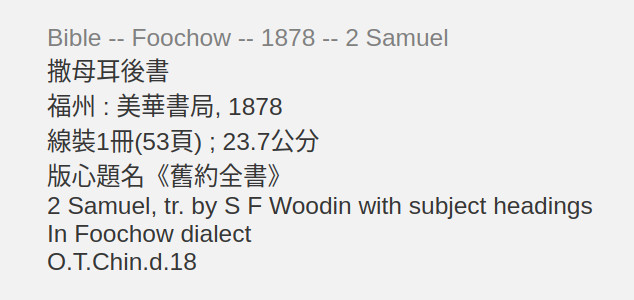
Spillett’s catalogue follows the pattern of Darlow & Moule’s, and is descriptive. My list conforms with standard library cataloguing rules, where possible reproducing bibliographic information as it appears on the book, and expressed in ISBD (International Standard Book Description) format. Here are examples of the same entry from each of the catalogues:


Darlow & Moule

Spillet
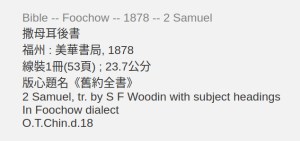

Serica Project

A few words of explanation are necessary.

I have used the headings and filing order of the two Bible Society catalogues, so that the word “Bible” (not necessary in their case, as the catalogues are of Bibles only) is followed by the language (usually called “dialects” in Chinese, even when they are mutually unintelligible), then the date, then the part of the Bible where necessary: it usually is, as most editions are not of complete Bibles. I have used the 19th-century spellings of the dialects and place names (Foochow, Amoy, &c) not out of antiquarianism, but to be consistent with the two existing published catalogues and the usage in all contemporary documentation.

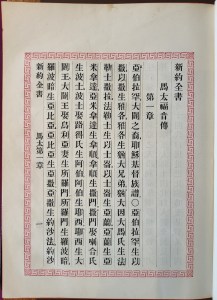
The Bibles, like all the other missionary publications, present cataloguing problems as they are neither Chinese nor English, but hybrid in both form and content. Unlike traditional Chinese publications, in which what appear to be title-pages are no such thing (see section 3 of this blog entry), in the missionary publications, which were written and printed by foreigners, they really are title-pages of the western type and as such are what cataloguers call the “principal source of information”. And as the publications are usually more western than Chinese in presentation, I have expressed the imprints not as a single sentence of classical Chinese, but with the more familiar ISBD punctuation: “place : publisher, date”. Also, the cataloguing language in the Serica Project is Chinese, but again the normal rules simply can’t be applied. Just as the English translation of the note 「版心題名《舊約全書》」 is long and inelegant, so the English “2 Samuel, tr. by S F Woodin” makes little sense in Chinese except to the initiate. So my cataloguing language is mixed.

And when noting the version of the Bibles, if the names of the translators don’t appear on the publication, which is usually the case, I’ve reproduced the information given by Spillett uncritically, having neither the energy, the ability, or the means to work it out for myself. In the case of romanised translations, I’ve ignored the accents altogether, as some of them are so bizarre that I doubt if they’re even encoded.

My records are therefore a bit of a mess, and I don’t know what to do about it. At least they’re better than nothing. It has taken nearly 150 years to get this far; perhaps it will take another 150 years for the Library to do the job properly. As things are, the only way to find out what we’ve got is to look at my list.

A few bright spots

Cataloguing our Bibles was on the whole a rather boring task, but during the course of the work, there were a few bright spots. Here are some of them.

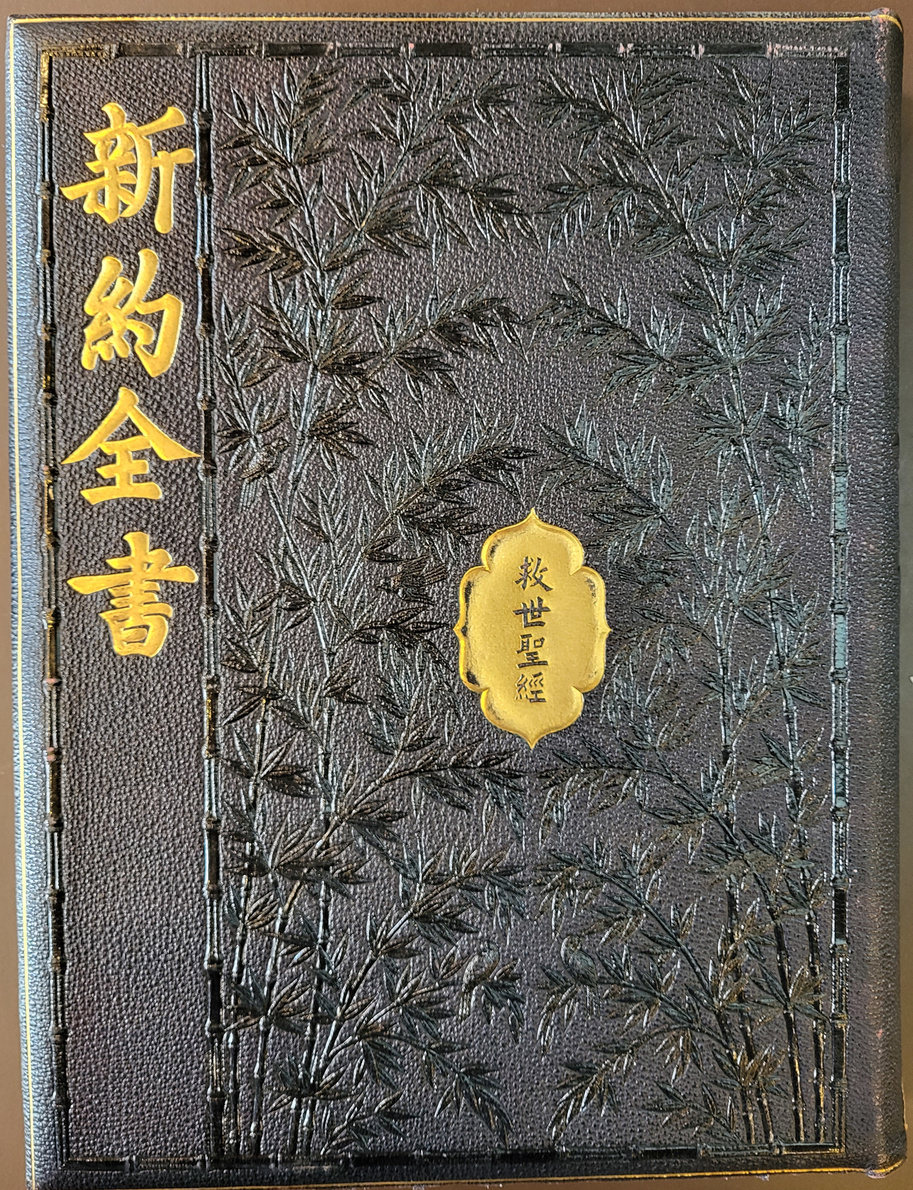
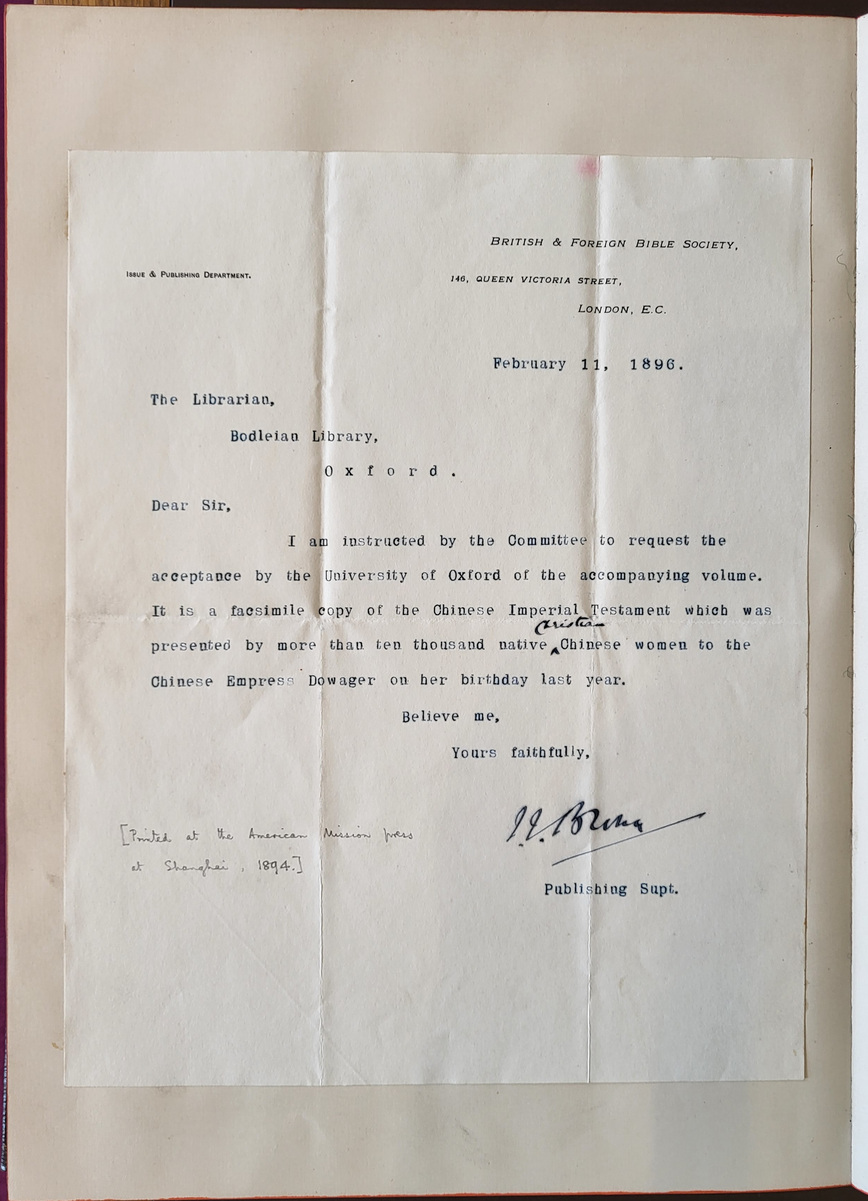
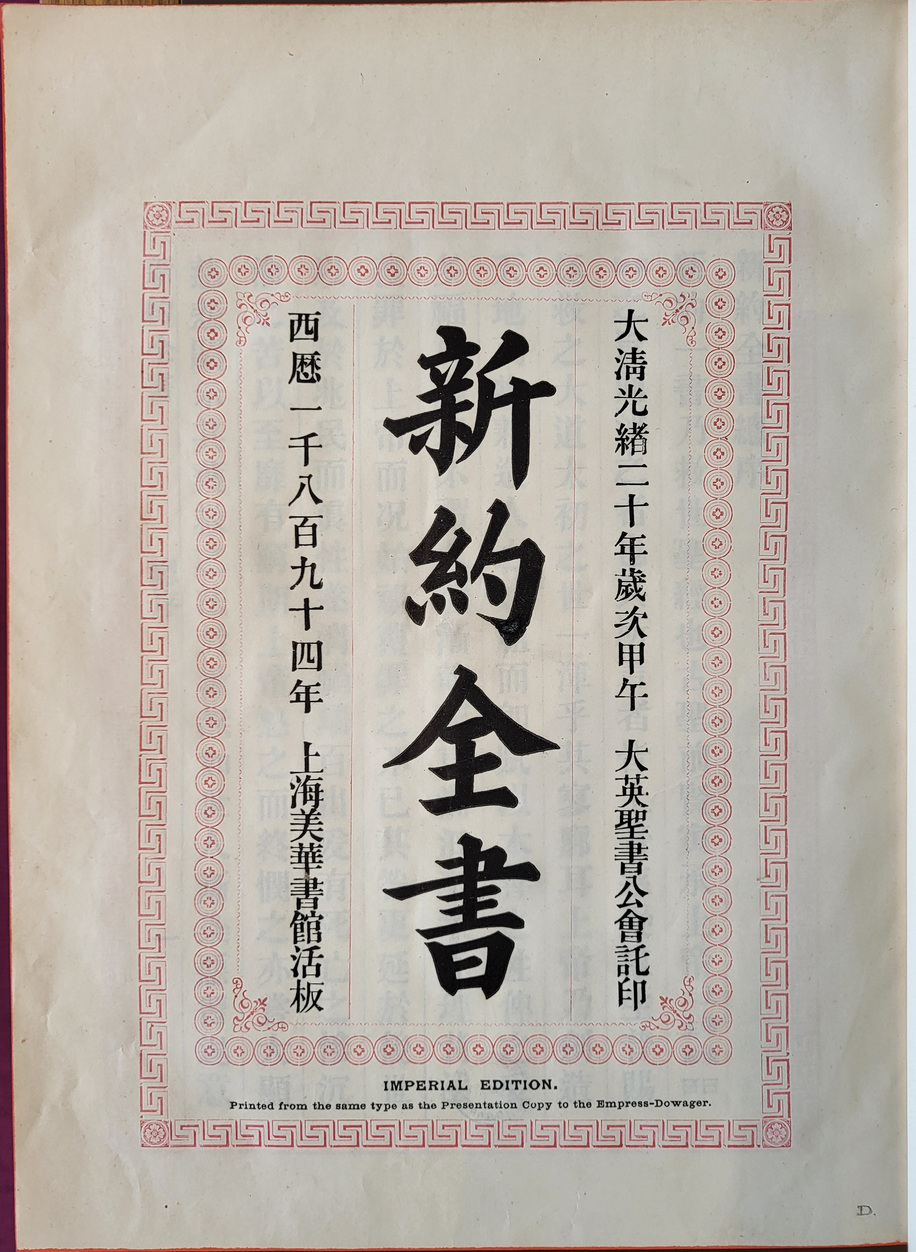
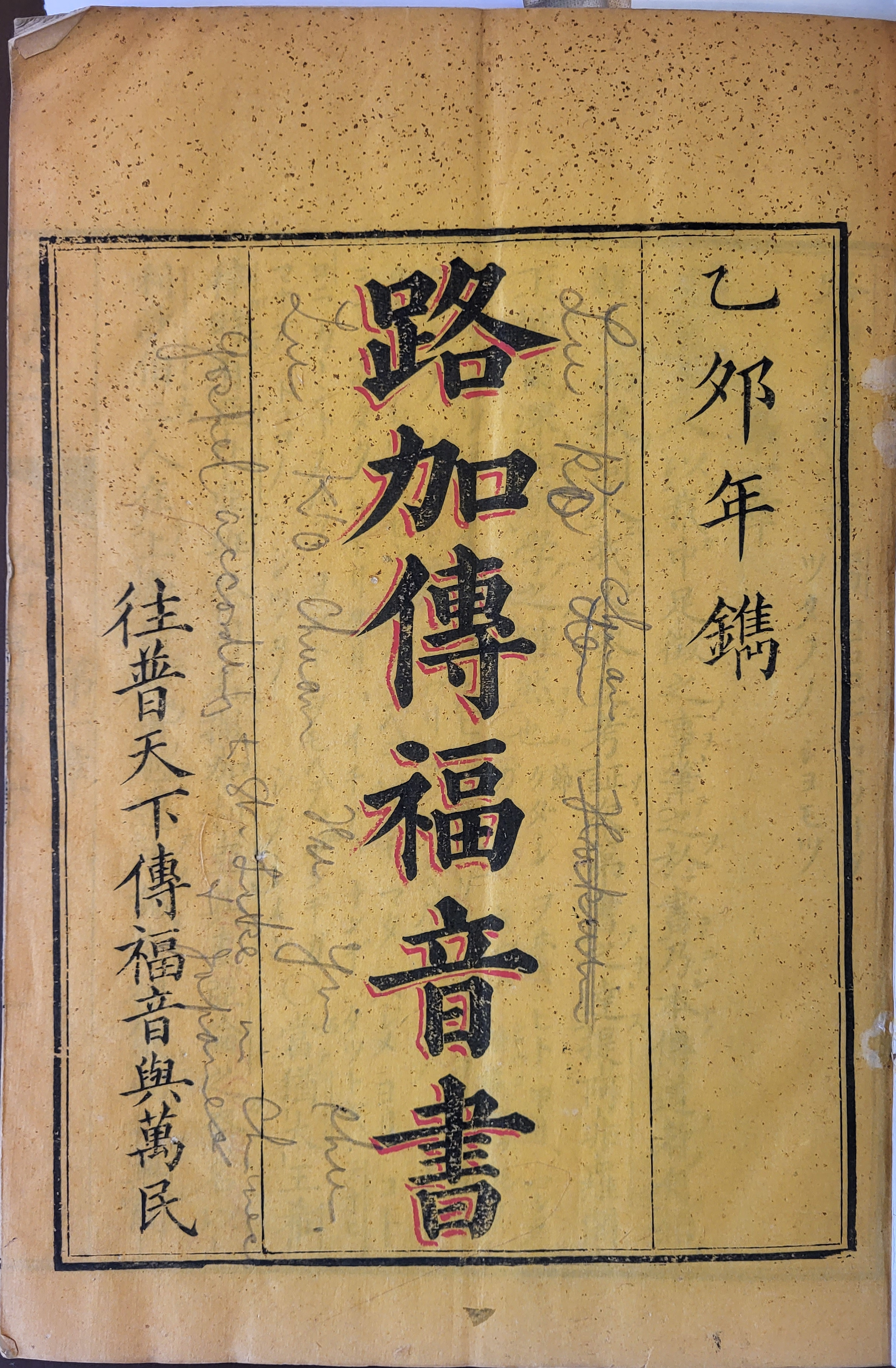
This is perhaps the most luxurious Chinese edition of the Bible ever produced. It is the New Testament which as the accompanying letter explains was presented to the Empress Dowager on the occasion of her birthday by a group of over 10,000 Chinese Christian women in 1894:
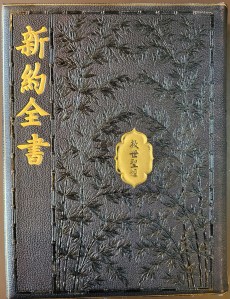
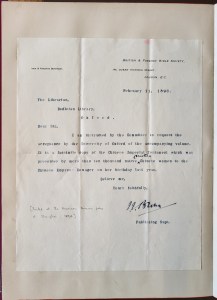
N.T.Chin.c.1

John Lai was a doctoral student in Oxford in the earlier years of my curatorship and now has a chair in the Chinese University of Hong Kong and is an authority on Chinese missionary translation work. He has confirmed my suspicion that the scriptures which the missionaries translated into Chinese dialects, usually in romanisation, are almost certainly the most substantial, if not the only examples we have of these dialects as spoken in previous centuries.

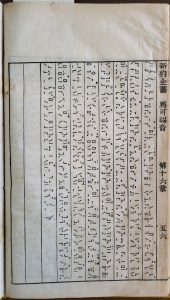
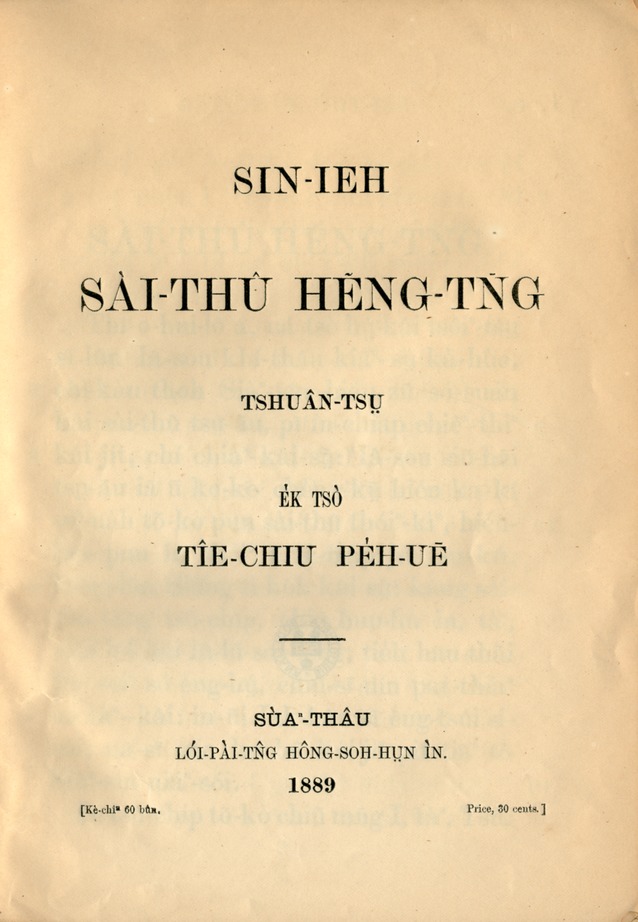
This is a translation of the Acts into the dialect of Swatow (Shantou 汕頭), a coastal city at the eastern end of Guangdong Province, typeset and published in 1889:

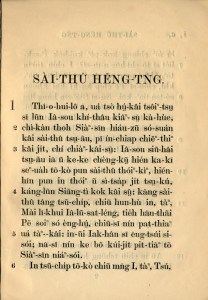
Sinica 6162

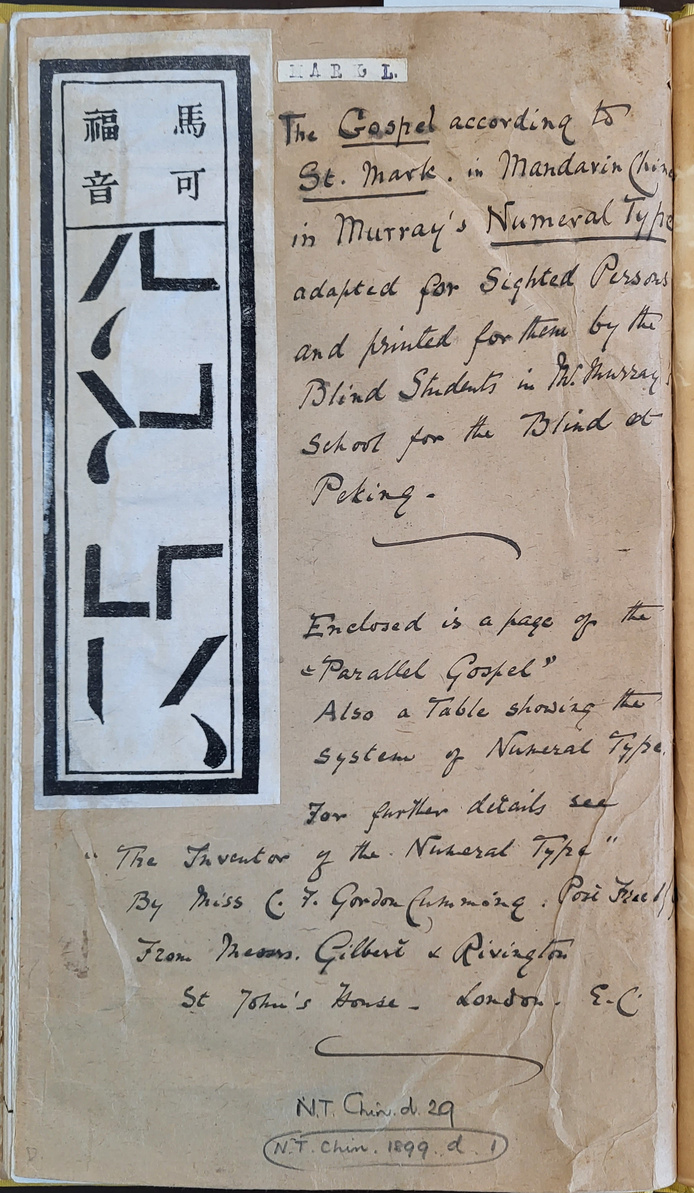
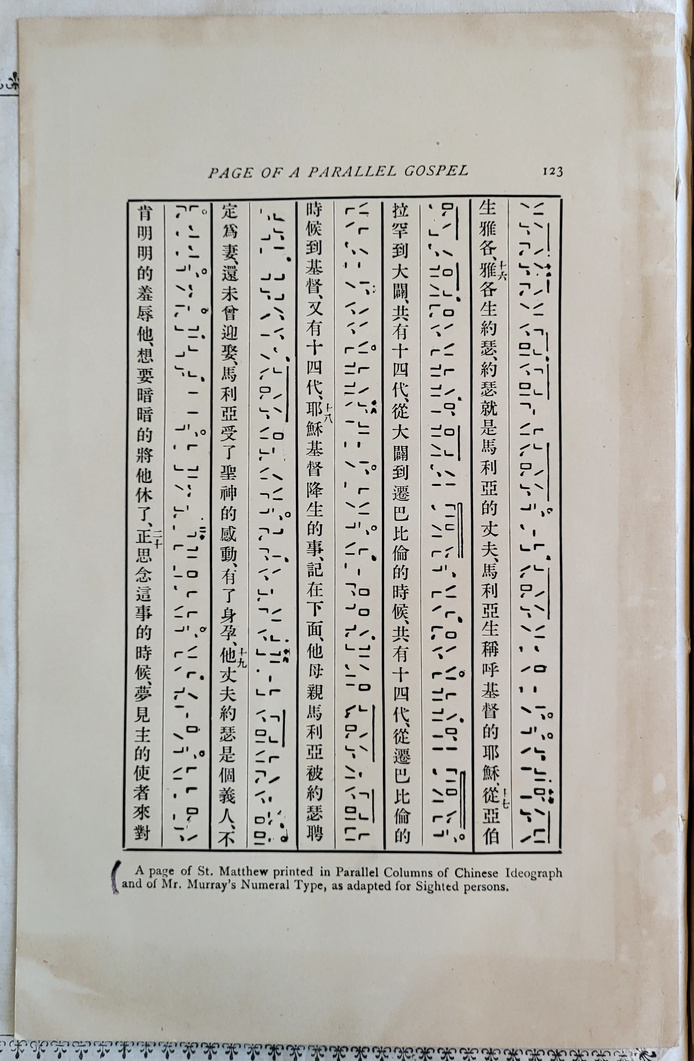
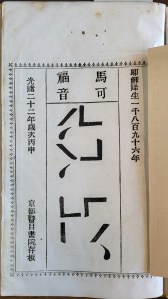
William H Murray (1843-1911), deeply moved by the fate of the blind in China, developed a Braille system based on numerals which enabled blind people to learn to read in a matter of weeks and used it to produce Bibles, hymnals, and other books.

This edition of Mark published in 1896 is a representation of his system in print – I don’t know if it’s a unique example, or whether there are other editions of this kind; I think the phenonemon deserves its own study:
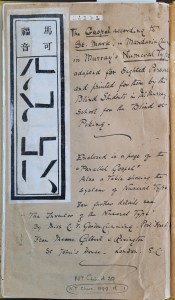
N.T.Chin.d.29

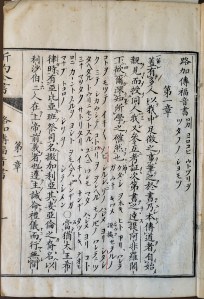
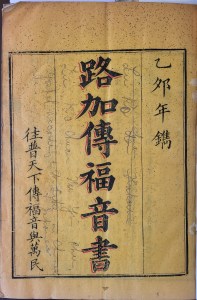
Finally, this very interesting edition came to light as I was going through the collection. It isn’t Chinese, and is an example of how Library books in non-roman scripts were often inappropriately shelfmarked so that they lay unnoticed and unidentified, sometimes getting lost for centuries. It’s actually in Japanese, but has a Chinese shelfmark. It’s a translation of St Luke’s gospel by Bernard Jean Bettelheim (1811-1869) which was blockcut in 1855. The text is in kambun 漢文, and each section is followed by a translation into Japanese expressed in katakana カタカナ:
N.T.Chin.d.4


1. Tedder, Henry Richard: E.W.B. Nicholson (Bodley’s librarian, 1882-1912): in memoriam. Aberdeen: Aberdeen University Press, 1914. Also Wikipedia
2. Wheeler, George William: Bodleian press-marks in relation to classification. Bodleian quarterly record 1:10 (1916), 280-292; 1:11 (1916), 311-322.
3. Heaney, Michael: The Bodleian classification of books. Journal of librarianship and information science 10:4 (1978), 274-282.
4. Darlow, T.H. & Moule, H.F.: Historical catalogue of the printed editions of Holy Scripture in the library of the British and Foreign Bible Society. Vol.II, Polyglots and languages other than English. London: Bible House, 1911.
5. Spillet, William Hubert: A catalogue of scriptures in the languages of China and the Republic of China. London: British and Foreign Bible Society, 1975.

Collotype

23 February 2024

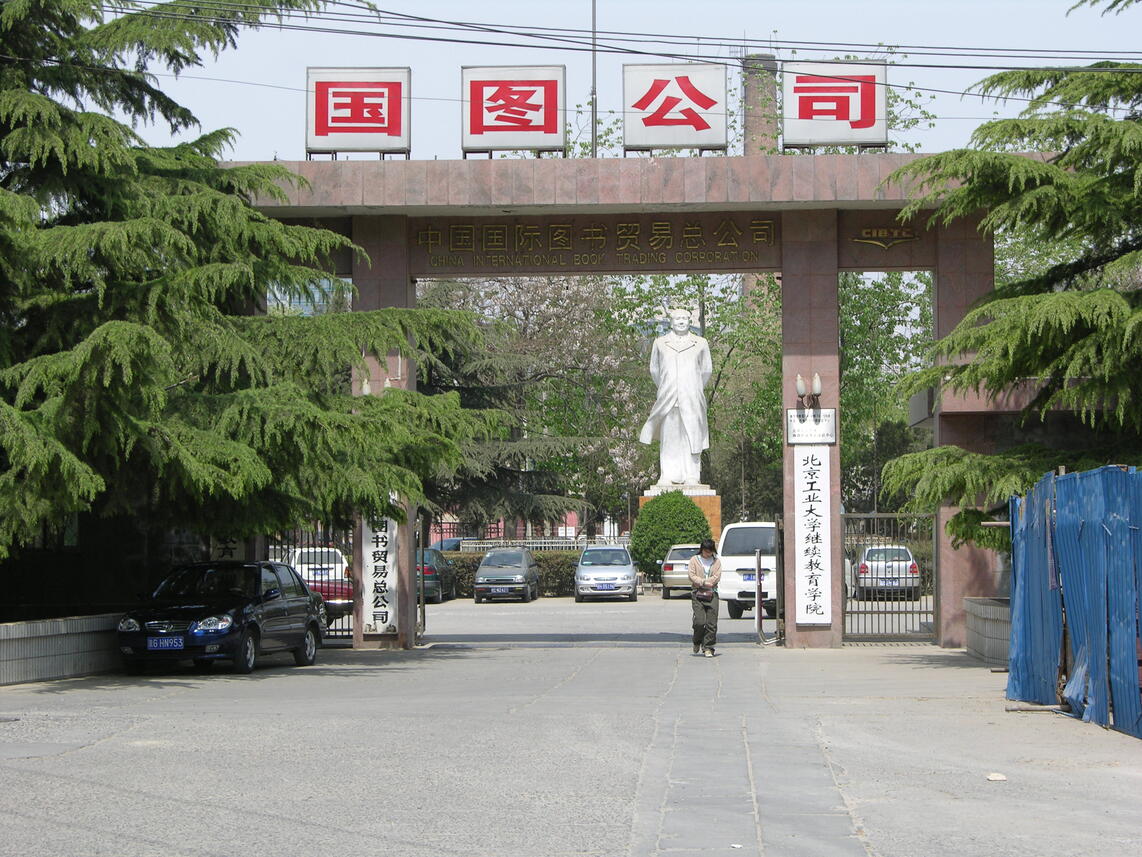
It was only following the appointment of Joshua Seufert in 2012 that I was able to devote all my time to the Bodleian Library’s so-called “special” collections of Chinese materials; before that I worked mostly on acquiring modern materials, both printed and later electronic. Our principal supplier was CIBTC (China International Book Trading Corporation 中国国际图书贸易集团公司), who hosted most of my visits to China.

I was usually looked after by Wang Tong 汪彤 and later Zhu Min 朱敏, who both developed a very good sense of what interested me, and took me to places that would have been inaccessible without their help. I can’t thank them enough for their hospitality over the years, and for showing me some of the most beautiful and impressive sights that I’ve ever seen.

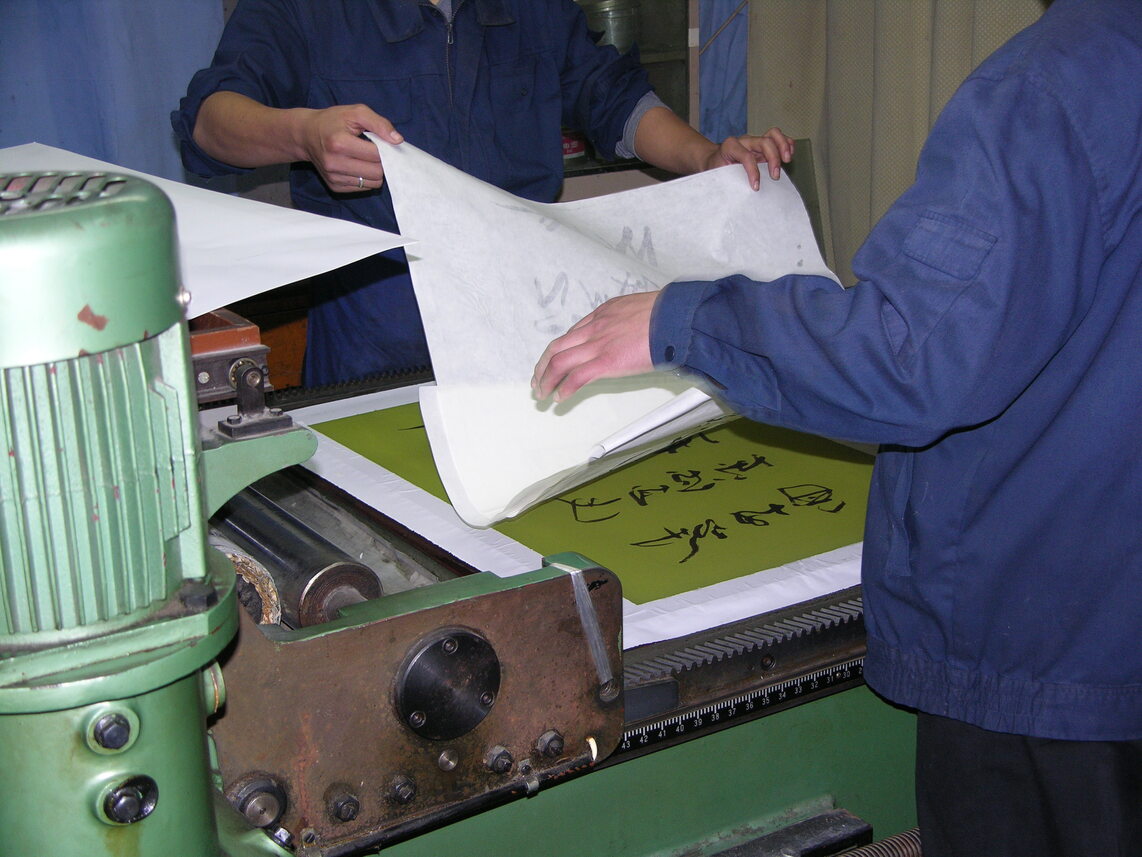
A particularly memorable trip was the one I made in April 2006, which included a visit to Wenwu Chubanshe 文物出版社 in the centre of Beijing. There I saw what I was told was the last remaining printing operation within the walls, a collotype process using a rather old machine.

Here is the complete collection of the pictures that I took on the day of my visit, Tuesday 25 April 2006.

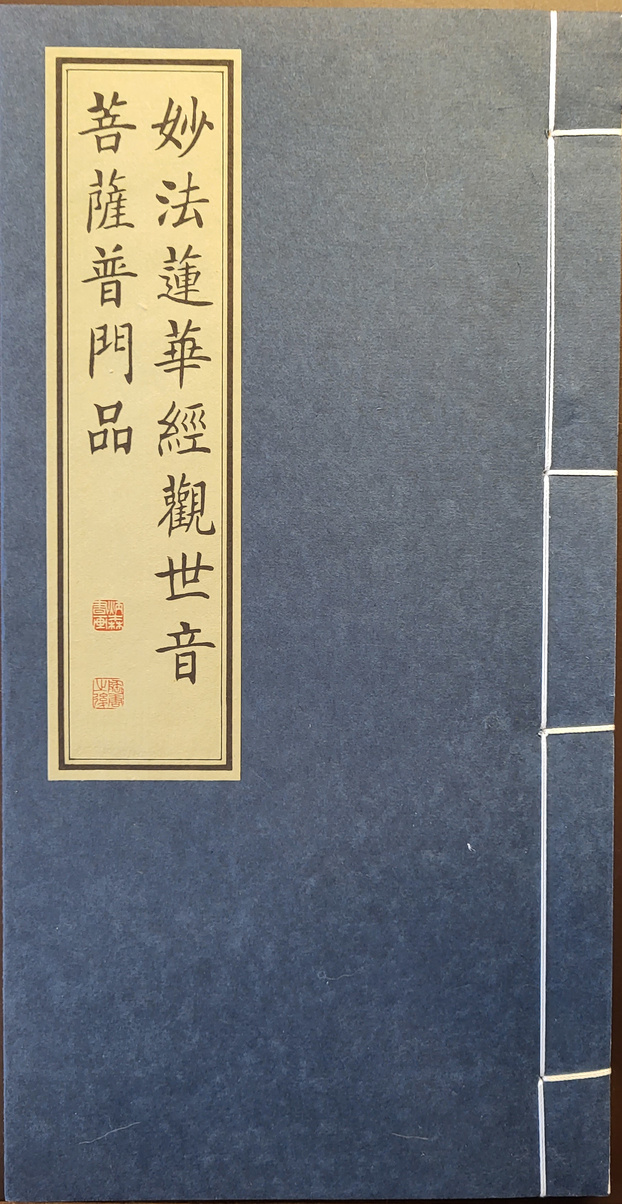
I don’t know what was being printed when I took these pictures, but clearly it is calligraphy and is nothing more than solid black ink on white paper. The same goes for a Buddhist scripture that had been printed on the press earlier in the year for a temple in Tianjin, of which I was given a copy as a memento. I subsequently gave it to the Bodleian and catalogued it as follows:

妙法蓮華經觀世音菩薩普門品 一卷 / (姚秦釋)鳩摩羅什譯
2006年北京文物出版社珂羅版印本
線裝1冊 : 圖 ; 34公分
天津大悲禪院敬印
Sinica 6004

A few more specimen pages 書影 from this edition are attached to its record in the Serica Project.

These pictures have led me to take another look at collotype printing, of which there are some classic examples in the Bodleian collection. I’m ashamed to admit that when I first catalogued them, I dismissed them as nothing more than early versions of what I was currently acquiring in spades: photolithographic reproductions of Chinese editions, many of them illustrated.

I will not pretend to understand the process of collotype printing in any detail. There is an excellent Wikipedia entry on the subject, and it is adequately summarised in the opening words of T.A. Wilson’s book The practice of collotype (1935):

“The collotype process is a photo-mechanical method of printing with ink from the plane surface of a photographic film. It is a process which is capable of producing prints of great beauty, prints that are soft in tone, continuous in gradation, and with remarkable definition of detail. The process combines the arts of photography, printing, and coloring, and provided that a suitable negative be made, any subject can be rendered in collotype. The plates may be printed in a hand press, where the manipulations are extremely variable, or in a power machine, where the dampening, inking, and printing are more or less automatic. The rate of printing of the best collotypes is slow, generally under 500 impressions an hour.” [1]

And in the short account of collotype in his book The technique of prints and art reproduction processes, Jan Poortenaar makes the point that “collotype is unequalled, save by hand-photogravure, among all the photo-mechanical processes for high-class reproduction-work.” [2]

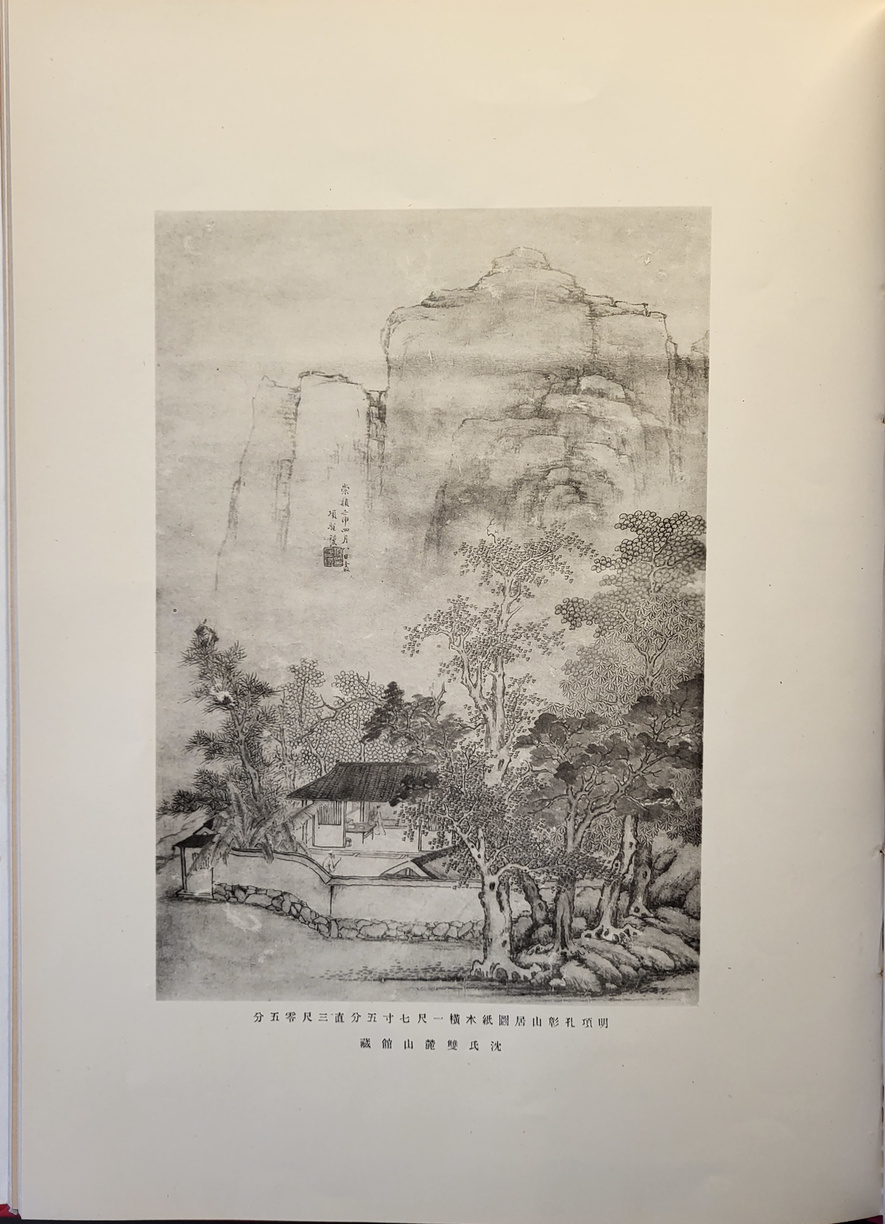
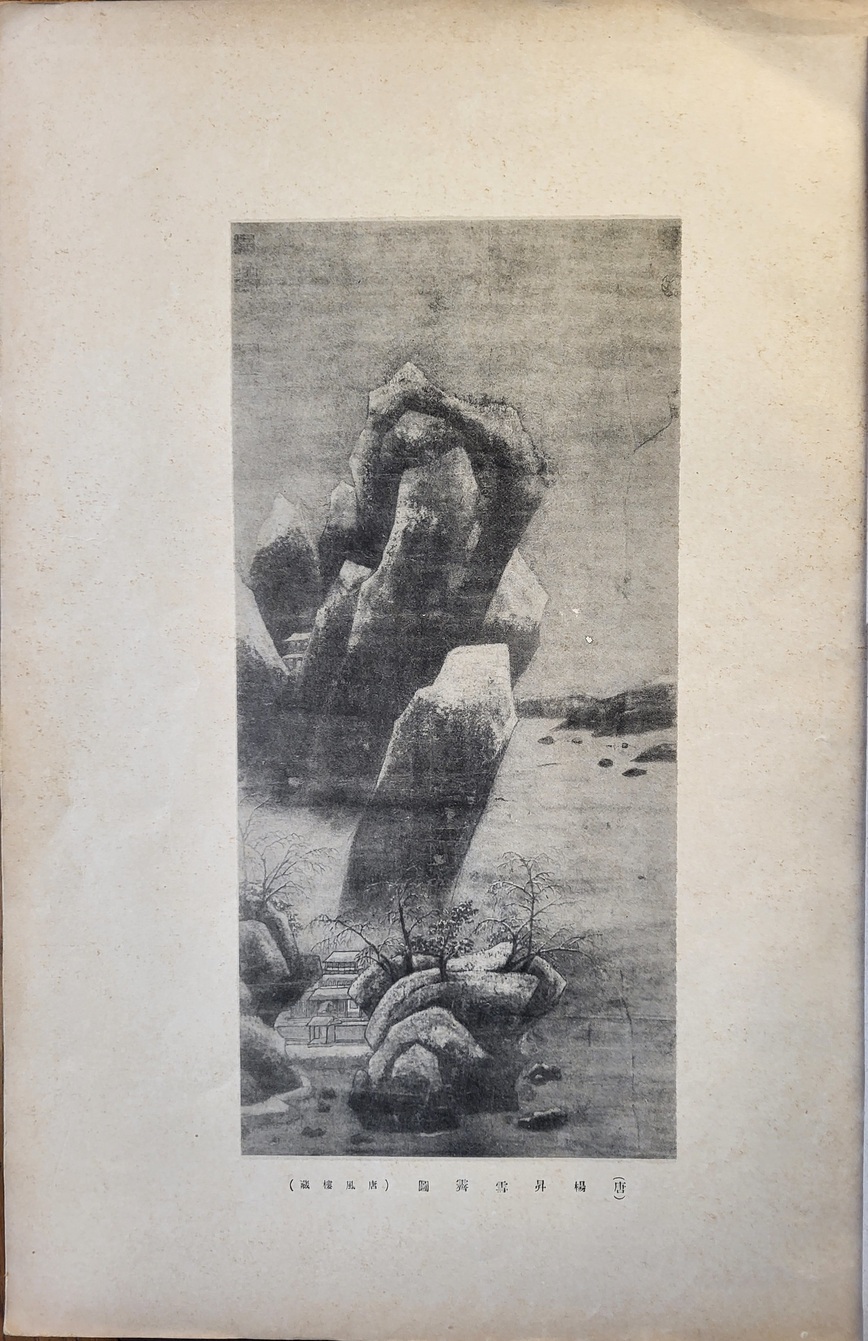
From this it is clear that the examples being printed in Beijing at the time of my visit did not represent the full capabilities of collotype printing. And it is equally clear that when I catalogued two of the earliest Chinese collotype editions in the Bodleian Library, I completely failed to notice how remarkable they were. These two editions are treated in extensive detail by Cheng-hua Wang (Professor of Art and Archaeology at Princeton) in her article New printing technology and heritage preservation: collotype reproduction of antiquities in modern China, circa 1908-1917.

Both were published serially in Shanghai beginning in 1908.

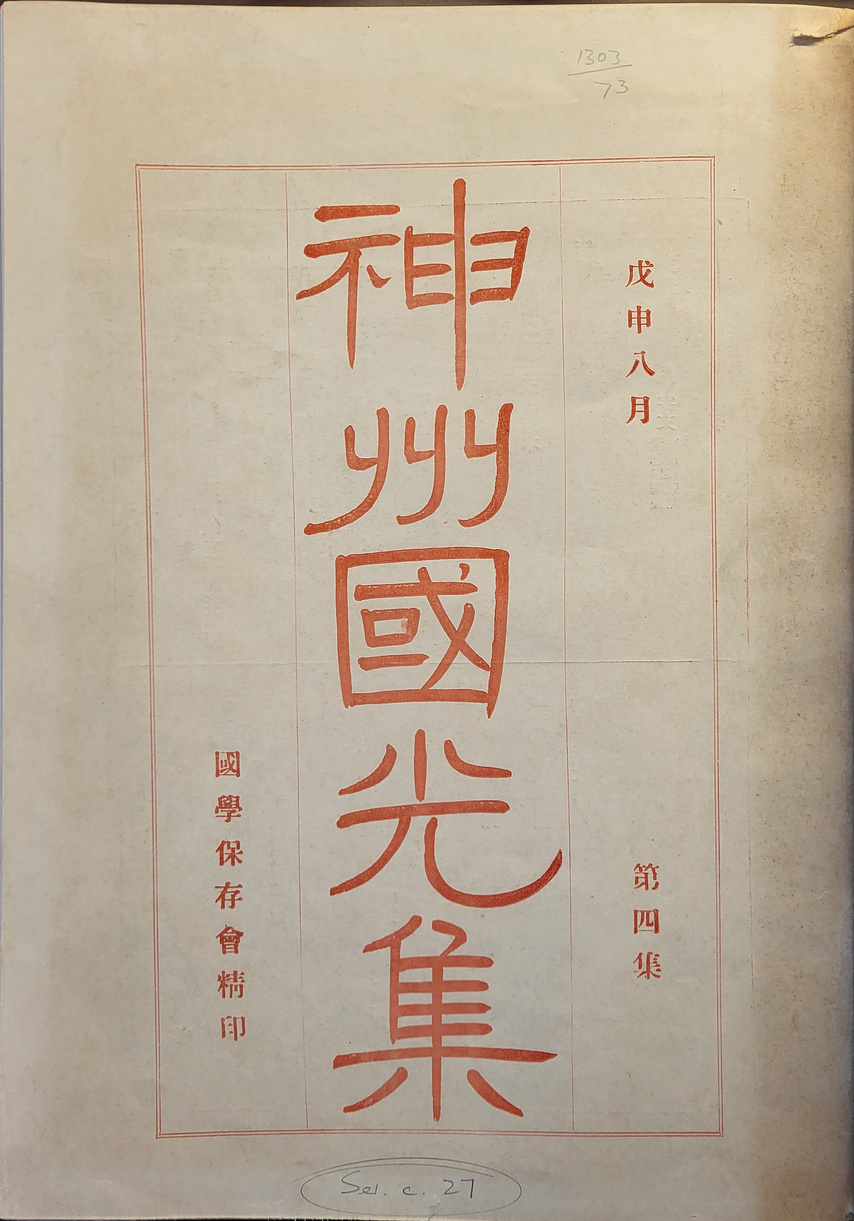
The Bodleian only has a single issue of the first one, Shenzhou guoguang ji, published by Deng Shi 鄧實 (1877-1951):

神州國光集 : 存第四集
清光緒戊申[1908]國學保存會珂羅版印本
洋裝(原平裝)1冊 : 圖 ; 31公分
Sinica 6848

But the Library has rather more of the second one, Zhongguo minghua, published by Di Baoxian 狄葆賢 (1873-1941):

中國名畫. 第一~二十八集 / (民國)美術研究會審定
民國上海有正書局珂羅版印本
木匣1盒(線裝28冊) : 圖 ; 38公分
Sinica 3973
Backhouse 719 存第一~十集. – 線裝10冊 ; 39公分
Sinica 6370 存第二﹑八﹑十集. -線裝3冊 ; 39公分

More illustrations from this work are attached to its record in the Serica Project. And sixteen issues of Zhongguo minghua are in the possession of a French collector who has not only reproduced all the illustrations from them, but has also presented a comprehensive and detailed account of the publication and its background.

The set in the Fung Ping Shan Library in Hong Kong has 40 issues, and is complete. The first copy in the Bodleian (Sinica 3973) preserves a set of the first 28 issues. It is contained in a wooden box (of which there are very few examples in the Bodleian) which suggests that the vendor or owner considered it to be both complete and valuable. Print runs were rather short – Poortenaar says (p.147): “Five hundred good prints may perhaps be obtained; some people speak of a thousand, but then the question arises what are good prints, and what are not.” So to satisfy demand each issue was reprinted many times. Actually these are not strictly reprints, but re-editions, as a comparison of the Bodleian copies will confirm; and in any case, I don’t think storing gelatinous collotype plates and reprinting from them is feasible. Sinica 3973 appears to have been put together in the mid-1920s from copies which had run to as many as 12 editions – here are the details.

It’s always good to discover “landmark” editions in the Library’s collections, and I never expected these two collotype publications to fall into that category. But they do. Professor Wang explains how for the first time they showed to the general public artworks that hitherto had only been available to a privileged few, leading directly to a discussion of what constituted the Chinese national art heritage and how it might be preserved, which was precisely the intention of their publishers, Deng Shi and Di Baoxian.


1. Wilson, Thomas Arden: The practice of collotype (London: Chapman & Hall, 1935), preface. For an earlier account, see Fithian, A W: Practical collotype (London: Iliffe, Sons & Sturmey, 1901).
2. Poortenaar, Jan: The technique of prints and art reproduction processes (London: The Bodley Head, 1933), 146.

Japanese matters

29 May 2023

It’s said that good things come in threes, and here they are.

1. The Kornicki Collection

The first is Peter Kornicki’s donation of his remarkable collection of antiquarian Japanese books to the Bodleian Library in November 2021. Peter is Emeritus Professor of Japanese at Cambridge University but is an Oxford alumnus, having taken his first degree here in 1972 and his D.Phil. in 1979.

Among them are twenty-three Japanese editions of Chinese works (kanseki wakokuhon 漢籍和刻本) and one Korean edition which I have catalogued and listed here, with links to illustrations of specimen pages (書影).

Peter has written a scholarly bibliographical description of his collection which he has made freely available, and I have made references to this at the end of each record, so that 「康仁希文庫目録, A, 19」, for example, points to the nineteenth work in section A of his catalogue.

Peter acquired all the books in the collection on numerous visits to Japan over a period of 40 years, with the exception of two which he bought from Sam Fogg Rare Books in London. These are not only the two oldest books in the collection, but are also kanseki wakokuhon, and thus fall within the remit of the Serica Project. They are both fragments of Buddhist texts and are fine examples of mediaeval Japanese temple printing.

The earlier of the two was printed in 1278 at the temple Kongōbuji 金剛峯寺 on Mt Kōya 高野山, and is thus a so-called Kōya-ban 高野版; the other was printed in the late Kamakura 鎌倉 period (14th century) possibly at Kōfukuji 興福寺 in Nara, whose editions are known as Kasuga-ban 春日版 owing to the custom of presenting copies of them to the nearby Kasuga Taisha 春日大社 (Kōfukuji was the temple of the Fujiwara family, and Kasuga Taisha was their family shrine).

These two related editions have a primal beauty which, I think, cannot fail to move anyone with an interest in East Asian bibliography. Here they are:

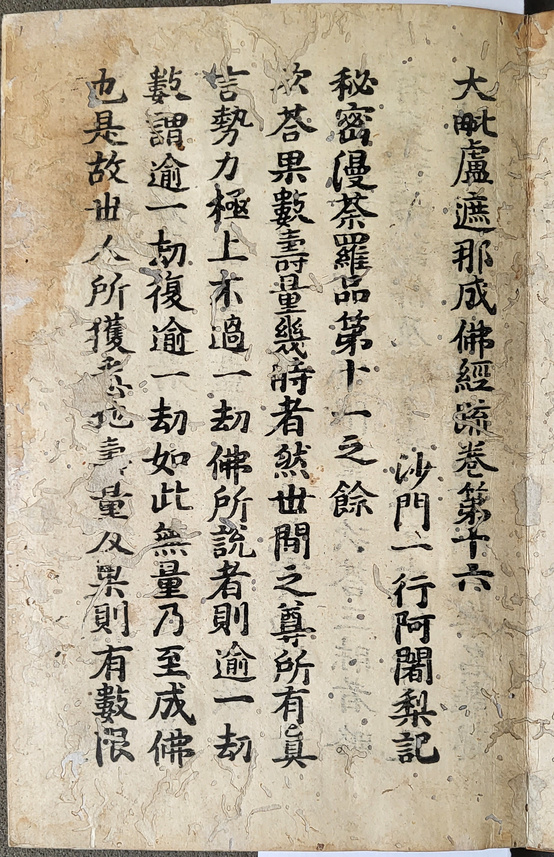
大毗盧遮那成佛經疏 : 殘一卷 / (唐釋)一行記
日本弘安元年[1278]高野山金剛峯寺刊本
線裝1冊 : 圖 ; 26公分
殘卷十六
有「月明莊」印記
康仁希文庫目録, A, 1

大般涅槃經 : 殘一卷 / (北涼釋)曇無讖譯
日本鎌倉後期刊本
1卷 ; 28公分
殘卷六
康仁希文庫目録, A, 2

Peter’s donation brings the total number of pre-modern kanseki wakokuhon in the Library to 87, and I have listed them all here.

2. Southern Ming calendars

In one of my earliest blog entries I discussed the calendars that were produced by the Ming loyalist regime in Taiwan to justify its imperial pretensions. At first I thought that the only surviving copies of these were in English libraries, but subsequently discovered from Yang Yongzhi’s 楊永智 book 《明清時期台南出版史》(台灣學生書局, 2007) that both the earliest and latest surviving issues (1667 and 1683) were “in the collection of the Kanda family” (p.16).

I assumed that “the Kanda family” referred to that of the great bibliographer Kanda Kiichirō 神田喜一郎 whose collection is now at Otani University in Kyoto, but its published catalogue 《神田鬯盦博士寄贈図書目録》(1988) makes no mention of them. So I concluded my entry by saying that I would very much like to know where they are. Of course, I could have contacted Yang Yongzhi, but as ever, wandered off in other directions.

A few weeks ago, my prayers were answered. Zheng Cheng had read my blog entry, and put me in touch with a young Chinese scholar who had taken a Ph.D. at Kyoto University last year and is currently engaged in post-doctoral work at Fudan University in Shanghai. I now know him by his English name of Leo – his real name is Yin Minzhi 尹敏志, and he blogs as Baixian 白鹇. He is keenly interested in the Chinese books that were published, collected, and studied in Japan, and has already written a book which touches on these things: 《 东京蠹余录》(广西师范大学出版社, 2020). I must thank him for most of the following information.

The calendars were offered for sale in 2021 at the annual antiquarian book auction organised by Tōkyō Kotenkai 東京古典会 , and appeared in the catalogue 《古典籍展觀大入札會目錄》 and also on the Society’s website. It seems that they were originally owned by Kanda Kōgan 神田香巌 (that is, Kanda Nobuatsu 神田信醇, 1854-1918, the grandfather of Kanda Kiichiro 神田喜一郎). They may well have been inherited by Kiichiro, but clearly they were not among the books that went to Otani University, and I don’t know under what circumstances they came to be sold.

At the time, Leo downloaded this image of them from the Tōkyō Kotenkai website; it’s no longer there, and unfortunately it’s not very clear, but it’s all we’ve got at present and it makes the point well enough:

Leo was also able to examine the calendars, and has told me that they are printed on brittle paper, and are wrapped in a thick paper cover bearing the following information presumably written by a former Japanese collector:

永曆二十一年
永曆三十七年
台灣曆二冊

永曆十六年永明王被難十八年鄭成功入
台灣是年以疾卒三十七年鄭錦卒子
克塽年甫十二不克統領其眾眾潰降于清
見賜姓始末此曆則其末年也偶得之
故紙堆中稱中興正朔者實可哀憐也

明治七年三月中旬 吉雪齋藏

The calendars were bought by the antiquarian bookstore Tōjō Shoten 東城書店 in Jimbōchō 神保町, reportedly for the sum of JPY10,000,000 (currently GBP60,000).

Learning all these things was very timely, as I had already arranged to go Japan in the second half of April. So I contacted Tōjō Shoten to ask if I might see the calendars and perhaps get some decent illustrations of them. Both requests were refused. The most I could extract from them was an undertaking that they would let me know when they eventually offered them for sale, which Leo tells me will be for an eye-watering price.

The 1683 (永曆三十七年) issue is particularly special as in that year the Southern Ming was finally brought to an end by the Manchus, and in the following year Taiwan became a prefecture of Fujian Province. All this is given additional piquancy by the current goings-on in that part of the world, something which has surely not escaped the attention of Tōjō Shoten.

3. Fengmian 封面

I’ve always found it difficult to translate the term fengmian 封面 in a way that would enable English readers to understand immediately what it is. Against my better judgement I’ve occasionally called it a “title-page”, but that is misleading as the Chinese fengmian lacks the authority of the western title-page and serves a different purpose.

While wandering around the streets of Tokyo during my visit last month, I came across this bookshop which almost certainly will not survive its present owner. There were many similar shops in Jimbōchō when I worked there 50 years ago, but almost all of them have now been replaced by modern multi-storey buildings with offices on the upper floors and what remains of the bookshop on the ground floor. It is called Asakusa Mikuramae Shobō 浅草御蔵前書房, and is situated in the neighbourhood of the famous temple of Sensōji 浅草寺 (better known as Asakusa Kannon 浅草観音) and the chefs’ paradise of Kappabashi 合羽橋.

Here, some old books (mostly pre-Meiji popular illustrated editions) can be seen in the centre of the display, laid flat so that their titles were visible, inviting passers-by to pick them up, examine them, and hopefully buy them. The setup reminded me of a photograph I once saw of an early twentieth-century Chinese bookshop in which a display of this kind occupied its entire frontage. It was almost certainly one of Hedda Morrison’s, but now I can’t find it.

The fengmian was designed to attract the attention of passers-by in just this situation, and the information it contained was drafted accordingly. It could include a descriptive title, the names of any famous authors or commentators, the name of the printing house or owner of the blocks, and a date. All these elements were intended to be eye-catching rather than strictly accurate or honest. Here are two examples from the late Ming:

史記 一百三十卷 / (漢)司馬遷撰 ; (劉宋)裴駰集解 ; (唐)司馬貞索隱 ; (唐)張守節正義
明末程正揆校刊本金閶書業堂藏板
線裝32冊 ; 26公分
封面题名《史記評林》
有「書業」、「書業鼎記圖印」印記
Backhouse 292

性理大全書 七十卷 / (明)胡廣等奉敕撰 ; (明)吳勉學重校
明末刊本季秀堂唐際雲藏板
線裝32冊 ; 27公分
版心下記刻工﹑字數
封面有「本衙藏板」印記
Backhouse 402

Note that both these editions are commercial ones. Imperial editions and the editions of private scholars were of an entirely different order and were not circulated in this way, so that they seldom have fengmian.

A missionary treasure box

3 January 2023

In April 2015 the Bodleian received one of the most interesting donations of Chinese materials to have been made during my time as Curator of Chinese Collections. It was small in size, and fitted entirely into a single cardboard box. Of scrappy appearance, the materials were of the sort that many people would throw out following the death of their owner. This alone would ensure that they were rare once a few decades had elapsed.

The donor was the distinguished constitutional lawyer Anthony Bradley who was living in retirement near Oxford, and the materials were the nachlass of his maternal grandfather Arthur Bonsey (1858-1942), who was a younger contemporary of the well-known Welsh missionary Griffith John (1831-1912). Last year I was shocked to see an obituary of Professor Bradley in The Guardian, and greatly regret my failure to post an account of the donation before his death.

In 2018 Tony published a biography of Bonsey [1], whose work at the London Missionary Society’s station in Hankow extended over a period of some forty years, from his arrival there at the end of 1892 until his retirement in the spring of 1923. He spent the rest of his life in Oxford until his death on 2 December 1942, with so far as I know no contact with the Bodleian Library, much less any idea that his box of odds and ends would eventually become one of its treasures.

The following portrait of Bonsey is taken from a commemorative publication of the Griffith John College in Hankow, of which he was appointed Principal in 1913 [2]:

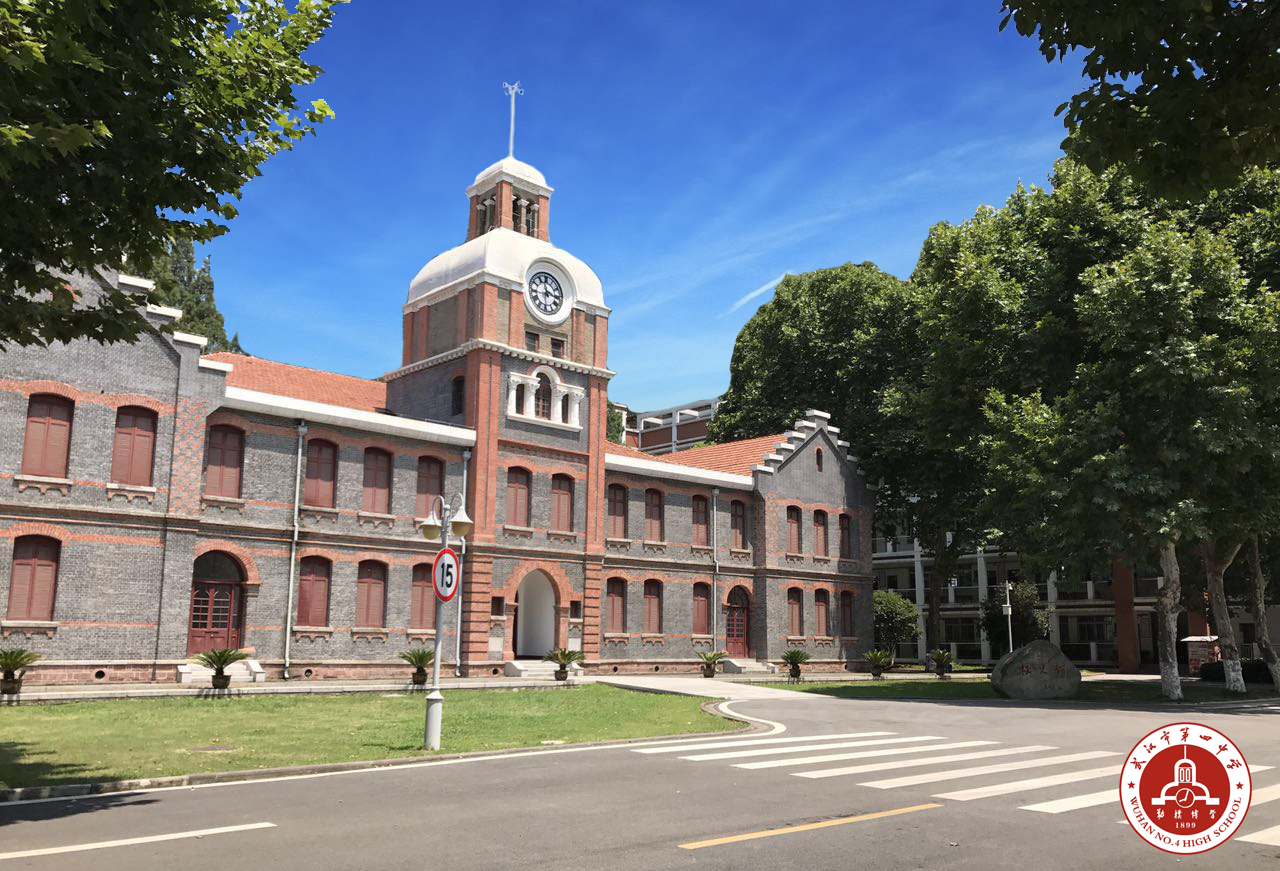
The College had been established in 1899 as the London Mission College 倫敦會書院, later changing its name to Boxue Shuyuan 博學書院 in Chinese and Griffith John College in English [3]. The main building with its bell tower survives as part of Wuhan No.4 Middle School 武汉市第四中学.

There are 197 printed items in Arthur Bonsey’s collection, of which 59 are single sheets. They are shelfmarked Sinica 6371-6421, 6423-6568 (Sinica 6422 is a manuscript) and they can all be found in Library catalogues except for two pieces of printed ephemera (Sinica 6552, 6553).

There are also 43 manuscripts, shelfmarked MS.Chin.a.24(1-13), MS.Chin.c.45, MS.Chin.d.77-78, MS.Chin.e.29, Sinica 6422. Some of them are single-sheet items, others are letters consisting of one or more sheets in an envelope grouped together under the same shelfmark. None of them can currently be found in Library catalogues, but they are all listed here with brief descriptions; all but three have been digitised.

Riots in the Yangtse valley

I distinctly remember the day when Tony delivered his grandfather’s nachlass to the New Library in Broad Street, Friday 27 March 2015. He opened the boot of his car to reveal a box of materials, on top of which lay a volume with a distinctive landscape orientation and grey paper covers. He was surpised when I recognised it immediately despite the fact that it was face down – Chinese books are much less varied in appearance than western ones, and I had long been familiar with two copies of the same work that were already in the Library’s collection: The cause of the riots in the Yangtse valley : a complete picture gallery (Hankow, 1891, 29 x 35cm), Sinica 5987 and (RHO) USPG 1861.

In view of the fact that the Bodleian already had two copies of this work, it was felt that a third was unnecessary, so it was kept by the family and I believe it was among the materials which Tony presented to Central China Normal University 华中师范大学 in Wuhan when he visited them a couple of months later in May 2015.

The work and its background are explained in full by Peter Perdue on the MIT Visualising cultures website, which uses the copy in Yale University Library. The copy in Princeton University Library has also been digitised.

In summary, it is a reproduction of an illustrated anti-Christian tract entitled Jinzun shengyu biye quantu 謹遵聖諭辟邪全圖, translated and introduced by Griffith John. The tract is said to have been written by Zhou Han 周漢 (1842-1922), a leading anti-Christian campaigner whose works were widely circulated in the middle and lower reaches of the Yangtse valley [4]. One does not need to be a Christian to find that the tract and its illustrations are utterly repellent – such material would be shocking no matter what religion it was directed against. For this reason I used to find it very hard to believe that Griffith John had actually reproduced it, despite his disclaimer in the preface (section 8) which states:

“This reproduction of the Picture Gallery being intended for the thoughtful few, and not at all for the multitude, no attempt has been made to gloss over its extreme grossness in picture and language. It is not the production of illiterate men. The Hunan antichristian publications, almost without exception, have scholars as their authors, and there can be no doubt about this one.”

However, among the Bonsey materials are seven manuscript illustrations which look as if they were indeed produced as drafts for the final block-cutting and printing. Bonsey must have seen the work being done and collected them as he approached the end of his first posting in Hankow (from 1882-1891).

Here is the draft of the first illustration, MS.Chin.a.24(7), described in the published text as “The Devils (foreigners) Worshipping the Hog (Jesus)”:

And here is what was actually printed and published (Princeton copy):

There are two drafts relating to the third illustration, MS.Chin.a.24(8, 9), described in the published text as “Propagating Religion in the Chapels”:

Perhaps the first of these two was intended to be for a block that was to print only the black portions of the illustration – in the taoban 套版 printing technique a separate block was required for each colour. In the event, the illustration that was finally printed and published had a different colour scheme and was much simpler:

The illustration shows the faithful worshipping the crucified Saviour, depicted as a hog, while foreign missionaries engage in acts of fornication at the back of the chapel.

Other works by Griffith John

Griffith John is a towering figure in the 19th-century Protestant mission, and much has been published about him both in print and on the internet; his Wikipedia entry is a good starting point.

Here I will only draw attention to the large number of his publications that were collected by Arthur Bonsey and which are now in the Bodleian Library. One of the many things that grated during my final years of service there was the increasing use of the term “world-class” by those who run the place to describe their own institution and its collections, something that struck me as being immodest to the point of vulgarity. So I leave it to others to examine my list of Griffith John’s publications, to search for them in WorldCat and elsewhere, and to decide for themselves whether such a claim can be made for this particular corpus.

The printed single-sheet items seem to be of exceptional rarity, which could be because they were considered too trivial and ephemeral to be taken into library collections; or they may indeed be in libraries but are lying unidentified and uncatalogued. I have found no examples of any of the six “sheet tracts” by Griffith John listed in Wylie’s Memorials of Protestant missionaries (Shanghae, 1867, 237-238) – but copies of all four of the multi-leaf tracts he lists are present in the Bodleian collection – nor have I found any other examples of the 35 single-sheet tracts in Bonsey’s collection. Of these, 28 are what I have described as “folded” single sheets, which look as if they might have been designed to be bound up into pamphlets; here is one of them, Sinica 6399 :

Griffith John regarded the establishment of schools, hospitals, and training colleges as an essential part of the Christian mission, and some of the single-sheet items bear witness to this, such as Sinica 6530, which explains the rationale behind it:

And on the subject of physical as well as spiritual welfare, John was particulary active in the anti-opium and anti-footbinding movements. I have compiled lists of materials on these subjects which are found in the Bodleian collections. Most of the anti-opium publications and all the anti-footbinding publications came from Bonsey; here is one of them, Sinica 6551:

Other single-sheet printed material

Visually impressive and certainly deserving attention are five calendars in the form of posters, clearly produced to promote the missionary enterprise. They are for the years 1887 (Sinica 6564), 1889 (Sinica 6565), 1890 (Sinica 6566), 1891 (Sinica 6562), and 1910 (Sinica 6567); this last one is printed in two colours and is particularly appealing:

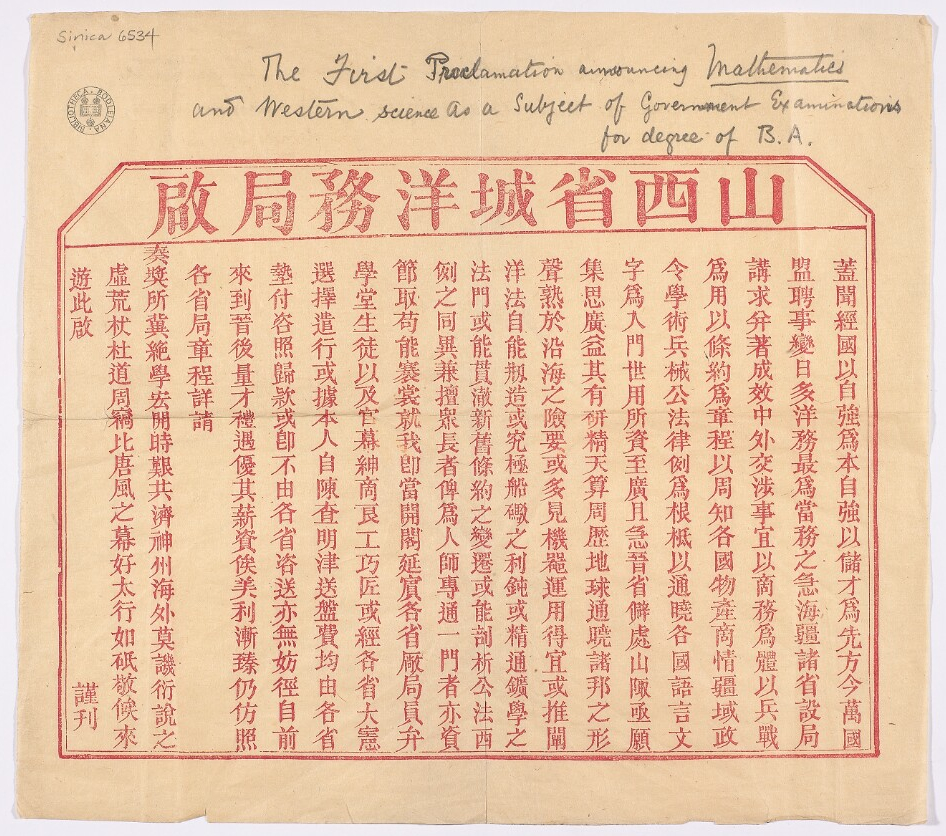
Bonsey also collected a number of contemporary single-sheet items that were not related to the Protestant mission. For example official handouts of one sort or another that were read and then discarded, such as the handbill (or perhaps a small poster) announcing the establishment of mathematics and western science as subjects for the official government examinations, Sinica 6534:

The most spectacular among them is Sinica 6568, an enormous poster measuring 90 x 266cm. and printed on yellow paper with a red border of imperial dragons. The text is part of an imperial edict dated 1 February 1901 (according to the western calendar) requiring local officials to suppress all anti-foreign demonstrations and punish those responsible on pain of immediate dismissal and with no prospect of being re-hired. The injunction was presumably printed repeatedly in a number of locations – there is another example in the Bavarian State Library, printed from different blocks but of similar size and appearance. I suppose these huge posters were intended to be pasted to city walls and gates, or the walls of government offices, but this is only a guess. I’d be grateful to hear if anyone has more knowledge of this.

And finally, there is Sinica 6559, a delightful New Year print of the “Woosung Railway” 吳淞鐵路, China’s first passenger railway which opened in 1876 and ran from Shanghai to Wusong; its chequered history is the subject of a Wikipedia article. There are several iterations of this print, as an internet search will reveal.

Hymnal

Bonsey himself appears to have written and published very little indeed. In fact I have only been able to find a single copy (in SOAS Library) of a four-page pamphlet entitled The loving doctor Chow Chi Kwan (London Missionary Society, c.1900).

At the Griffith John College, as well as being Principal, Bonsey also taught history, English, and music, and there is a large musical score entitled The tune book of the C.C.R.T.S. Union hymn book (Hankow: Central China Religious Tract Society, 1905) in Rolvaag Memorial Library, St. Olaf College Northfield, MN (USA); again, this is the only copy I have found.

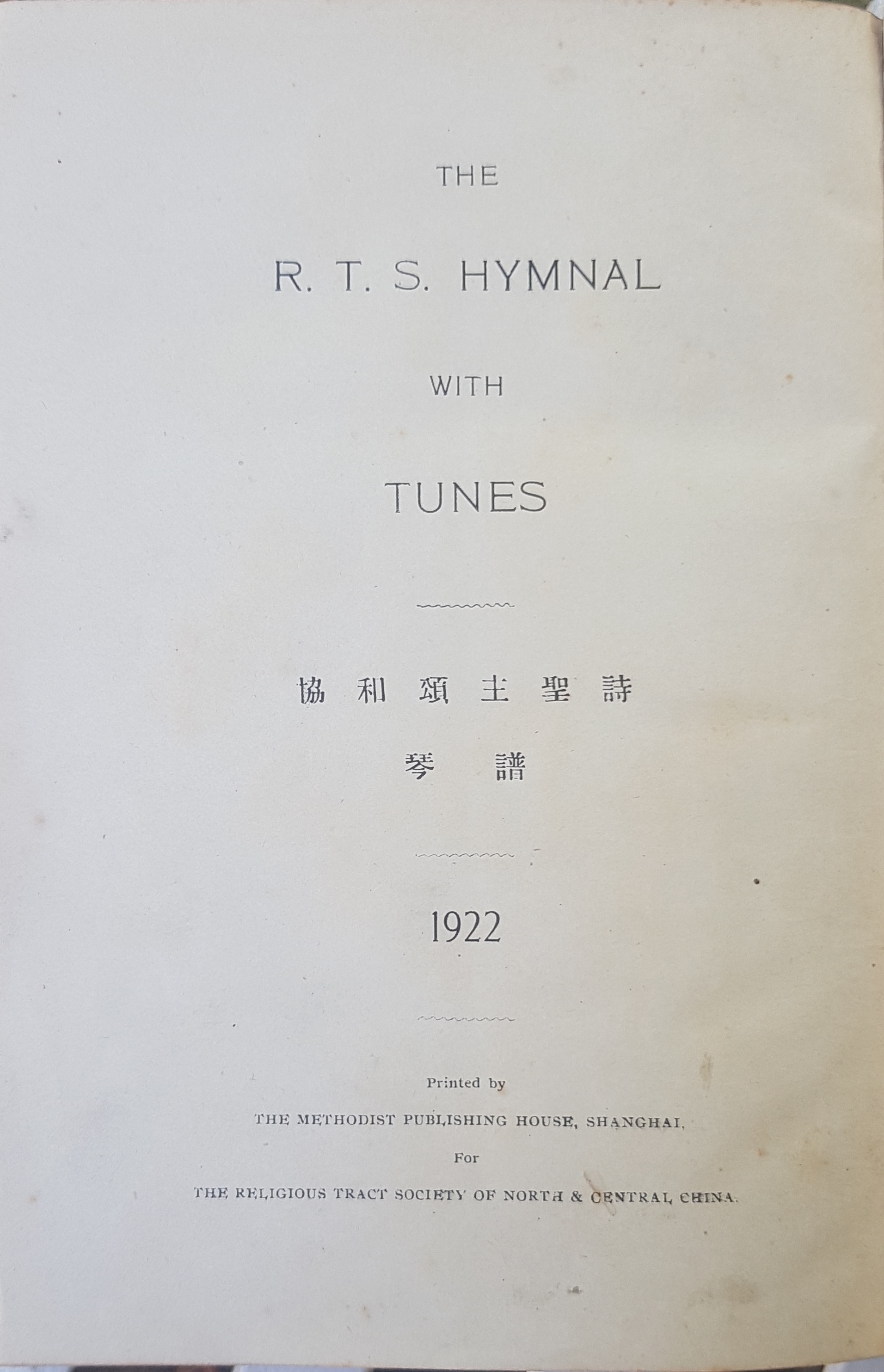
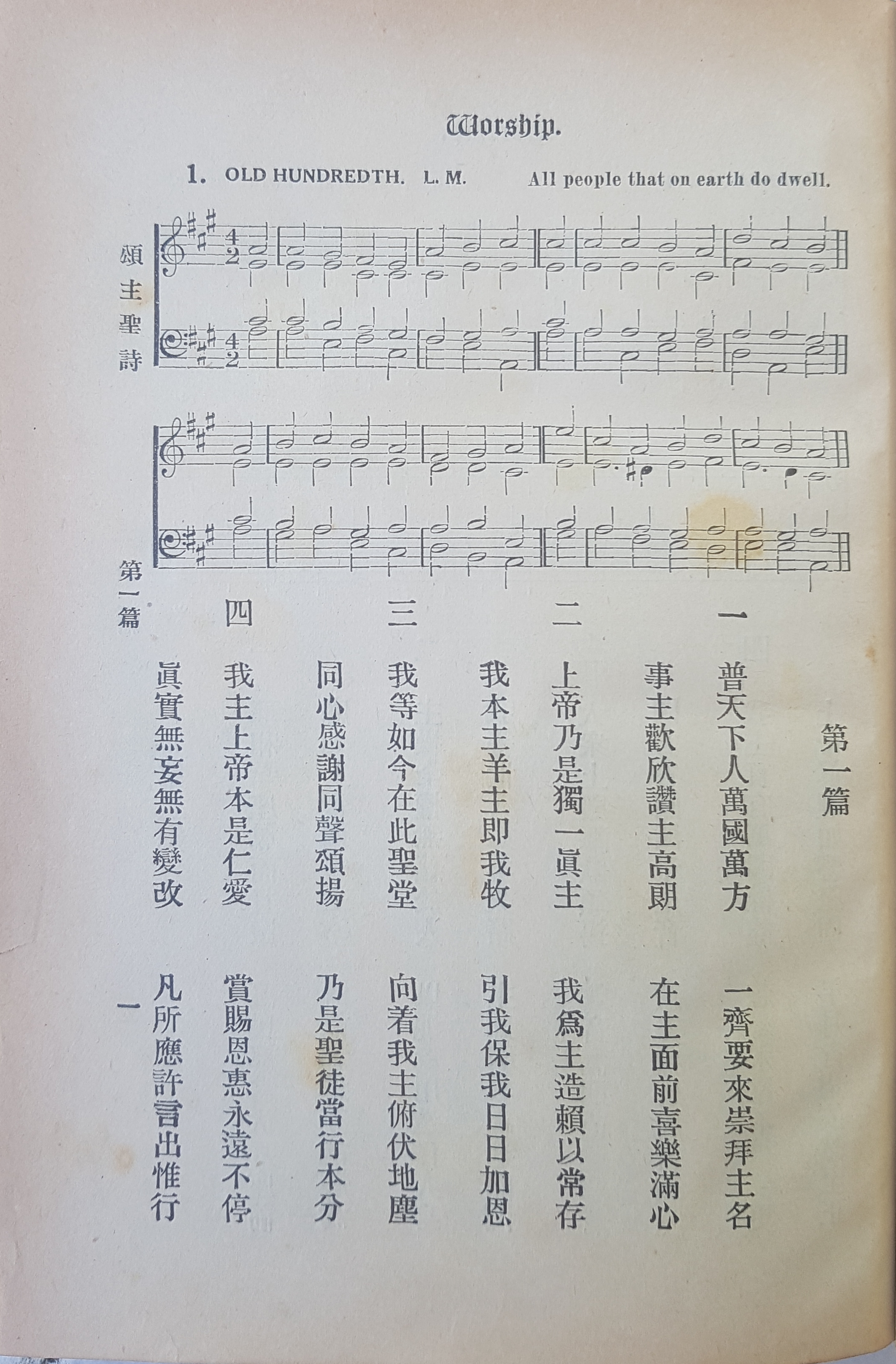
Although it was not published under his name, for many years Bonsey chaired the editorial team that compiled The R.T.S. hymnal with tunes, which was published by the Religious Tract Society of North & Central China in Shanghai in 1922. It has a preface signed G.A.C., who I presume is the Methodist missionary George Alfred Clayton.

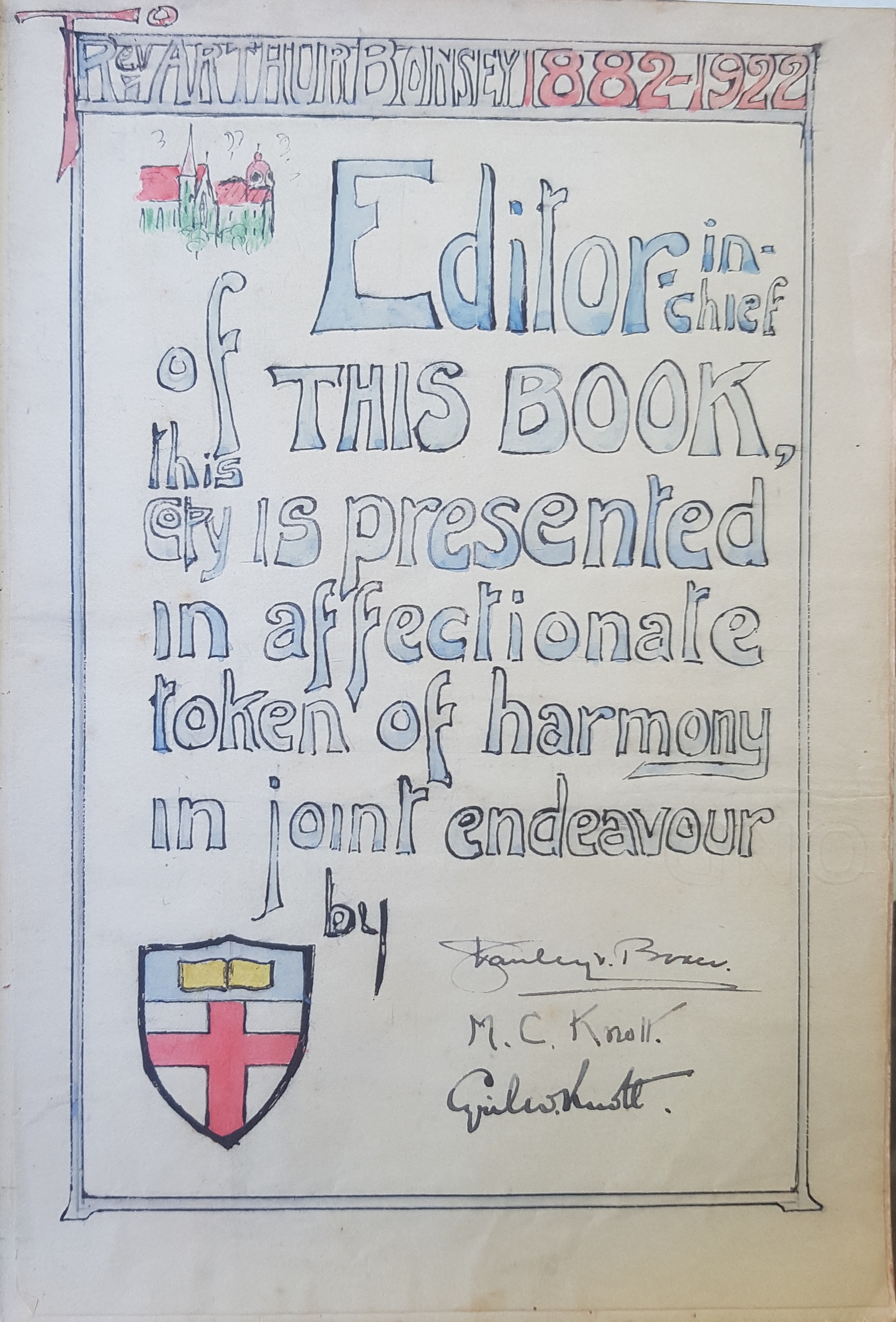
There is a copy in the London Missionary Society Collection in the National Library of Australia, but apart from that the only other copy I know of is the presentation copy given to Bonsey in commemoration of his forty years’ service in Hankow, the front fly leaf of which bears a beautifully drawn dedicatory inscription. The volume is in the possession of the Bradley family, and Tony showed it to me in his son’s garden on 26 June 2020. That was the last time I saw him, and the pictures of it which he allowed me to take for my blog are an appropriate place to conclude this entry.


1. Bradley, Anthony: Arthur Bonsey (1858-1942) and the missionary enterprise in central China. In The journal of the United Reformed Church History Society, 10:3 (November 2018), 125-144.
2. 級友錄, 漢口博學書院, 1919. Sinica 6508.
3. See 中國現代化的區域研究. 湖北省, 1860-1916 / 蘇雲峰著. – 台北 : 中央研究院近代史研究所, 民國70年[1981]. – (中央研究院近代史研究所專刊 ; 41). 145-146.
4. See 黄金乐: 周汉生卒年考, in 黑龙江史志, 346(2015:9), 18, 20; also 邵雍: 《谨遵圣谕辟邪全图》之解读, in 史學月刊, 223(2007:9), 131-134.