Archive for the 'Uncategorized' Category

Serica project website

27 October 2012

In my first post, I described this blog as the “outer chapter” to the “inner chapter” of my project to locate, identify, and list all the pre-modern Chinese materials in the Bodleian Library. The initial results of that project can be seen here:

http://serica.bodleian.ox.ac.uk/

There isn’t much content in the site at present, but now that the framework is in place, very much more will be added in the coming months and years. Already, two categories of important material have been presented in their entirety: our Taiping Tianguo publications (tentatively classified under 史部 – 政書類 – 太平天國印書)  and our holdings of Yongle dadian (子部 – 類書類).

It is possible to view the “marc” (馬克) format of each record. This is not one of the standard MARCs in use in libraries throughout the world, but simply a variant of our in-house format for cataloguing Chinese and Japanese books.

The records of the Taiping Tianguo publications all offer sample pages (書影) as a means of enabling the reader to see what they look like, and to confirm (or question) the identification. Some of the other records also offer these, particularly in cases where the identification is open to question or the object is of unusual interest.

Our Yongle dadian holdings have all been digitised, and the quanwen 全文 button gives access to the scans; although this Chinese term literally means “full text”, it should be noted that the digitisation is not “full-text” in the normal English meaning of the word, which usually means “full-text searchable”.

There are some loose ends in the database which will be tied up as the project proceeds. Additional functionality will also be provided.

Survey of the Great Ming empire

24 September 2012

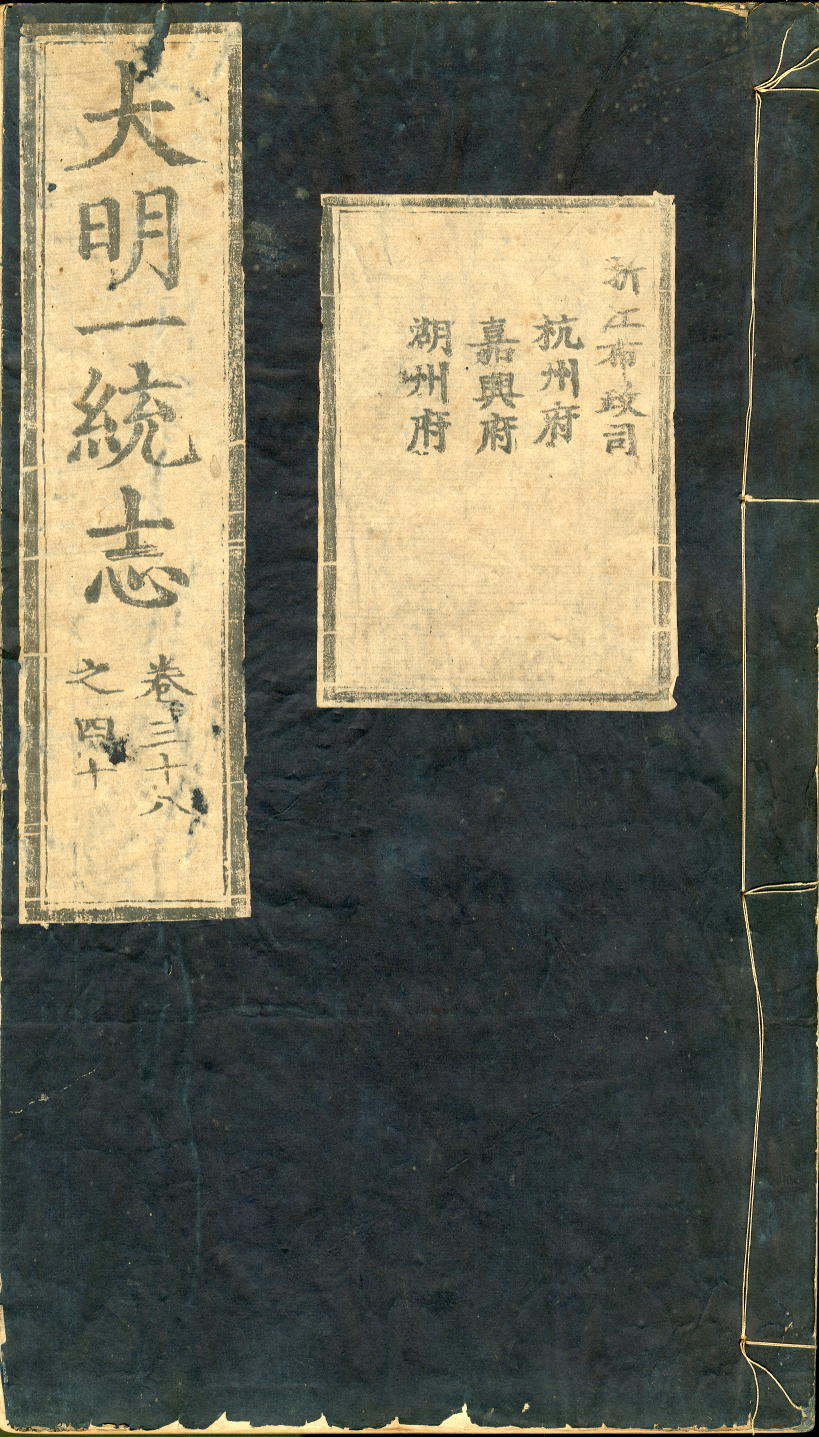
The first official geography of the Ming dynasty was the Huanyu tongzhi 《寰宇通志》, a name which is partly derived from the official geography of the Northern Song upon which it was modelled, the Taiping huanyu ji 《太平寰宇記》. However, shortly after its completion it found disfavour with the Emperor Yingzong 英宗, who commissioned a new geography to be modelled on that of the Yuan, the Dayuan dayitong zhi 《大元大一統志》 (“Great survey of the Great Yuan empire”) which had been compiled in the late 13th and early 14th century (and of which only a relatively small proportion is extant). Like the earlier history, its title Daming yitong zhi 《大明一統志》 reflected that of the work upon which it was modelled.

It was completed in the fourth month of 1461 (天顺五年), and printed in the palace. The statesman and political operator Li Xian 李賢 heads the list of compilers, something which is due more to his status than the role he played in its production.

There is a copy of this edition in the Library:

大明一統志 九十卷 / (明)李賢等奉敕撰
明天順五年[1461]內府刊本
線裝40冊 ; 37公分
Backhouse 466


This is not an early printing, but is nevertheless a most impressive example of Ming imperial book production, and the fascicles bear their original printed labels. The fascicles are disposed in eight han 函. Curiously, the single owner’s seal in the edition has only been applied from the first fascicle in the fifth han, that is, only starting half-way through the book. Like all editions of this date, it was originally bound in “wrapped-back” style (baobeizhuang 包背裝), and traces remain of the paper that was originally pasted on to the back edge of the fascicles.

Of considerably greater bibliographic interest however is the following edition which was presumably made much later in the dynasty:

天下一統志 九十卷 / (明)李賢等奉敕撰
明萬曆中(?)萬壽堂刊清初剜板印本
線裝36冊 ; 28公分
本書為《大明一統志》, 清初用原板重印時將每卷卷端題名及板心「大明」兩字挖去, 或以「天下」代替
Backhouse 242

No cataloguer seems to have determined precisely when the blocks were originally cut, but the assumption is that it was during the Wanli period (which is sufficiently long to make such an assumption fairly safe), sometime either side of the year 1600. The publisher’s name 「萬壽堂」 appears in the lower banxin 版心 of each leaf, and is otherwise unknown.

When I first catalogued this edition in the early 1980s, I thought it was rather rare. Since then, first comprehensive printed union catalogues and now the internet have shown that it is in fact very common, but that does not diminish its interest. I thought it was rare because at that time, I could not find the title 《天下一統志》 in any catalogue then available to me, so began to study the edition in some detail, and examined every single leaf. This soon gave the game away – it always does!

The edition may well have been cut in the Ming, but this copy was printed in the Qing, as the doctoring of the blocks makes clear. The publisher could hardly sell a survey of the “Great Ming” dynasty once the “Great Qing” had taken over, yet he was unwilling to lose his considerable investment in the printing blocks. So he excised the words “Great Ming” 「大明」 wherever they appeared, that is, in all the prefatory material, at the beginning and end of each juan 卷, and in the lower central column of each block 版心下. In the prefatory material and at the beginning of the first juan only, he inlaid a new piece of wood and carved the two characters tianxia 「天下」, so that the title of the book now became a “Survey of the whole empire”. The other chapter beginnings and endings simply read “Survey” 《一統志》.

One may have some sympathy for the operative who was told to carry out this task, as it was necessary to excise the words “Great Ming” in several thousand places, and inevitably some were missed. And so we find that in the Bodleian copy, the original title 《大明一統志》 remains at the end of juan 54, and in the banxin of the following leaves:

19:36; 21:2; 23:34; 25:18,24; 26:7; 28:29,30,46; 29:45,46; 31:15,16,22; 33:13; 34:35; 35:33,35,36; 46:5; 47:2; 51:2; 53:2,13; 58:2; 72:10,29; 77:2; 88:13.


I wonder if all the Qing printings of this work (and many are extant) retain the original title in these places, or whether upon discovery they were later excised from the blocks in their entirety.

A drop in the ocean

30 August 2012

One of the most aesthetically pleasing works in the entire Chinese collection is also a Buddhist work, but quite different from the Guanyin ritual described in my last post, and readily comprehensible:

御錄經海一滴 六卷 / (清)世宗撰
清雍正十三年[1735]內府刊本
線裝6冊 : 圖 ; 25公分
Backhouse 19


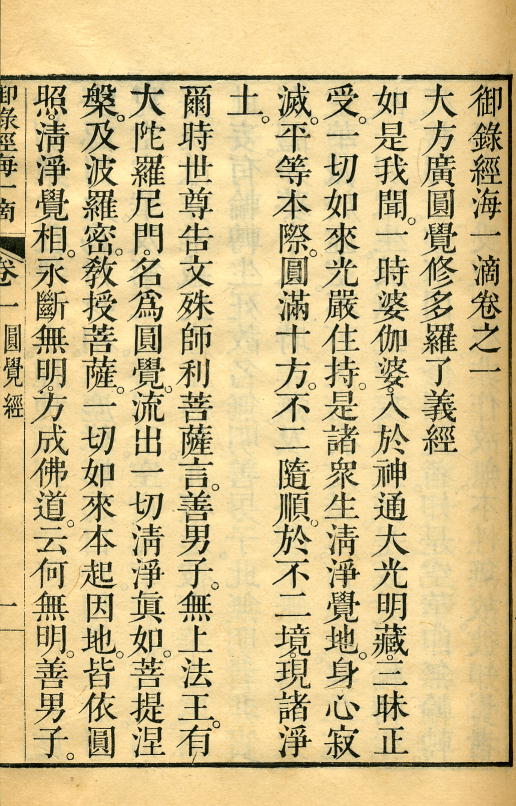
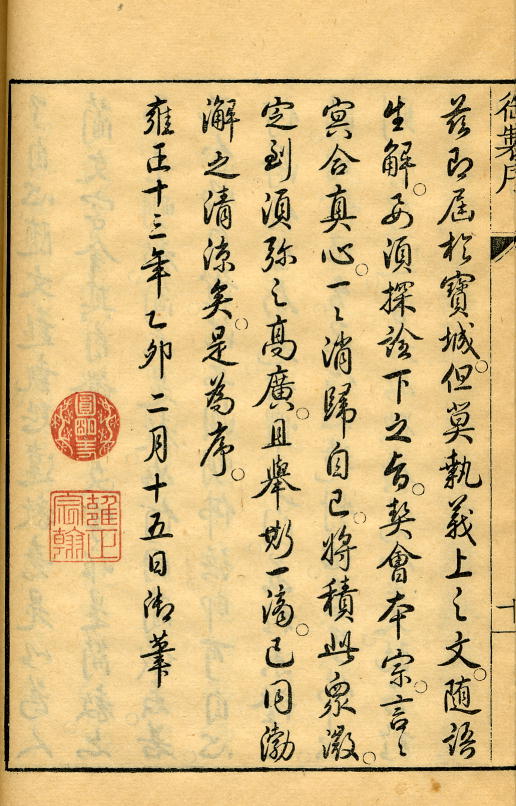
It was written by Yinzhen 胤禎, the third emperor of the Qing dynasty and a devout Buddhist. In 1732 he had the Yonghegong 雍和宮 palace in which he had lived before becoming emperor turned into the Lama Temple, which survives as one of Peking’s favourite tourist attractions, and in his final years instigated the publication of a number of Buddhist works. He personally compiled this distillation of twenty Buddhist sutras and aptly named it One drop from the sea of scriptures. It was printed in 1735, and in the same year he gave the order to compile the Longzang 龍藏 tripitaka, which was finished three years later under the Qianlong 乾隆 emperor in 1738. Unusually, as it contains no new material, One drop from the sea of scriptures was included in the Longzang, as the final work in the “works of this land” 此土著述 section (but here it is divided into 20 juan).

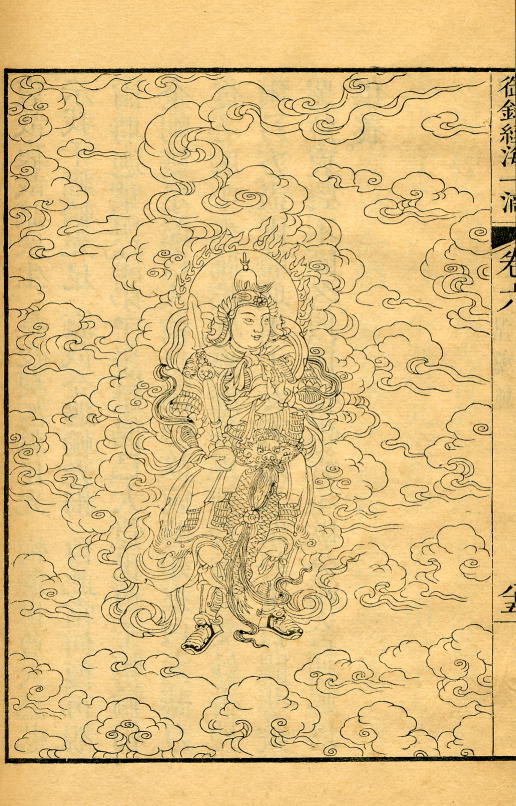
The edition was printed in the palace, and is a perfect example of the genre. It is modest in size, and printed on bamboo paper. The impression is crystal clear, and must have been taken from the blocks very soon after they were cut. There are two illustrations: the Buddha preaching the Law as a frontispiece, with Weituo (韋陀 or 圍陀), the guardian of Buddhist scriptures and libraries, at the end (as in the Guanyin ritual). These two illustrations are among the finest examples of Chinese woodcut of the period.

A Guanyin ritual

18 July 2012

Work on my project, and indeed everything else, was suspended for the second week of July while I attended the funeral of my mother-in-law in Japan. There are already one or two English accounts of Japanese funerals on the internet, but there is no harm in offering a different perspective, and my observations are both fresh and close, so I wrote down my recollections of the event with my netbook on the flight home last week (netbooks are perfect in the cramped conditions of economy class), and published them in my blog as soon as I returned.

I have now removed my account from the blog entry itself (but it is still visible here), as I felt not so much that the account was off-message (although it was), but that it was destroying the blog’s proportions and elegance. Removing it also helps to emphasise the fact, as if any emphasis were needed, that whatever is found on the internet is evanescent, and that the only way to time-proof it is to print it out.

At the funeral in Japan, while the Buddhist priest performed the rites, seeing him read sacred texts caused my mind to wander to our old Chinese books, and in particular to the scriptures and rituals of Buddhism and Daoism. These are well-represented in the Bodleian and other western libraries, for the simple reason that they were readily available to early western visitors to China, whereas the more respectable editions of the scholarly class and the imperial government were not. Conversely, owing to their lack of respectability, religious texts such as those that would have been used in a local temple are not commonly found in Chinese libraries.

Andrew West, in his masterly Catalogue of the Morrison Collection of Chinese Books (London, School of Oriental and African Studies, 1998), puts it thus (p.xvi): “[Morrison] … bought whatever books were available and affordable, with the result that the majority of books in his collection were the output of the contemporary publishing industry. These were precisely the books that Chinese collectors did not deign to collect, and hence which today are often more difficult to locate than ‘rare’ Ming editions.”

Furthermore, of the 893 records in the Morrison catalogue, 212 – approaching a quarter – are Buddhist and Daoist works (pp.169-237). The author’s classification and explanation of these texts in particular are essential reading for those who like me are attempting to document their own collections, as they are among the most difficult to comprehend.

There are two reasons for this difficulty. The first is linguistic, but as in other subject areas, the technical vocabulary of Buddhism and Daoism although large is limited, and with application can easily be learned, even if the precise meaning of the concepts they express is elusive; the second is more serious, as it concerns the book as an object, and how it was used.

The following richly illustrated Buddhist work in the Bodleian collection is one of the best of its kind, and is a case in point. I bought it from Han-Shan Tang (London) in 2003, and have not found it in any other library, whether Chinese or western:

大悲懺儀合節 一卷. 附 大悲經咒繪像 一卷. 大悲出真言 一卷
清中葉後期(?)刊本
板存成都文殊院
線裝2冊 : 圖 ; 32公分
Sinica 4015

According to the colophon, the owner of the blocks was the Wenshuyuan temple in Chengdu. This temple was founded in the Tang dynasty, and is still in existence; it is the best preserved temple in Chengdu, and a major tourist attraction. Most likely the Wenshuyuan was also responsible for cutting the blocks, and before that, assembling and editing the text. I have guessed the date on the basis of the book’s appearance – there is no date anywhere in the text, and there is no preface.

In Oxford, this book is far removed from its context. To know how it was used we would have to be present among the clergy and congregation of the Wenshuyuan at the time it was produced, just as I was at the Japanese funeral. There, I saw the large folded sheet from which the priest read out the canonical name of the deceased, so that if I found such a document in our collection, I would now know not only what the text was, but also exactly why the document was produced and how it was handled at the ceremony.

In the case of Sinica 4015, I can only attempt to explain its contents. I have no idea how it was distributed (was it sold, or was it for free distribution?); to whom it was distributed (everyone, or just the clergy?); or how it was used (like a Christian missal at a religious ceremony, or for private study in preparation for the ceremony?).

Sinica 4015 has been restored in jinxiangyu 金鑲玉 format, and is now presented in two volumes, containing three different and separately paginated sections. However, the title on the first leaf of one of the volumes has left an impression on the blank final half-leaf of the other volume, so that we know not only that the two volumes were originally bound together, but also in what order. Restored books are often interleaved, as here, with the result that their volume is doubled, so that in catalogues, even greatly different volume counts of the same title cannot be taken to indicate different editions.

The work’s three sections are presented in this order:
1. 大悲經咒繪像. 45 leaves.
2. 大悲出真言. 22 leaves.
3. 大悲懺儀合節. 20 leaves.

The main section

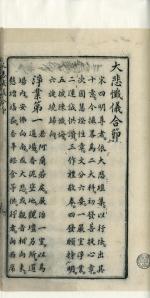
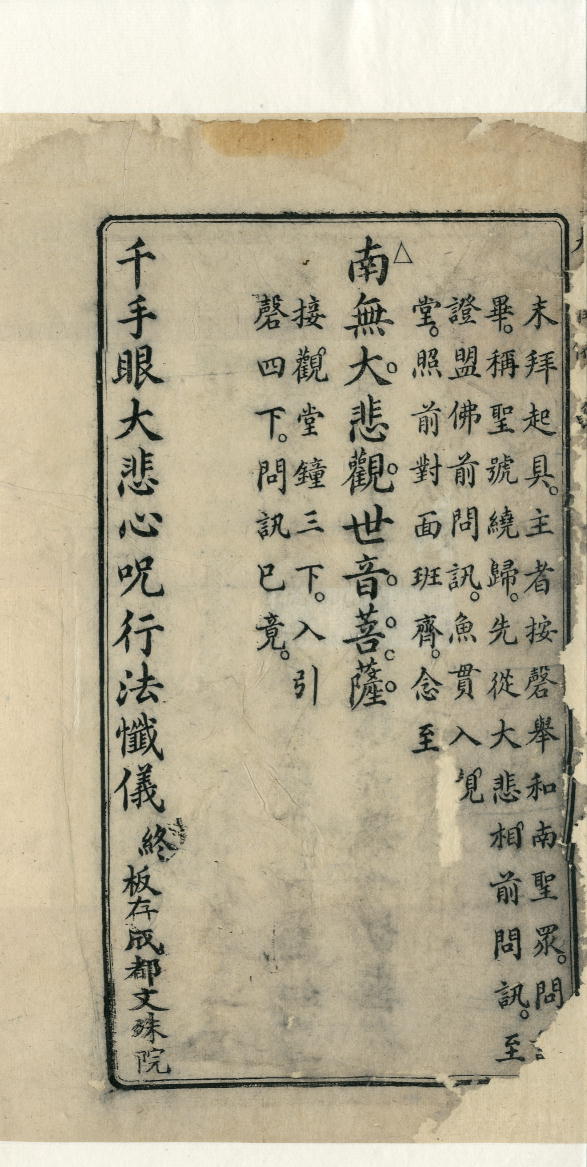
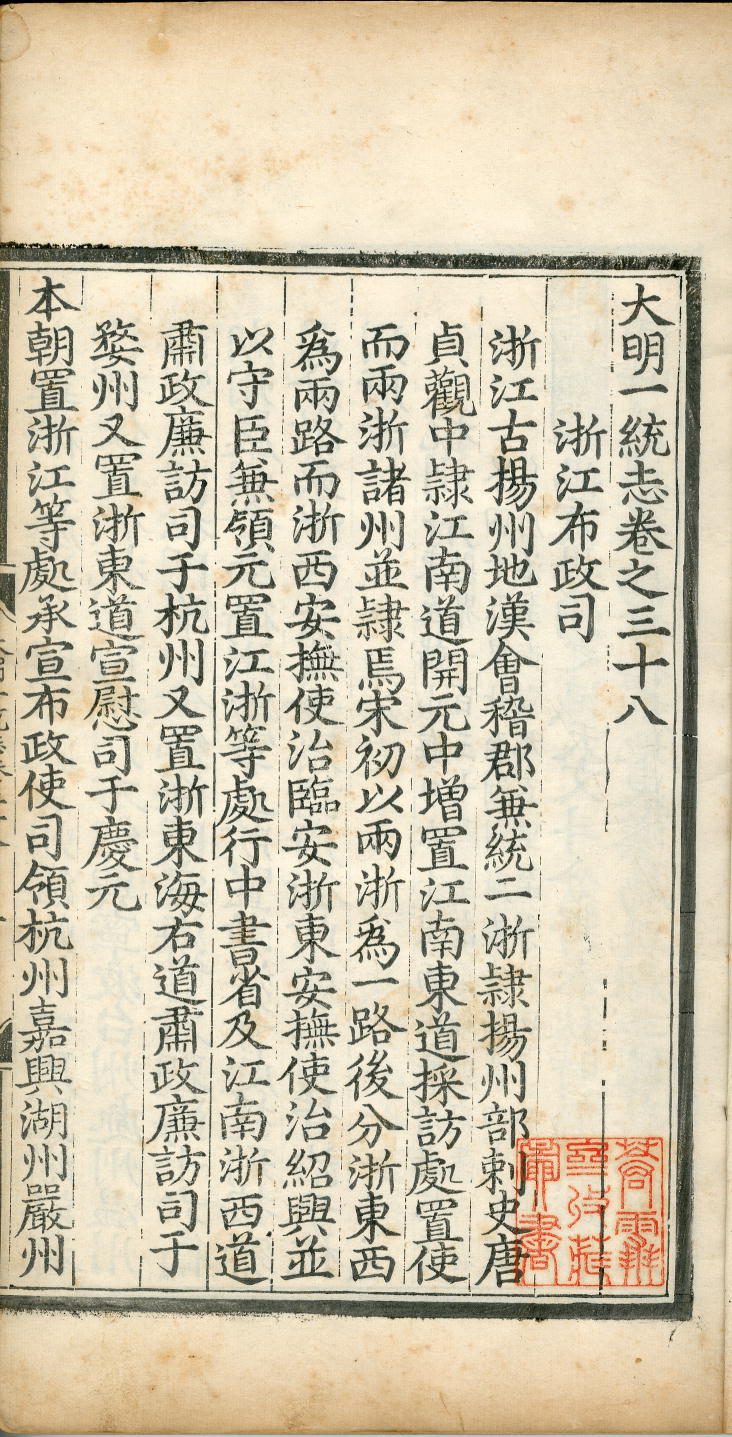
This order notwithstanding (works described as “appended” 附 in Chinese bibliography often precede rather than follow the main title), I consider the third section to be the main title in this edition, on account of both its content and its presentation: it is the only one to have its title presented at the beginning and end of the text in the conventional way (《大悲懺儀合節》 at the beginning and 《千手眼大悲心咒行法懺儀》 at the end), and the only one to have its title in the banxin 版心 of each leaf; the banxin of other two sections are completely blank. Also, the only evidence of the edition is found on the final page of this section (illustrated above, together with the first page). The text has six parts, and describes how to perform the Guanyin “confessional” ritual; chan 懺, from the Sanskrit kṣamayati, is defined by Soothill as “to ask pardon” (p.478). This includes a recitation of the all-powerful Dabeizhou 大悲咒, or Dhāranī of Great Compassion, the most powerful means of invoking the deity. The six sections are (1)淨業 (2)供讚 (3)禮敬 (4)持明 (5)懺悔 and (6)歸向, and I am leaving it to others to provide a detailed account of them.

The first appendix

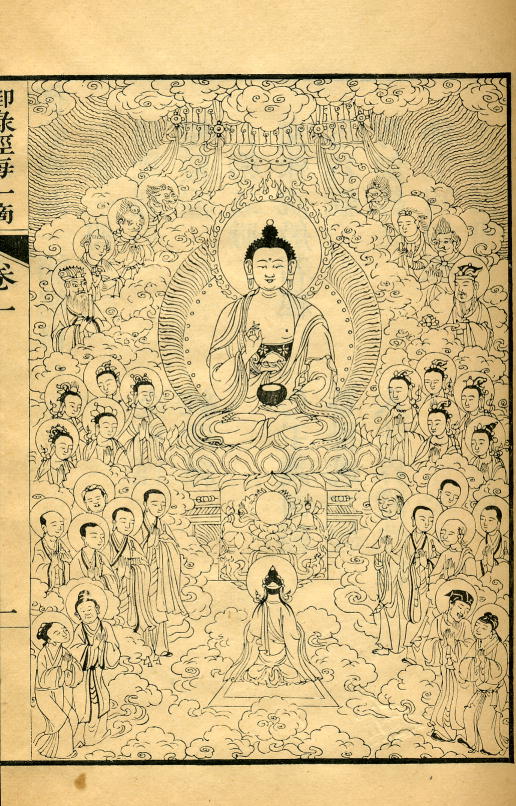
The edition opens with the first of the two “appended” works, which is an illustrated exposition of the text of the Dabeizhou. The pietistic writer John Blofeld has said of it: “So powerful is this dhāranī, especially when recited under such circumstances as those I am describing [at an annual Guanyin ritual in a large temple on the coast near Amoy], that one’s consciousness, borne aloft by the flow of mantric sound, soars upwards to a sphere of marvellous luminosity”. (Bodhisattva of Compassion, 1977, p.109). The mantra was translated into Chinese in the Tang dynasty from the Sanskrit, which is now lost, so that the current Sanskrit text has been reconstructed in modern times from the Chinese. The words are apparently meaningless, but are taken as an invocation of (or an appeal to) 84 bodhisattvas and other deities, each of which is illustrated; the illustrations are of some quality, and are followed by an illustration of Weituo (韋陀 or 圍陀), the guardian of Buddhist scriptures and libraries, which is often postfixed to works of this kind.
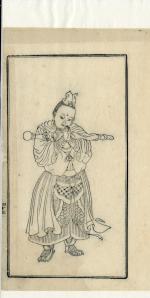
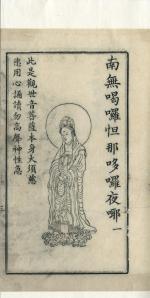
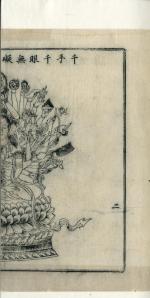
There are two interesting illustrations at the front of this section (the first two leaves of the whole book). The first is of what Blofeld (p.128) calls the “visualisation” (meaning mental picture) that one should have in one’s mind when reciting the mantra Oṃ maṇi padme hūṃ (an ma ni ba mi hong 唵嘛呢叭彌吽), moving with each syllable from the heart, through the left shoulder, the throat, the right shoulder, and the navel, to the head, so that one’s body, speech, and mind are transformed into the body, speech, and mind of Guanyin.
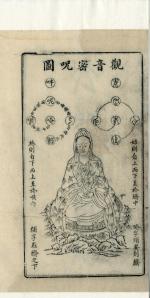
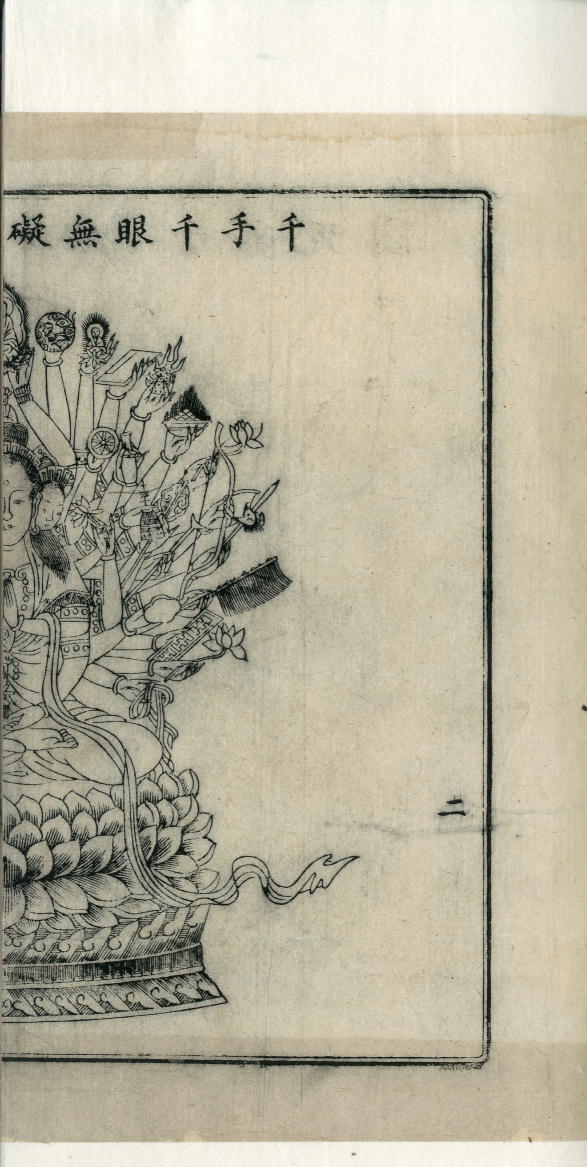
The second illustration is of the thousand-armed Guanyin, who is conventionally depicted with 42 arms, each of which holds one of the instruments of salvation.

The second appendix

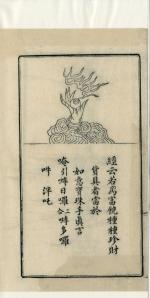
This is an illustrated account of these 42 instruments, the words being derived from scripture, as evidenced by the introduction to each explanation with the words 「經云 …」 . A search of the Chinese Buddhist Electronic Text Association’s (CBETA) full-text database suggests that the sutra whose words most closely match both these, and the words of the Dabeizhou in the first appendix, is 《千手千眼觀世音菩薩大悲心陀羅尼》 (Taisho Tripitaka 大正新脩大藏經 vol.20, no.1064).
Not only have I so far found no other copy of this edition, but I have not even found any pre-modern edition at all with the title 《大悲懺儀合節》, with the single exception of an edition that was auctioned in Peking in 2011 and which is clearly from different blocks, being described as 「清咸豐五年[1855]易居齋刊本」. But the text of the main part and its appendix seems so basic that it may have been published with other titles. I’m hoping that readers with a greater knowledge of this subject will tell me.
A Parliamentary Blue Book

11 June 2012

The second Professor of Chinese in the University of Oxford was Thomas Lowden Bullock.

Bullock had studied at Winchester and New College, from which he made a natural progression into the Consular Service. He served as British Consul in Formosa (as it was then known) for most of the 1870s, and then in various mainland locations until he was forced to return to England on the grounds of ill health in 1896. He was appointed to the Oxford chair in 1899 (two years after the death of the first professor, James Legge) which he occupied until his own death on 27 March 1915 at the age of 69.

The Bodleian received twenty Chinese books from his estate on 7 December 1915, and this is among them:

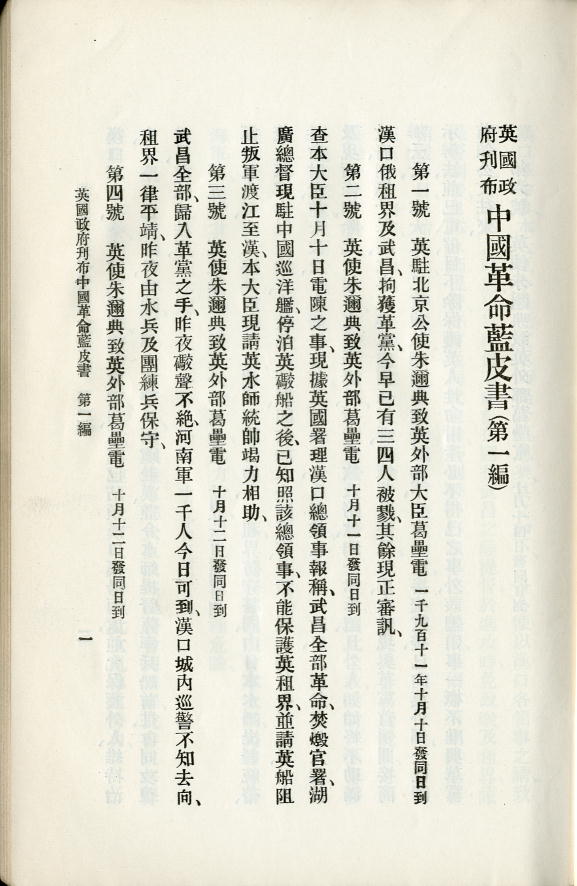
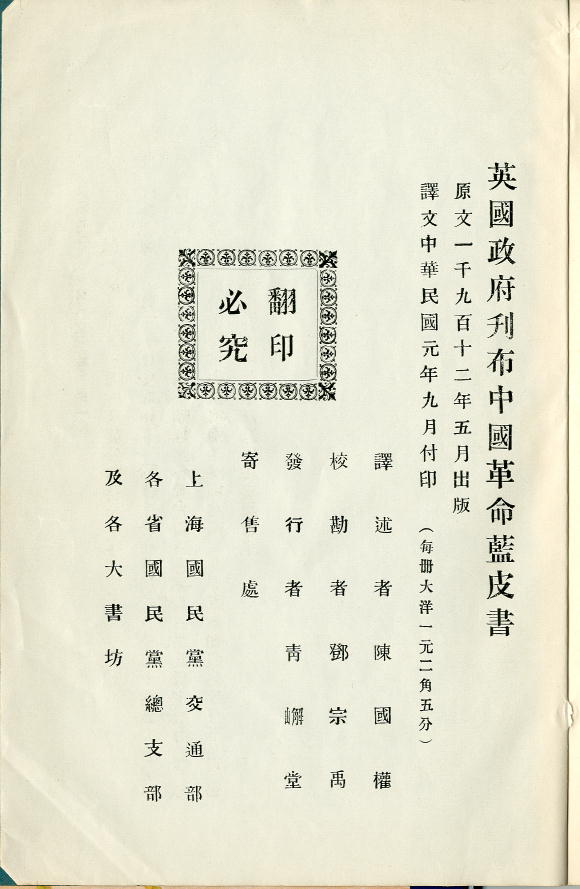
新譯英國政府刊布中國革命藍皮書 / (民國)陳國權譯述 ; (民國)鄧宗禹校勘
民國二年[1913]排印上海青嶰堂發行本
平裝1冊([6], 24, 196頁) ; 23公分
Sinica 2484

The presence of this item in my blog invites the question, what is an “old Chinese book”? A while ago, when asked what materials I would put into the Sinica Collection, I came up with this list of criteria for inclusion:

1. Language
All works added to the collection must be in Chinese. Exceptions are only made for the purpose of keeping historic collections together, and then only when the number of non-Chinese items is very small.
2.Date
Works dated 1911 or earlier, or
3.Production method
Works produced by traditional methods, even if later than 1911, or
4.Rarity
Works of exceptional rarity, or
5.Value
Works of exceptional monetary value (which usually makes them rare).

These criteria make the collection “special”, but not necessarily “old”, and I think few librarians would disagree with them. The book described above is undoubtedly special, as I will show in a moment, but not really “old” by the definition “1911 or earlier”.

In an attempt to circumvent this arbitrary date-setting, I came up with the expression “pre-modern” to define my project, but there are difficulties even with that. By “pre-modern”, I meant books that were composed more or less entirely within the limits of traditional Chinese civilisation, before the significant intrusion of western thought-patterns. This would allow me to include, for example, Piet van der Loon’s large collection of Cantonese muyushu 木魚書, most of which were published in the Minguo 民國 period, many of them in Hongkong as late as the 1950s and 1960s. But what about the works published by the Jesuits in the 17th century, which were published entirely outside the limits of traditional Chinese civilisation? Here we must revert to my earlier set of criteria.

And so the standard is fluid, and boils down to personal judgement. The only qualification for inclusion possessed by the book I have described is that it is rare. Having searched the main online Chinese union catalogues (principally CALIS, NII, and WorldCat) and many more besides, I have so far found only a single copy apart from ours, in Tsukuba University Library 筑波大学附属図書館 in Japan.

The colophon provides the following information regarding its distribution:
寄售處
上海國民黨交通部
各省國民黨交通部
及各大書坊

I don’t know what is meant by “large book shops”, and it is odd that no American library seems to have a copy. That it was sold on the market is attested by the printed price (每冊大洋一元二角五分), but Bullock presumably got his copy through a personal contact, perhaps one of his old friends in the Consular Service.

As an early reaction from a major western government to the first Chinese Revolution, the text of this British Parliamentary Blue Paper was considered sufficiently interesting to be reprinted in 1968, when it was reproduced together with a work entitled 「辛亥革命與列強態度」, being translated selections from a later German work on the same subject, Die grosse Politik der europäischen Kabinette, 1871-1914 (Berlin, 1927); this combined edition was reprinted again in 1983.

I will not dwell on the appalling visual mess which greets the reader who wants to examine the details of this edition in WorldCat, which require a full three pages to print out. But it you persevere, you will find that all the entries give the date of the original Chinese edition of the Blue Paper as 1912 (民國元年). So do the entries in all the other online catalogues.

The most concise and intelligent publication note is in the National Library of China’s catalogue entry, and reads 「原文1912年5月出版,译文中华民国元年(1912年)9月付印」, that is, sent to be printed in September 1912, not necessarily completed in that year. Actually, the printing could scarcely have been completed in 1912, and certainly not in September, because the prefaces of Sun Wen 孫文, Wu Tingfang 伍廷芳, and Wang Chonghui 王寵惠 are dated 21 December, 18 December, and 25 November respectively. The calligraphic title-page and cover are clearly dated 1913 (民國二年).