Archive for the 'Uncategorized' Category

Five classics, Four books

2 June 2015

In the Backhouse Collection there is an edition of the Wujing sishu 五經四書, the most important sections of the Confucian canon and essential reading for anyone about to take the official examinations. This edition has puzzled me for over thirty years. During that time – I can’t remember when, where, or how – I came across a catalogue entry for an edition in the Bavarian State Library which I thought might be the same as ours.

Last month, I was able to see the Munich edition, and it is indeed identical. To judge by the quality of the impression, it may be a little later, but not much. Putting my conclusion before the reasoning, if it were in Oxford I would catalogue it as follows:

五經四書讀本
清雍正中北京國子監刊本
線裝33冊 ; 31公分
4° L.sin. C 16

周易 四卷 / (宋)朱熹本義
書經 六卷 / (宋)蔡沈集傳
詩經 八卷 / (宋)朱熹傳
禮記 十卷 / (元)陳澔集說
春秋 三十卷 / (宋)胡安國傳
大學 一卷 / (宋)朱熹章句
中庸 一卷 / (宋)朱熹章句
論語 十卷 / (宋)朱熹集注
孟子 七卷 / (宋)朱熹集注

Actually, we have two copies of this edition, but both are incomplete. I was once tempted to shelfmark them together, but this would have been quite wrong as although the paper of both text and covers is the same, as is the thread and the silk used for the corner protectors, the fascicles differ in size by a few millimetres. Also, the seals and tao 套 show that they are ultimately of different provenance (we can ignore the manuscript label 「殿本四書」; if labels were an indication of contents, we would have Song editions – we have none).

fcfb-01

The “Five Classics” were originally shelfmarked separately, but as these are obviously part of a set, I have amalgamated them, and now catalogue our copies as follows:

五經四書讀本 殘五經
清雍正中北京國子監刊本
線裝25冊 ; 28公分
Backhouse 36

周易 四卷 / (宋)朱熹本義
書經 六卷 / (宋)蔡沈集傳
詩經 八卷 / (宋)朱熹傳
禮記 十卷 / (元)陳澔集說
春秋 三十卷 / (宋)胡安國傳

五經四書讀本 殘四書
清雍正中北京國子監刊本
線裝5冊 ; 27公分
Backhouse 229

大學 一卷 / (宋)朱熹章句
中庸 一卷 / (宋)朱熹章句
論語 十卷 / (宋)朱熹集注
孟子 七卷 / (宋)朱熹集注

In his list of Palace editions (清代殿板書目), the authoritative Republican period bibliographer Tao Xiang 陶湘 inverts the sequence of the two sections of this work in the overall title, calling it Sishu wujing duben 四書五經讀本; and unusually (because for the most part it’s simply a list) he goes into some detail about the edition.

It was supplied to the Guozijian 國子監 (the “Imperial Academy”) and the Baqi Guanxue 八旗官學. The latter was a department of the Guozijian set up in the first year of the dynasty (1644) to educate the offspring of the Eight Banners who were not members of the imperial family. It was also supplied to provincial academies and commercial publishers, who used it as a model for their own editions, which were therefore popularly known as “Academy editions” 監本. When first published, the Chunqiu 春秋 was the version with Hu Anguo’s commentary, as shown above, but during the Qianlong period this was replaced with the Zuozhuan 左傳, and Hu Anguo’s commentary fell into disuse.

In view of all this, it is extraordinary that complete sets of this edition (as distinct from copies of the individual works in it) seem to be rather rare. Other than the Munich and Oxford copies, from both printed catalogues and online databases I have only been able to find copies in the following libraries:

吉林大學圖書館
遼寧省圖書館
吉林省圖書館
故宮博物院圖書館

The entry in the descriptive catalogue of government editions prepared by the National Palace Museum Library and Liaoning Provincial Library (清代內附刻書目錄解題, 紫禁城出版社 1995, 18-19) is based on the copies in those libraries, and corresponds with the Munich and Oxford copies in all but one respect: it describes the text frame as having a double border (雙邊), whereas ours is single (單邊), and so does the entry in Weng Lianxi’s 翁連溪 illustrated catalogue of government editions (清代內附刻書圖錄, 北京出版社 2004, 3). The descriptions in the two catalogues are identical, and one must have been copied from the other, or both from the same source.

In WorldCat however, the Liaoning copy is described as having a single border 單邊, like the Munich and Oxford copies. Furthermore, both the CALIS database and WordCat record a copy of the Shijing 詩經 from this edition in the library of the University of British Columbia in Canada which is also described as having a single border. So it seems clear to me that the Chinese printed catalogues are mistaken.

So how do we know that the copies in Munich and Oxford are of the same edition as those in China? In the edition itself there is nothing to help us. The overall title is invented, and there is no prefatory material relating to the edition, only the standard short prefaces to each individual work.

We could make a start with the date, because the edition is a simple, classic example of how works can be dated by examining taboo characters, especially during the reigns of the Kangxi 康熙, Yongzheng 雍正, and Qianlong 乾隆 emperors, when the observance of taboos was particularly strict.

It cannot have been made earlier than the Kangxi period, because the taboo of the first character in the emperor’s personal name, Xuanye 玄燁, has been avoided by omitting the final stroke of the character:

fcfb-02-yi-1-13b   周易 1:13b

Nor can it have been made earlier than the Yongzheng period, because the taboo of that emperor’s personal name, Yinzhen 胤禎, has been similarly avoided:
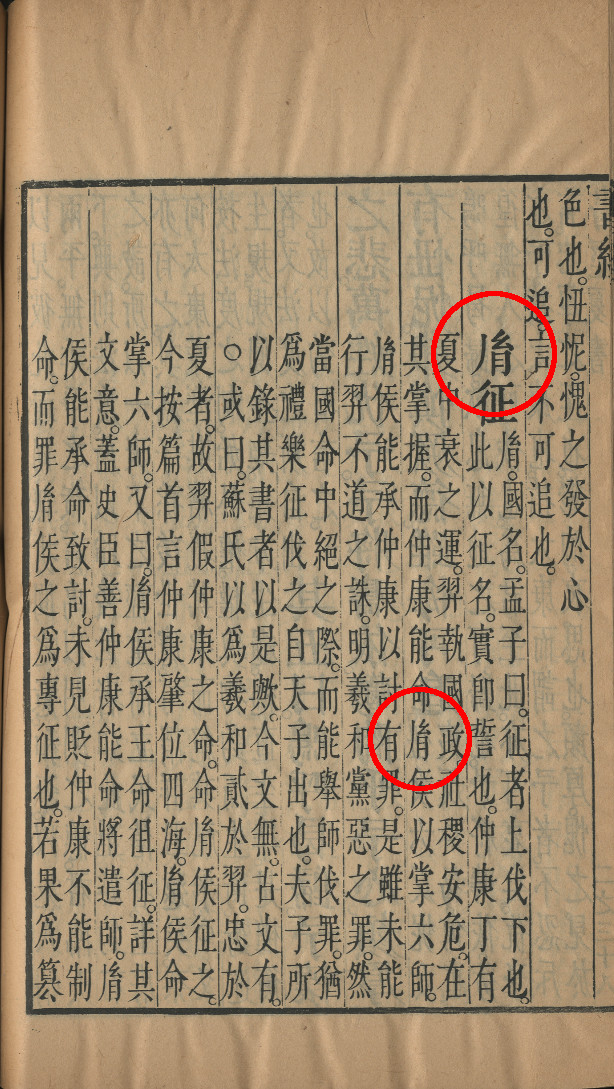
fcfb-04-shu-2-38b   書經 2:38b

The taboo of the Qianlong emperor’s personal name Hongli 弘曆 is not observed:

fcfb-06-lun-4-13b   論語 4:13b

This does not necessarily mean that the edition was not made in his reign, as only in the thirteenth year (1748) was the order given to avoid the taboo of his personal name by omitting the last stroke. But it is generally reckoned that the edition was made during the Yongzheng period, and the taboos do not preclude that.

We have copies of individual works made from this edition later during the Qing dynasty, and it is instructive to compare them with the orginal edition, and to note how the taboos have been treated.

For example, in this edition of the Shijing, the taboo of Qianlong’s name has indeed been observed:

詩經 八卷 / (宋)朱熹傳
清嘉慶十年[1805]刊本
線裝4冊 ; 29公分
Sinica 2607

fcfb-07-shi-5-20a   fcfb-08-shi-5-20a
詩經 5:20a; L: 監本, R: 嘉慶十年本

And consistent with the Jiaqing date of this edition, we find that the taboo of the Jiaqing emperor’s name Yuyan 顒琰 is also avoided:
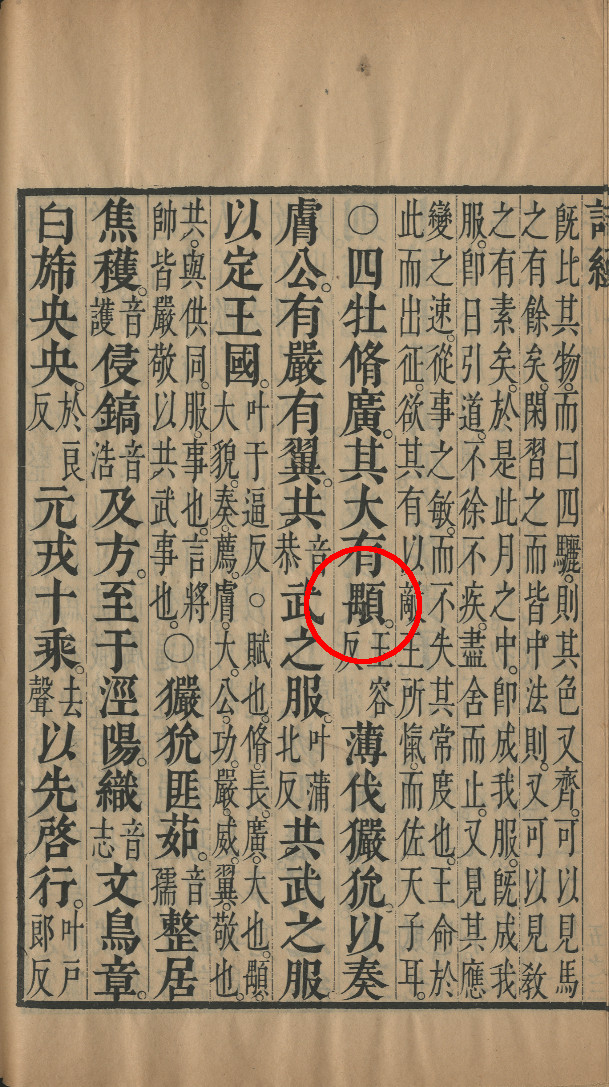
fcfb-09-shi-5-3b   fcfb-10-shi-5-3b
詩經 5:3b; L: 監本, R: 嘉慶十年本

However the character ning 寧 in the personal name of the Daoguang emperor, Minning 旻寧 is not replaced with ning 甯, which it invariably is in even the Protestant missionary works that were printed in Ningbo (甯波 for 寧波) in that period:

fcfb-11-shi-3-10a
詩經 3:10a

By contrast, in this edition of the Liji:

禮記 十卷 / (元)陳澔集說
清嘉慶辛未[1811]刊本金閶多文堂發兌
線裝10冊 ; 27公分
Backhouse 183

the original edition has been copied without observing the taboo of the Qianlong emperor’s name in the only place in the text where it occurs:

fcfb-12-li-7-31b   fcfb-13
禮記 7:31b

But if we have a Jiaqing edition which doesn’t observe the later taboos (and at this time the observance of taboos was not very strict), how can we be sure that the Munich and Oxford copies are not also a later edition? I believe that a single leaf in one of the Oxford copies provides the answer to that. It is the first leaf of the Four books section:

fcfb-14

A large square seal has been excised in the upper half of the leaf and the text replaced in manuscript; and in the bottom right corner, a large vertical seal has been excised and replaced by a new owner’s seal.

What I believe are the same seals are to be found on different pages in this palace edition, and in the same position:

欽定四書文 存化治六卷正嘉六卷隆萬六卷啟禎六卷 / (清)乾隆五年[1740]弘晝等奉敕編
內府刊本
線裝9冊 ; 28公分
Backhouse 5

fcfb-16   fcfb-15

The seals are 「國子監印」 and 「國子監八學官書」, the Imperial Academy and the Baqi Guanxue, precisely the establishments that Tao Xiang says the edition was made for.
Yongle dadian – 3

29 May 2015

Most of the extant parts of Yongle dadian were published by Zhonghua Shuju in 1960, when 730 juan were reproduced in reduced format in 202 ce, contained in 20 han. This publication was continued in 1984 when a further 67 juan were added in 20 ce, contained in 2 han. I catalogue the complete work as follows:

永樂大典 / (明)永樂中解縉等奉敕撰
北京 : 中華書局, 1960-1984
線裝222冊 ; 20公分
影印嘉靖隆慶間內府重寫本殘卷
內容:
第1-20函 永樂大典 殘七百三十卷. – 1960.-  202冊
第21-22函 永樂大典 殘六十七卷. – 1984. – 20冊

Since then, other parts have been discovered in various places, and have been published from time to time either singly or in groups. The Bodleian has recently digitised all its holdings, which can be seen here. A single volume in the Staatsbibliothek zu Berlin has also been digitised and made available online.

A group of hitherto undiscovered volumes was published the year after the 2002 conference in Peking:

海外新發現永樂大典十七卷 / 胡道靜撰序 ; 許中毅, 余嵐責任編輯
上海 : 上海辭書出版社, 2003
精裝1冊 ; 30公分
ISBN 7-5326-1285-6

I must confess to having been rattled by this, as three of the volumes it reproduces are in Ireland, and I thought I’d taken full stock of what is located in European libraries; now, I had to start again.

It is irritating that no details are given as to the precise whereabouts of the volumes, only the countries where they are located. But I suppose this is a little better than the Zhonghua Shuju edition, which gives no details at all. Thus we are told that of the 17 juan reproduced, 2 are in America, 2 in Japan, 5 in England, and 8 in Ireland.

Those in England are contained in two volumes in the British Library, and a colleague told me that the ones in Ireland were in the Chester Beatty Library. Later, a little searching on the internet quickly revealed the locations of the volumes in America and Japan. Here they are, seven volumes in total:

  1. juan 803-806 — Chester Beatty Library (Republic of Ireland)
  2. juan 8569-8570 — Kurokawa Institute of Ancient Cultures 黑川古文化研究所 (Kobe 神戶, Japan)
  3. juan 10110-10112 —  Chester Beatty Library (Republic of Ireland)
  4. juan 13201-13203 — British Library (United Kingdom)
  5. juan 14219-14220 — British Library (United Kingdom)
  6. juan 15957-15958 — New York Public Library (United States of America)
  7. juan 19866 — Chester Beatty Library (Republic of Ireland)

Actually the last of these, containing juan 19866, had already been reproduced by Zhonghua Shuju in 1984, but page 8a had been omitted, perhaps because it was accidentally omitted when the photostats were being made in 1931. The Shanghai reproduction makes good that omission.

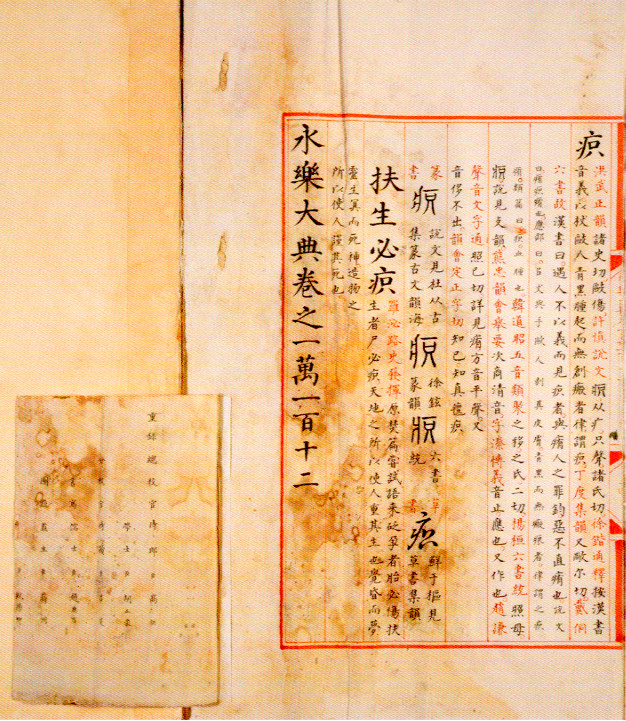
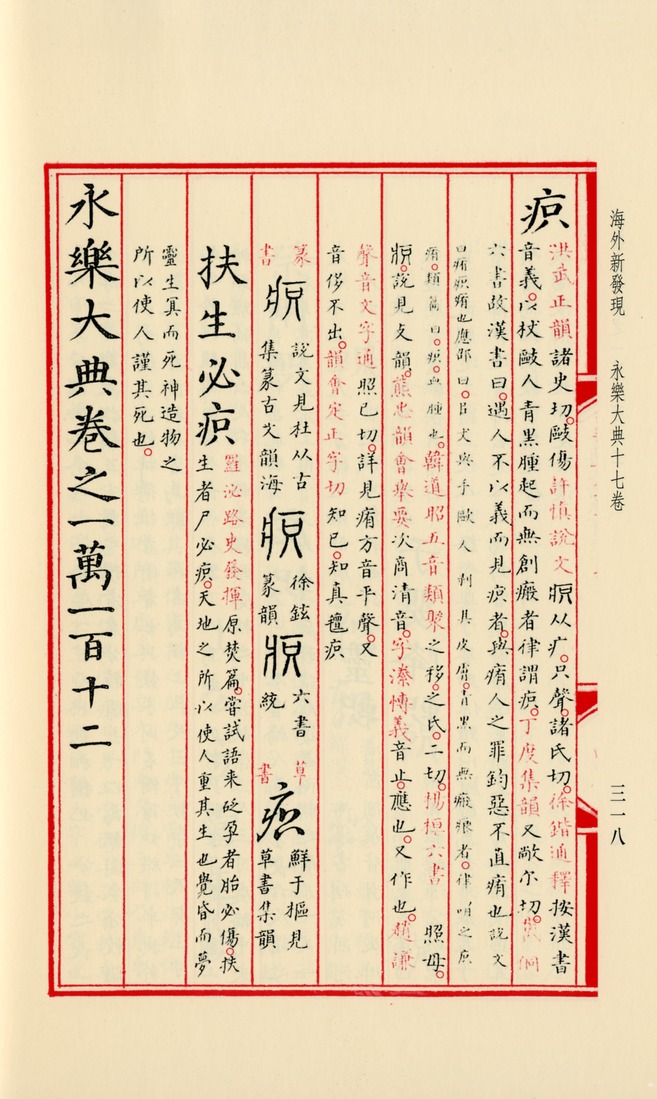
Unfortunately, as in the Zhonghua Shuju edition, only the text is reproduced, not the matter that appears before or after it. Thus we lose the Siku quanshu forms (see Yongle dadian – 2) as well as any inscriptions and details of provenance. Whether by accident or design, the history of these volumes has been erased.

So we find that the extensive water damage that resulted from the British action to extinguish the fire that had been started by the Boxers has been airbrushed out. This is particularly obvious from the last leaf of one of the Chester Beatty volumes –  I reproduce the image from Shane McCausland’s Copying and transmitting, knowledge and nonsense (in Original intentions : essays on production, reproduction, and interpretation in the arts of China, University Press of Florida  2012) alongside the Shanghai Cishu Chubanshe version:

sac250a shcscbs1

The images have also been heavily edited in other ways. For example, instead of reproducing each page as photographed, the black text has been extracted and an identical red frame superimposed on it. This may be because the editors were working from black and white or greyscale images, and wanted to reproduce the appearance of the original. But in the case of one of the Chester Beatty volumes, absurdly, a red text frame has even been printed over an illustration:

sac249 shcscbs2

Most recently, the Bodleian has received visits from Li Honglin 李虹霖, Deputy Director of the National Library of China, and Fang Zijin 方自金, Director of the National Library of China Publishing House. Their aim is to produce a full-size facsimile of all extant volumes of Yongle Dadian, and to that end last week we presented them with high-resolution scans of all 19 volumes in our library. As mentioned above, these are already accessible online, and were included in the Zhonghua Shuju’s printed edition in 1960. We still have a copy of the microfilm from which this edition was made. It was produced for us in the 1950s by Oxford University Press, presumably because at that time we didn’t yet have our own filming studio.

It will be interesting to see how the National Library’s facsimile turns out. I’m on the lookout for airbrushing, as a very prominent inscription which defaces the first leaf of the volume containing juan 14607-14709 (MS.Chin.b.9) leaves its history in no doubt:

“Peking 1900. One volume from a Chinese Encyclopaedia found in the ruins of the Hanlin Library during the Boxer rising, 1900 … which the Chinese burnt in the expectation that its flames would set fire to adjacent British Legation buildings. T. Biggin.”

The bronze man

21 May 2015

On Friday 8 July 2011 I moved out of my office in the New Library in Broad Street having worked there since Monday 5 April 1976 sitting at a desk in the same corner of the same room, a continuous occupancy of more than thirty-five years and almost certainly a record.

In August 2011 work started on the redevelopment of the New Library into what is now called the Weston Library, and was sufficiently complete to enable me to begin the move to my new office there on Monday 6 October 2014. I suppose it’s doubtful that I’ll occupy my new office for quite as long as I occupied the old one.

In the meantime, the special Chinese collections (that is, the materials that are the subject of this blog) were temporarily housed in the basement of the Radcliffe Science Library, and my office was in the Library’s building on Osney Mead. Although this building isn’t in the centre of town, it’s not that far out, and was actually rather pleasant once one had recovered from the shock of working on an industrial estate. I had a beautiful view of the river and its willows from my window, and my commuting time was halved to three minutes and 45 seconds by bicycle.

One of the jobs I undertook before moving out of the New Library was to sort out the Oriental Department’s collection of rolls and other oddly shaped material, which was then crammed into a grill on L-floor at the very bottom of the building, three floors below ground level. The collection included a number of Chinese items, some of which I had never seen in over three decades of working with the collection – they were quite literally buried in other things, in dark and dirty conditions.

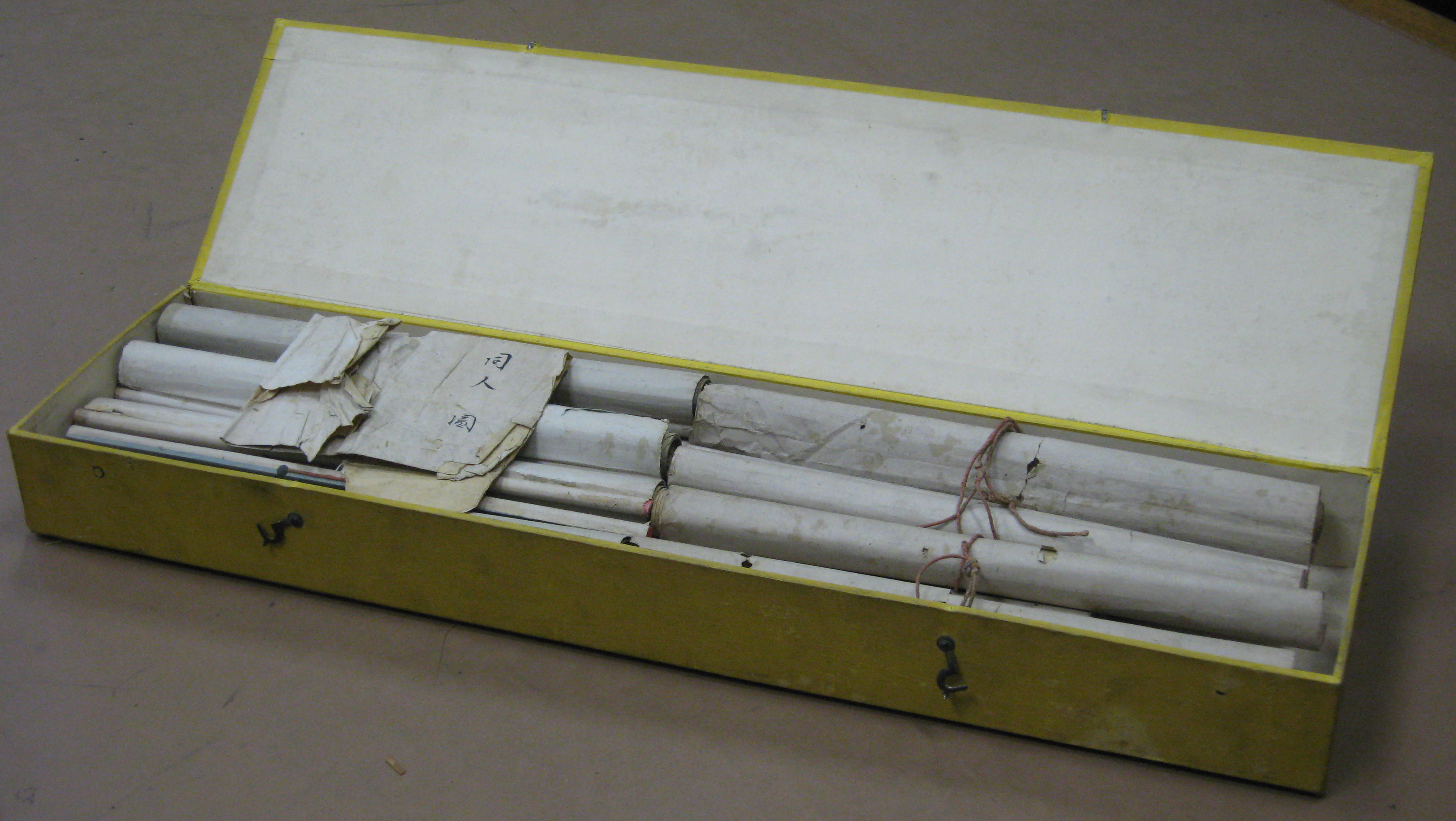
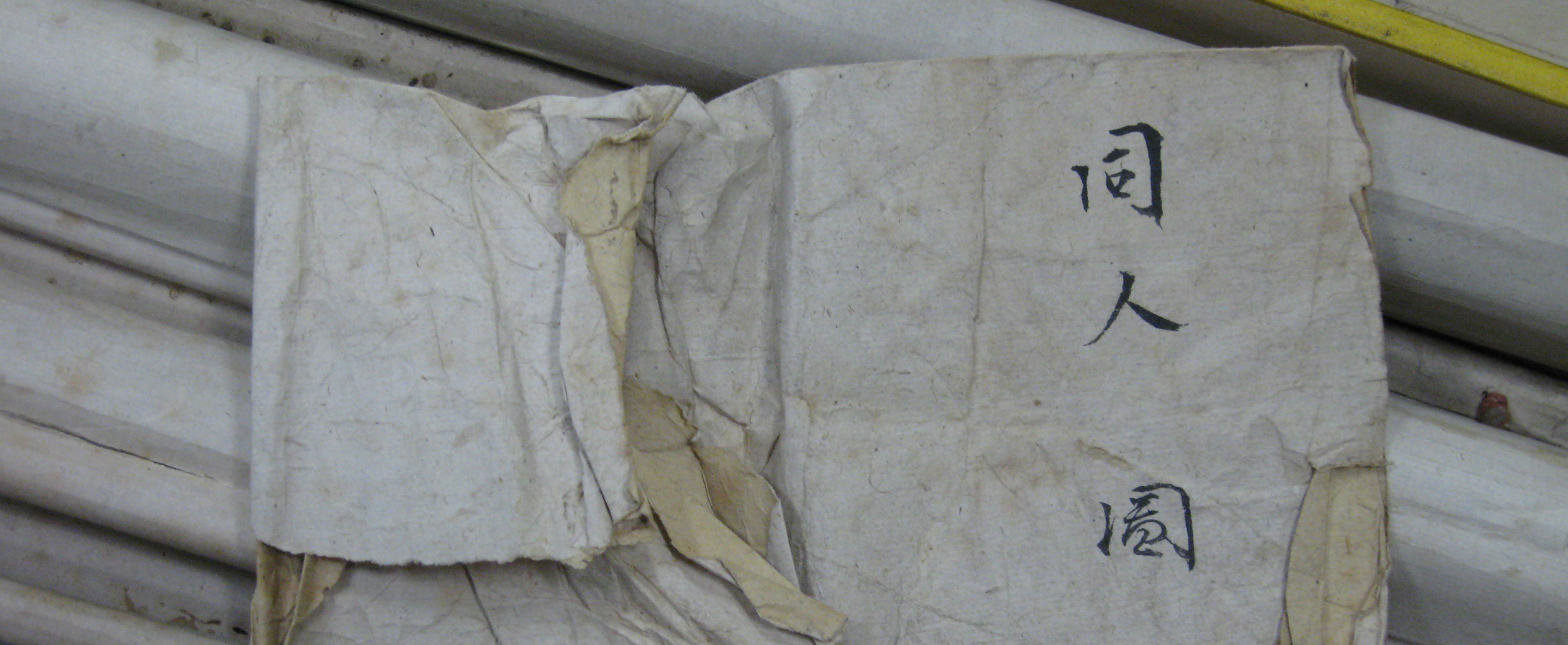
It was then, in the summer of 2010, that I first set eyes on what was then shelfmarked Chin.a.4. It was a yellow box bearing the words “Chinese anatomical designs”, and containing 12 rolled paper hanging scrolls stamped with the date 24 January 1907, but lacking any indication of provenance. Tucked into the scrolls was a scrap of paper bearing the three characters tongrentu 同人圖 (the first being a simplification of tong 銅), meaning “pictures of the bronze man”.

charts1

charts2

charts5

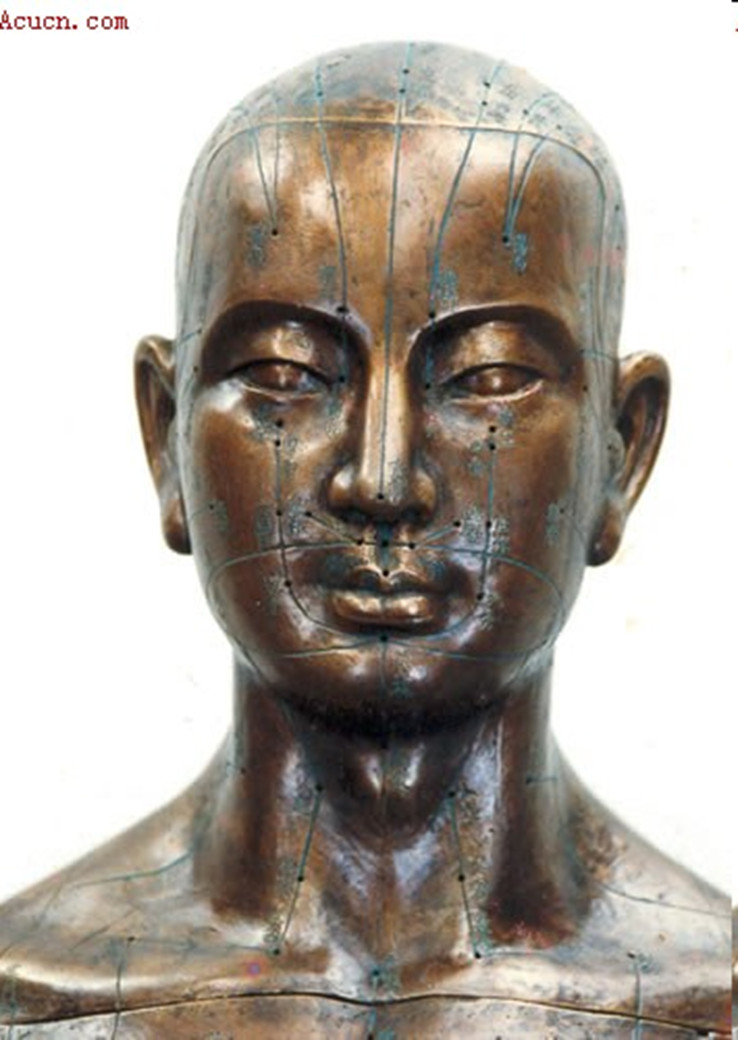
The twelve scrolls turned out to be three sets of acupuncture charts, each consisting of four scrolls, which I shall describe presently. These “pictures of the bronze man” are so called because the art of acupuncture was taught by using a hollow bronze model in which the acupunture points are represented by holes. Here is a photograph of such a model that I took two years ago in the National Museum of China (中国国家博物馆) in Tiananmen Square:

bronzeman1

The prototype was a life-sized model kept in the state medical college of the Song Dynasty (Yiguanyuan 醫官院). The model was covered with wax, thus sealing the holes, and was then filled with water. The examiner named a point, and if the candidate located it correctly with his needle, the water would flow out. If he located the hole correctly five consecutive times, he qualified.

The model disappeared when the Jin invaders overran Kaifeng – presumably it was looted and destroyed. But during the Ming, which is generally regarded as the heyday of acupuncture, many such figures were created, but not all of them life-size, and many are extant. Huang Longxiang 黄龙祥 and others have argued that the bronze man preserved in the Hermitage at St Petersburg is the only one to have been copied directly from the Song original [1].

Acupuncture charts are also called mingtangtu 明堂圖, meaning “pictures of the human body”. Needham explains the term mingtang in Celestial lancets (Cambridge, 1980, 100 note c). It originally referred to the ancient imperial cosmic temple or ritual palace, and from the Han onwards its use was extended to the body, and subsequently it appears in the titles of anatomical and physiological writings. This idea of the human body as a temple is, of course, not uniquely Chinese.

In another work, his compendious two-volume illustrated history of Chinese acupuncture, Huang Longxiang distinguishes two main series of what he calls “mingtang diagrams”, the first being “general diagrams”, and the second “diagrams of acupuncture bronze statues” [2].

I interpret this to mean that the first series of images is purely theoretical in the sense that from the start, the points and meridians were plotted in two dimensions on paper. The second series, on the other hand, is a two-dimensional expression of points and meridians that were originally plotted on a three-dimensional bronze man. It is clear that of our three sets of charts, two belong to the first series, and one to the second. I’ll call them Series A and Series B.

Series A

We have two closely related sets of these, described as follows in my catalogue, taking all details of authorship and imprint from what is clearly printed on them:

明堂圖 / (元)滑壽撰 ; (明)吳崑校
清乾隆壬寅[1782]吳郡魏玉麟刊
4幅 ; 106 x 33公分
Sinica 6335

明堂圖 / (元)滑壽撰 ; (明)吳崑校
清乾隆癸卯[1783]吳門鄒啟華刊
4幅 ; 108 x 34公分
Sinica 6336

The charts have been scanned, and the links at the shelfmarks give access to these scans. Clearly, they are the same in content and design, but are from different blocks.

There is a problem with their attribution to the famous Yuan 元 dynasty physician Hua Shou 滑壽. Huang points out that as there are significant points of divergence from the illustrations in his treatise Shi si jing fa hui 十四經發揮, they cannot possibly have come from his hand. But it is quite possible that Wu Kun 吳崑 was indeed the editor, as the illustrations are close to those in his Zhen jiu liu ji 針灸六集 and the text is mostly accurate.

I have found no record of either of these editions in another library. What I thought may have been a copy of the 1782 edition in the National Library of China turned out to be no such thing; it is reproduced in Huang’s book, and although it bears exactly the same imprint and is identical in format, it is clearly from different blocks and the titles of the charts are in seal script, not kaishu 楷書 as in the Bodeian copy.

A Google search for the printer “魏玉麟” and “明堂圖” will lead only to the apparently very well-known copy in the National Library of China and to our own, while a search for “鄒啟華” and “明堂圖” will currently lead only to the Bodleian. I can therefore only assume that our copies are either unique, or that others are lying somewhere uncatalogued, or even unnoticed, exactly like ours were for over a century.

Series B

I describe our set of charts from Huang’s second, “bronze statue” series as follows:

銅人明堂之圖 / (明)趙文炳繪製
清乾隆中覆刊康熙四年[1665]林起龍刊本
4幅 ; 112 x 56公分
Sinica 6334

Here is a detail from the first of the four charts, showing how it relates to an actual bronze man, using an image I found on the internet:

charts4

bronzeman3

Actually the first surviving charts to be taken from a bronze man were made by Shi Su 史素 on the basis of charts preserved in Zhenjiangfu 鎮江府 by the Song dynasty physician Shi Zangyong 石藏用. The blocks were cut in 1474 (成化十年) in the Ming medical college. Neither the Song dynasty charts nor the original printing of Shi Su’s charts are extant.

Shi Su’s charts were two in number, the bronze man from the front (正人) and from the back (伏人). Although a manuscript copy of the front view is preserved in Japan, we only have a modern reconstruction of the back view.

The first charts based on the bronze man in the Ming medical college, of which the Bodleian’s edition is a copy, were made in 1601 (萬曆辛丑) by Zhao Wenbing 趙文炳. Now, to the front and back views are added two side views – really 45° views, one from the front, the other from the back (正側、背側). There are no extant copies of this edition.

Zhao’s edition was re-cut in 1665 (康熙四年) by Lin Qilong 林起龍, a jinshi 進士 of the Shunzhi 順治 period, and I originally thought that Sinica 6334 might be an example of it. But I had failed to spot (or rather, to realise the significance) of the characters used for expressing the Wanli period (萬歷 for 萬曆). Clearly, our copy cannot have been printed earlier than 1760, when the order was given that the taboo of the characters in the Qianlong 乾隆 emperor’s personal name Hongli 弘曆 might be avoided by the use of homophones.

There is actually no extant copy of Lin Qilong’s edition, so that all surviving editions of Zhao Wenbing’s charts, including ours, are re-takes dating from the Qianlong period or later.


1. 黄龙祥: 圣·彼得堡国立艾尔米塔什博物馆藏针灸铜人研究, in 中华医史杂志 35:2(2005:4), 67-73.
2. 黄龙祥: 中国针灸史图鉴, 青岛出版社, 2003, 上卷:79ff, 200ff.

Canton operas

15 September 2014

In almost four decades of work in the Library, unlike a number of my colleagues, I have never had offers of voluntary work.

But earlier this year, an undergraduate by the name of Cameron Henderson-Begg, who has just completed his first year of study in Oxford followed by a year in China, asked if he might join us during the summer for some work experience. He is contemplating a career in curatorship, whether in a library or a museum, and wanted a taste of what might be on offer. This, too, is a first among the students who have passed through Oxford during my time here. We children of the sixties did what we fancied without a thought for the future (and at the time, for China there wasn’t one – it was a third-world country in total chaos with no sign of an end to it). How different are most of the present generation of Thatcher’s children, who have studied venality from the cradle!

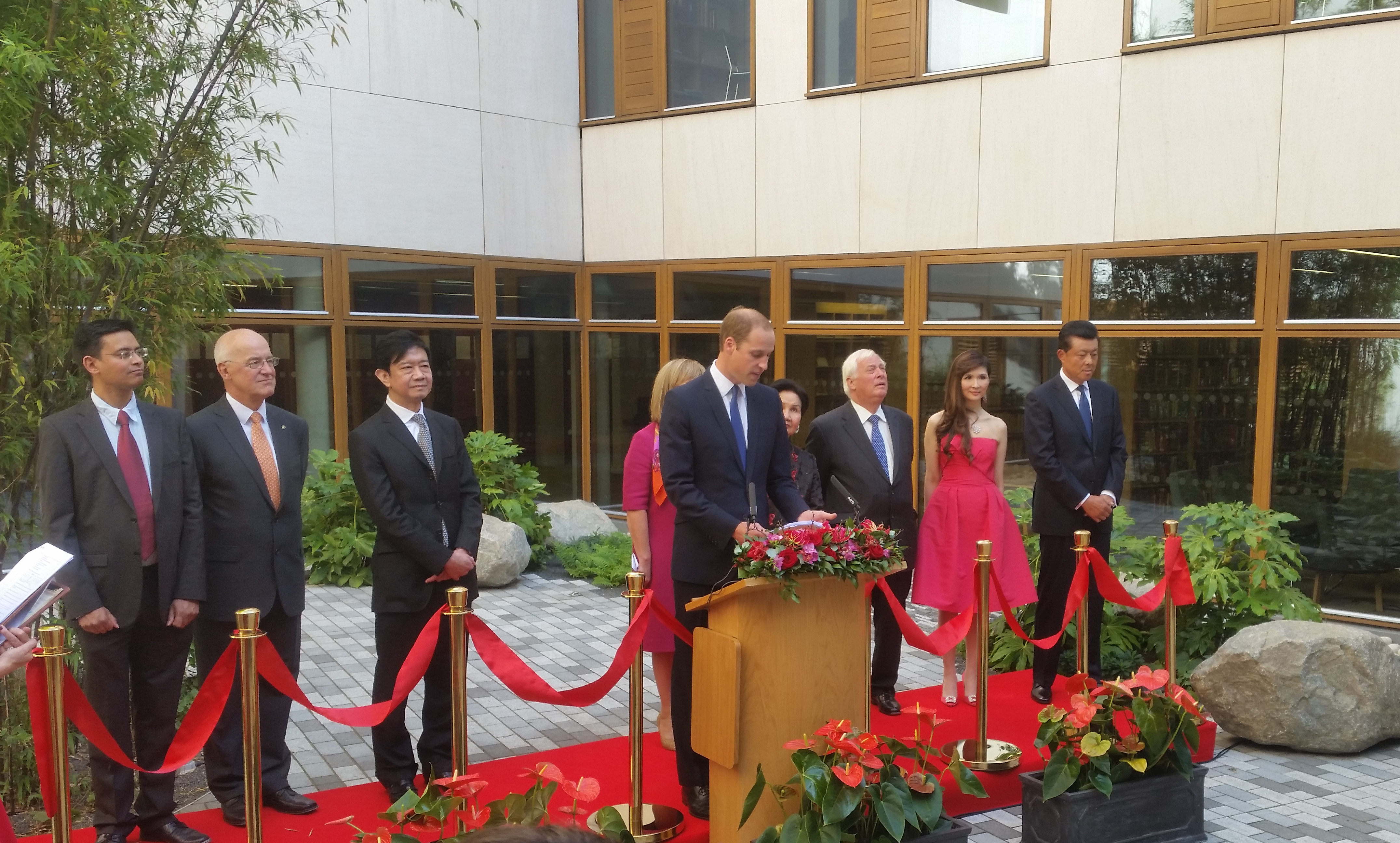
Cameron’s time was split between helping my colleague Joshua Seufert at the brand new China Centre Library which was officially opened by the Duke of Cambridge only last week, and helping me with my project to catalogue our special collections.

20140908_152436

I gave him a very clearly defined corpus of material to work on from Piet van der Loon’s books – a large collection of Canton ballads. There was something rather shocking about how good his Chinese is after only two years of study, and how easily he got the hang of cataloguing this material with our newly developed browser-based allegro catalogue. In little more than a full week’s work, he had not only catalogued the operas, but had warmed to the theme sufficiently to write one of the better pieces in this blog. Here it is, exactly as Cameron gave it to me.


Piet van der Loon’s Cantonese operas

Cameron Henderson-Begg

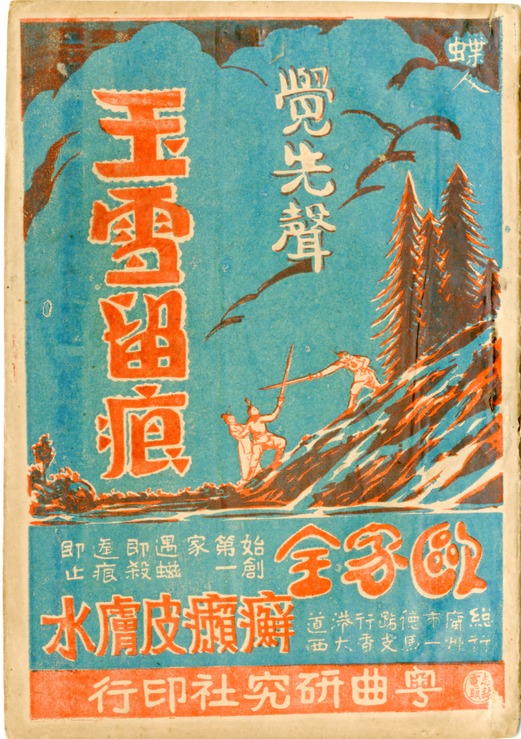
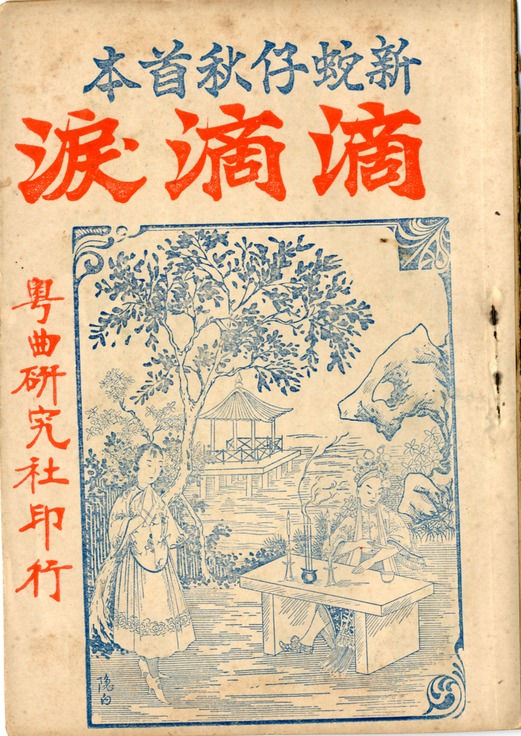
Among the many items bequeathed to the Bodleian by the late Piet van der Loon are nine boxes of yueju 粵劇 (Cantonese opera) scripts with colourful printed covers, averaging around 30 pages long. In total Piet left us 459 of these, and they now occupy numbers 5241-5700 in our Sinica collection. For instance:

七字奇冤
廣州 : 華興書局[印行], [1920或1930年代?]
平裝1冊(40頁) ; 19公分
Sinica 5251

The speculative date will be changed soon – more on that below. The vast majority of the items seem to have been published in Canton, with occasional interlopers from Hong Kong and a couple of intrepid outsiders from Shanghai.

Now in something of a decline, Cantonese opera enjoyed a heyday in the Republican era, with thousands of new scripts issued for purchase. Old favourites soldiered on, but many of the van der Loon scripts are striking in their modernity: a silhouetted female nude on the cover of Sinica 5326, for instance, reminds of nothing so much as a first edition Great Gatsby, with its famous nudes-in-the-eyes above Coney Island.

s01696

And these scripts seem very much aimed at southerners invested in the new Republican ideal. In the back pages of some, the cavalry carry the national flag proudly past copyright notices; in one, perhaps short of matter for their last two leaves, the publishers have copied the score of the Sanmin zhuyi, now the ROC national anthem, in both the traditional gongchipu system and the newer jianpu or numerical notation system. A notice informs the public-spirited reader that the score is placed there in case they should have need of the “Party song” but find themselves stuck without it (the likelihood of a reader so unprepared coincidentally having this particular opera to hand seems not to have been considered).

s01679

s01681

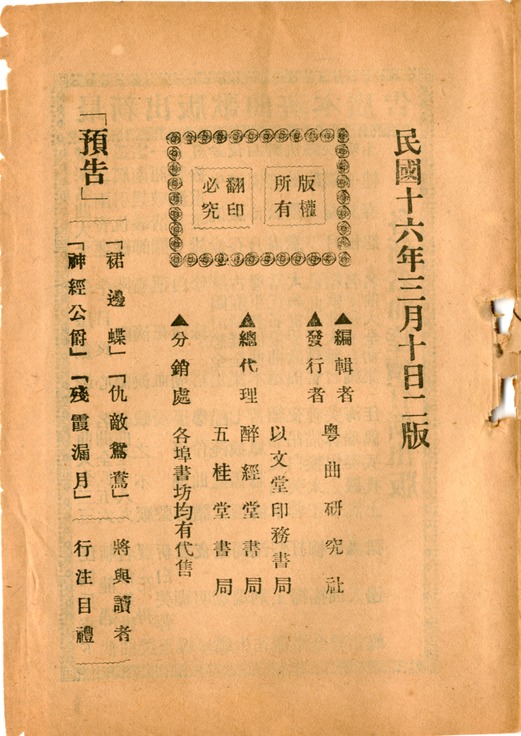
The presence of these scores brings us neatly to the matter of dates. The Sanmin zhuyi was the “Party song” (黨歌) of the GMD from 1928 onwards, only becoming the national anthem officially in 1943, so we seem to be dealing with the mid-Republican period. But very few of the scripts carry any kind of dating data. Of the 459, only one, Sinica 5657, carries an obvious printed date. Here a part of the colophon reads 民國十六年三月十日二版, that is, the item is a second edition from March 1927.

s01694

s01695

Happily all is not lost for dating the collection as a whole. A 1985 index of Cantonese operas, the 粵劇劇目通檢, lists 11,360 separate works from the very late Qing to the early years of the PRC. In a random sample of 20 of our items, nine were listed with year-of-publication ranges. (Of the remainder, six were listed with no known publication date. Five were apparently not known to the author of the index, but the rather cumbersome layout of the book, whose entries are listed not in a single body but as a main text with three large sections of addenda, means it is possible some slipped under my radar.) In the dated sample, all but one were from the years 1920-1936; the other was from the period 1937-1945. It seems reasonable, then, to take the majority of the collection as dating from 1920 to 1936, with the odd straggler up to the end of the Second World War.

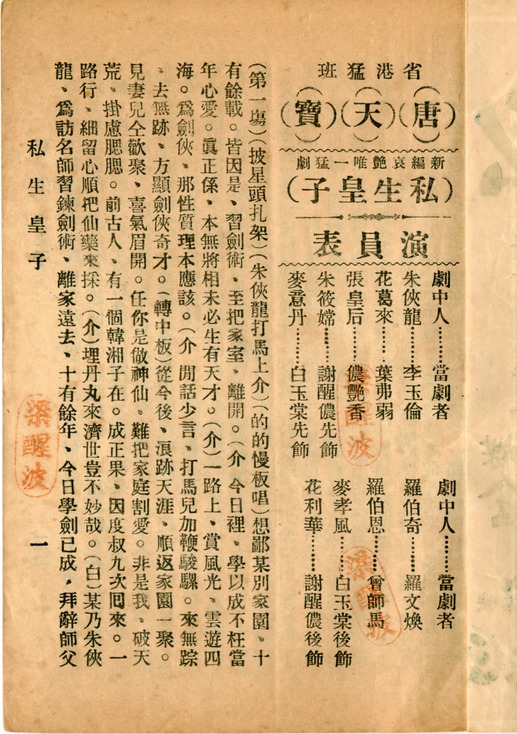
Most all of the scripts carry printed ads, usually for medicines—Oujiaquan Pharmaceuticals seems to have felt it had found its target audience with these little books. Some of them bear the marks of previous owners: handwritten names are common, with a few more traditional seals thrown in along the way. The recurrence of a few names, plus the repeated presence of a stamp from a bookshop in the Petaling Street Chinatown in Kuala Lumpur, suggests that large parts of the collection come from bulk purchases. The most notable mark of provenance is a cartouche-style stamp in at least a couple of numbers with the name 梁醒波.

s01669

s01670

If genuine, this would link some of our items to Leung Sing-Bor (1908-1981), one of the greatest Cantonese opera performers of his time. After showing an early interest in performance, he went on to become one of the “Four Kings” 南洋四大天王 of the yueju 粵劇 stage. From 1950 he appeared in enormous numbers of films, and until his death he was a long-running host on TVB’s enduringly popular “Enjoy Yourself Tonight” 歡樂今宵, a kind of Hong Kong version of Saturday Night Live.

Away from possible connections to the stars, one of our numbers, Sinica 5690, has had its back cover used for calligraphy practice, and this along with the frankly flaky quality of the paper suggests that these were workaday books, certainly not treasures. That in turn brings us to the value of these items. They are probably not immensely rare. The size of our collection and the ability of an author to piece together over 11,000 separate titles in the 1985 index speak to that. Nevertheless, their very un-treasured status makes them a notable holding. Cambridge University Library possesses some, but Chinese libraries and collectors have rarely ascribed much value to such low-brow works. For what they tell us about the vitality of theatre in the Republican south, for their links to the long tradition of Chinese illustrated book printing and for their snapshot of the concerns of the opera-going classes in the new China, these are objects deserving of study.

Chen Yuan – a draft history

4 August 2014

I love to discover editions in the collections that have what I call “integrity”. Over and above being rare or fine, they must be distinguished in other ways.

A case in point is what at first sight appeared to be a rather poor edition by a twentieth-century author, and probably not suitable for inclusion in the Serica database. I catalogue it as follows:

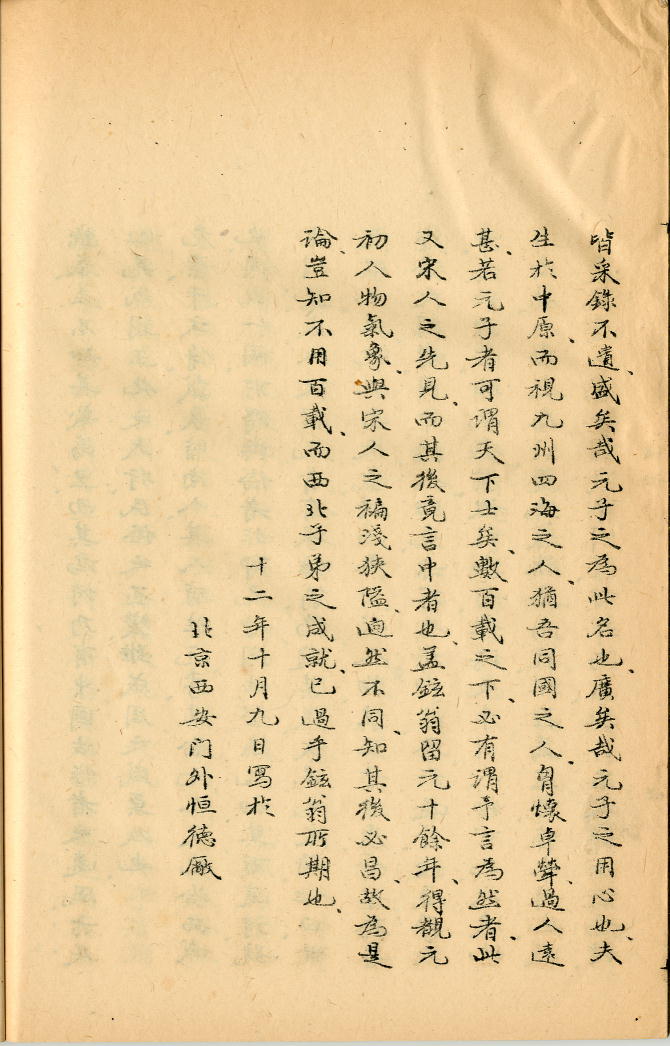
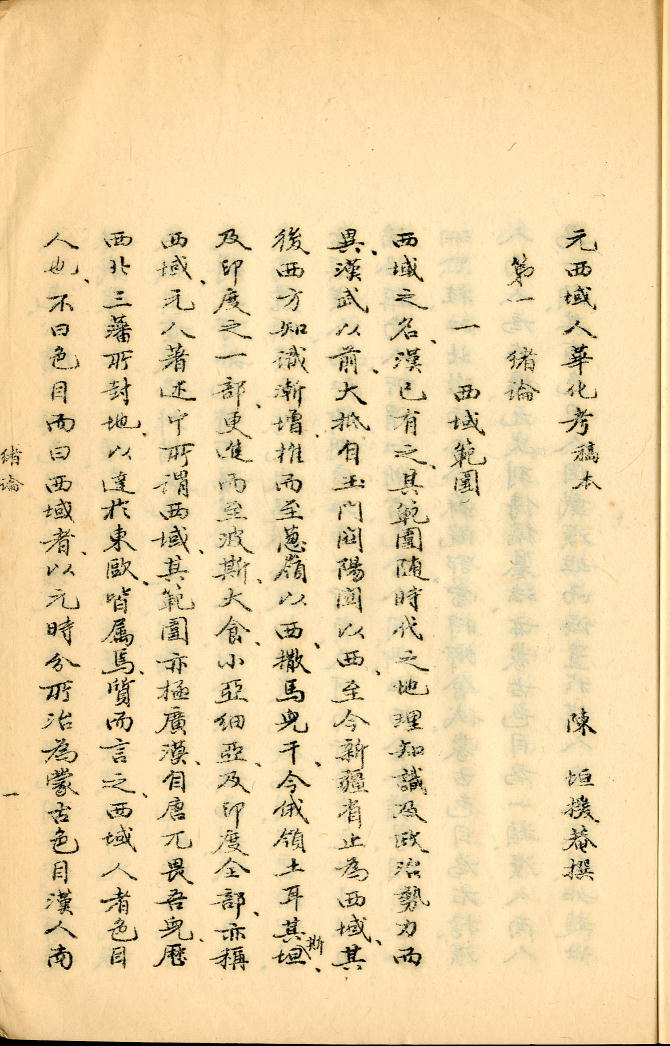
元西域人華化考稿本 : 八卷附錄一卷 / 陳垣撰
民國十二年[1923]陳氏油印本
線裝2冊 ; 27公分
Sinica 2589

s01501 s01500

Chen Yuan (1880-1971) was a native of Xinhui county 新會縣 in Guangdong province 廣東省. He received a classical Confucian education and sat the provincial examination. I haven’t been able to establish when and where, but it was probably the last such examination to have been held in Canton. His paper, and the conditions under which he was examined, would have been exactly as described in my blog entry for the recent exhibition in the Bodleian Library’s Proscholium.

He failed, but like many such failures, subsequently distinguished himself far more in the field of letters and scholarship than he would have done in officialdom. Perhaps it was this failure, together with the realisation that the old order was fast disappearing, that made him change direction completely.

He began by founding the pictorial magazine Shi shi hua bao 时事画报 in Canton in 1905, and two years later in 1907 enrolled at Guanghua Medical School 光华医学院, where he graduated in 1910. Having fallen under the spell of Sun Yatsen, at the beginning of 1911 he co-founded the Zhen dan ri bao 震旦日报 with Kang Zhongluo 康仲犖 and Liang Shenyu 梁慎余, and later that year, following the success of the revolution became a representative in the National Assembly 國會 in Peking. Although he eventually became Deputy Minister of Education in 1921, he left politics soon after to pursue an academic career which he had been developing in parallel during the 1910s.

His two interests were history and religion, and his first major work – the one that launched his scholarly career – was his Yuan ye li ke wen kao 元也里可温考, which he completed in 1917. This was an investigation into the Nestorian Christianity of the Yuan period, the term ye li ke wen 也里可温 being derived from the Syriac term arkagun, meaning “blessed people” (Syriac was the official language of Nestorianism). In 1919, he became a Christian himself.

His interest in the Mongol period continued, as evidenced by the production of the present work (“The sinicisation of the Western Region peoples during the Yuan dynasty”), Sinica 2589, about which more in a moment.

After resigning from politics in 1921, he founded Peking’s Pingmin Middle School 平民中学 (the present Number 41 middle School 北京市第四十一中学). And then, although he was a Protestant Christian, he became the second president of Fu Jen Catholic University 輔仁大學, a post which he held from 1926 until the closure of the university by the Chinese government in 1952, and the forced merger of its departments with other universities in Peking, notably Peking Normal University 北京師範大學 of which Chen Yuan continued to serve as president until his death in 1971.

Chen Yuan was almost an exact contemporary of Chen Yinke 陳寅恪 (1890-1969), and the two were of equal scholarly fame, becoming known as “the two Chens of historical studies” 史學二陳.

So in what way does Sinica 2589 have “integrity”?

Firstly, it is in near perfect condition, and preserved exactly as published.

Secondly, it is rare. As its title suggests, it is the first draft of a work which the author later printed by woodblock in 1934, without the additional words gao ben 稿本 in the title. This first “real” edition of the work is very common.

But the present edition was printed by the mimeograph process with which those of my generation are very familiar, because it was used to print our assignments at school and also for the production of many local, low circulation magazines. In fact, the process was still in use in China in the late 1970s, and the Chinese students used it to produce most of their “Democracy Wall” publications during the short-lived “Democracy Movement” of 1978-1980 (which gives me the opportunity to say that we have a collection of these which comprises 48 different titles in 146 separate items, shelfmarked Sinica 3861-3912). The best known example is:

北京之春 = The spring of Peking
油印本
[北京], 1979
冊 ; 27公分
本刊為「民主牆」(Democracy Wall) 刊物
存: 1979:1(8:1:79), 1979:2(27:1:79), 1979:3(17:2:79), 1979:4(2:4:79), 1979:5(16:5:79), 1979:5增刊(13:5:79), 1979:6(17:6:79), 1979:8(28:9:79)
Sinica 3862

In this printing process, a stencil bearing the text (produced either by a typewriter or as here, by hand) is mounted on a drum, and an oil-based ink is forced through it on to the paper, which is why the Chinese term for the process is “oil-printed”. The drum is turned by a handle and the paper is automatically fed through the machine. Nevertheless, it is a crude, home-made method, and only suitable for relatively small print-runs.

For this reason, Chen Yuan’s first draft of this work is rather rare. I have only found fourteen other copies, of which all but one are in China, and of these, four are in Peking University Library and another four in the National Library. Clearly, it was not distributed widely or commercially.

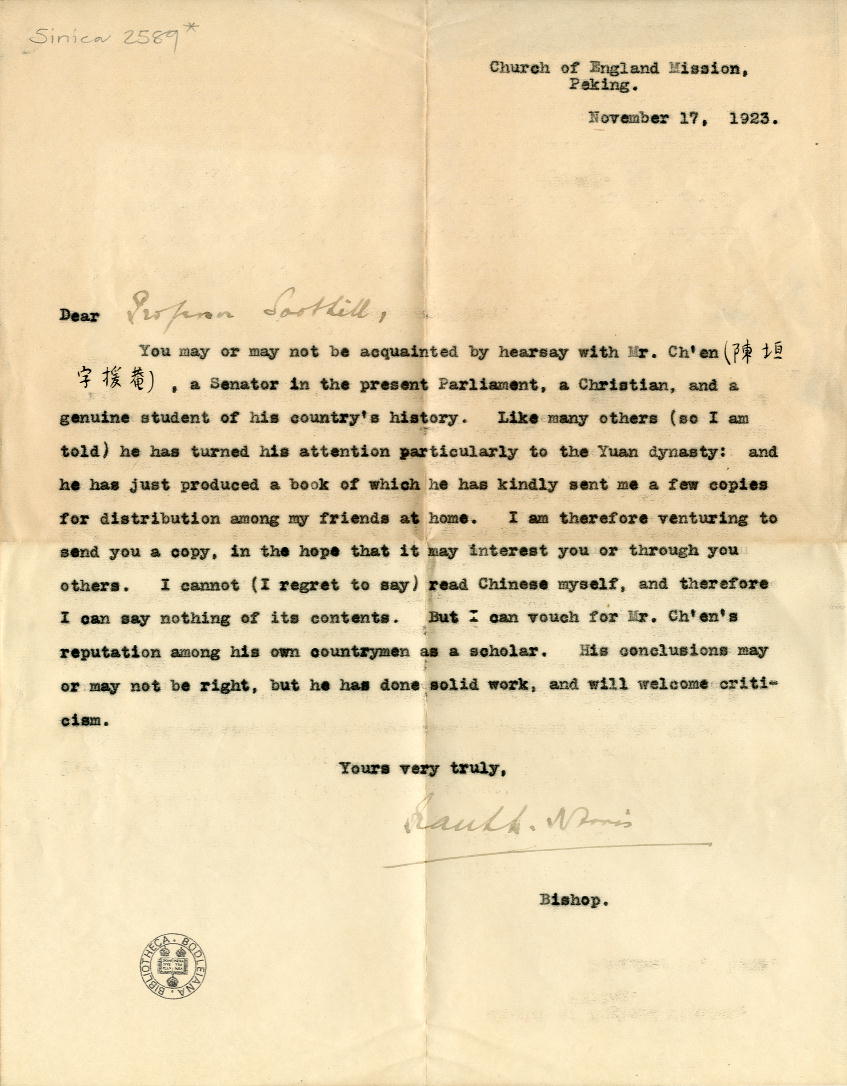
This leads to the third reason why I consider our copy to have “integrity” – its provenance. We know exactly where it came from. There is a letter accompanying the book that tells us that it was given to us by Bishop Frank L Norris in the same year as its publication. Francis Lushington Norris (1864-1945) was an SPG missionary, who became Bishop of North China in 1914, retiring in 1940. As a recent convert, Chen Yuan must have known him, and given him a copy of his work. Yet again, it is evident how much we owe to the missionaries – it was another, Arnold Foster, who sent us the juren papers a decade or so earlier.

s01502

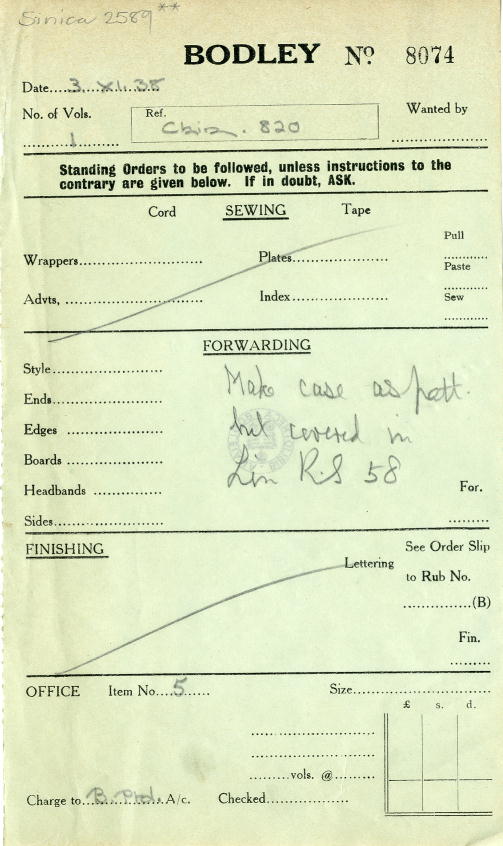
Fourthly, and finally, also accompanying the book there is a Library binding order dated 3 November 1938, or rather not a binding order, but an order for a Chinese-style wrap-around tao . Of the thousands of pre-modern books in our collection that I have handled, this is the only such order that I have discovered, and it is very interesting because it provides the exact date when this, and by association the other wrap-around tao were made.

s01503

One could expatiate on the appalling practice of giving western bindings to traditionally bound Chinese books, but for the moment it is sufficient to say that at the Bodleian, it was rarely done. Perhaps we never had the money for it, or perhaps we were ahead of our time in knowing it to be bad. Whatever the reason, I’m glad I don’t have to think of how to rescue the thousands of Chinese books in richer places whose heavy western bindings are now wrecking what they were supposed to protect.