Archive for the 'Uncategorized' Category

Woodblock

24 January 2013

In October last year Chris Fletcher drew my attention to an early Chinese missionary printing block advertised for sale in a catalogue of mostly western books which I would not normally have seen, and I bought it immediately. It is now in the Library, shelfmarked Sinica 6002.

The bookseller was Samuel Gedge (Hanworth, Norwich), and his Catalogue XIV says that “the Chinese text, identical on both sides, includes a translation of the Lord’s Prayer in the version of the missionary Robert Morrison (1782-1834).” (no.59, p.46).

Here is an image of what I call “side A” of the block, as it bears a western inscription written with pen and ink, now very faint, and discussed below:

block1

The block has been cut on both sides, as blocks usually are, but it is curious that on this block the text is identical on each side apart from the very minor differences noted below, the two extra punctuation marks on “side B”. The text is indeed that of the Lord’s Prayer, and it is followed by that of the Ten Commandments, and nothing else. Here is a transcription of it:

祈禱文

吾等父在天者、愿爾名成聖、爾宰王臨至、爾旨奉行於地、如於天焉。賜我等今日日所用糧。免我負債、如我等免負債與我等者也。不引我等進誘惑、乃救我等出凶惡。葢國者、權者、及榮者、皆屬爾、于世世焉、啞門。[1]

除我外、爾不可有別神也。爾不可為自而造何雕刻的像、或天上之何像、或於地下、或於水在地之下也。汝不可自俯伏向之、並不可事之、蓋我神主、爾神、乃忌被忽之一位神、而問父之罪及子輩、於恨我者之三四代也、乃施慈憐於愛我者、守我命者、之于萬人也。爾不可徒然而用神主爾神之名、蓋徒然而用、厥名者、將不算其人為無罪也。記憶撒吧日、以守之聖然。六日間、爾可勞而行汝諸工、但第七日乃神主、爾神之安息日、在之爾不可行何工、連爾、與爾子、爾女、爾僕、爾婢、爾牲口、及在爾門內之客皆然。蓋六日內神主造天、地、海、及凡在伊內、[2]且於第七日安息、故此神主祝福安息日、而聖之。○ [3] 敬爾父、[2]爾母、致爾各日可為長多於神主爾神給爾之地。爾不可殺人。爾不可姦人妻。爾不可偷人物。爾不可言妄証及爾隣也。爾不可貪爾隣之家、爾不可貪爾隣之妻、厥僕、厥婢、厥閹牛、厥驢及凡屬爾隣者、皆不可貪也。

[1] The columns of the Lord’s Prayer are widely spaced.
[2] The two punctuation marks 、 here are only found on side B.
[3] This circle divides the first four commandments (concerning God) from the last six (concerning others).

So far, I haven’t found the text of either the Lord’s Prayer or the Ten Commandments exactly as it appears on this block in any of Robert Morrison’s works. But it comes very close, and certainly much closer than the text of any other versions.

I have compared the text of the Lord’s Prayer with the versions in Matthew 6:9-13 and Luke 11:2-4 in the first two editions of his New Testament (1813 and 1815, noted in my previous blog entry). I have also compared it with the version in the little prayer-book which according to Milne (Retrospect , 269) he produced in 1818, although our edition of this only raises more problems (it appears to be an experimental edition, containing only the first part of the text, and is at variance with the descriptions in Milne’s Retrospect, Wylie’s Memorials, and other catalogues). But here, for what it’s worth, is my catalogue entry for it, together with an image of the page on which the Lord’s Prayer first appears:

年中每日早辰祈禱之敘式
[s.l.], [s.a.]
平裝1冊(12頁) ; 18.5公分
Running title 《祈禱敘式》
Tr. by R Morrison
Printed on single leaves of western paper
Has no title-page
Sinica 2511

s00472

Similarly, I have compared the text of the Ten Commandments with the versions in Exodus 20:1-17 and Deuteronomy 5:4-21 of Morrison’s Old Testament (completed in 1823 with the assistance of William Milne), and it comes very close to the text of the Exodus account.

Morrison was active in Canton and Macao, but our block was cut in Java, according to the inscription on Side A. This is very faint, and not easy to read, so we took it to the Papyrology Room of the Sackler library where it was subjected to multispectral imaging by Alexander Kovalchuk, who uses the technique to enable ancient papyri to be read. Monochrome images of the object are taken with light of different wavelengths, ranging from infrared through the visible spectrum to ultraviolet; the images are then digitally processed using complicated mathematical algorithms. Here is what emerged when the process was applied to the block:

block2

I’m reading this as follows: “Chinese Blocks cut at Waltefreden at the Missionary station in Java. Bennet.”

As ever in this game, each additional piece of information raises more questions than it answers: where are the other blocks, and who is Bennet?

But first, I must acknowledge the help of my former colleague Ralf Kramer in solving the problem of  “Waltefreden” (which at first I had found impossible to read). It is actually an anglicisation of Weltevreden, a wooded, swampy place 12km southeast of the old city of Batavia (now part of modern Jakarta, the capital of Indonesia).

As its name suggests, the European colonists found Weltevreden to be a more pleasant place to live than the old walled city of Batavia, which was dirty and overcrowded and suffered from bad sanitation.  According to an article in The Jakarta Post (Saturday 19 February 2000), in 1797 the Dutch colonial authorities started to turn it into an administrative and military area. Soon after, Herman Willem Daendels, governor-general of the Dutch East Indies from 1807 to 1811, selected the site for his residence and also for the new city centre.

Also, the blogger P’i-kou has pointed out that it was in his residence at Weltevreden that Daendels established the first printing press in Batavia, around 1810. Medhurst’s mission and its press however were based not in the governor’s residence, but in Parapattan, so that the reference on the block is to the general area in which Parapattan was located, not the governor’s press.

Turning to the block itself, there is something odd about it. I’ve already noted that the text is almost absolutely identical on both sides, but also, neither side has ever been inked – the block has never been used to make an impression. The format is also puzzling. The text appears in a frame, as if intended to be a leaf of a book rather than a “sheet” tract. But neither the title nor collation details appear where they would normally be in the central column of the block, which is completely blank. I wonder if the block was produced as a specimen, to show what a Chinese block looked like, and how leaves were printed and bound to make books? And perhaps more than one of these specimens was produced.

It is hard, but essential, not to be led astray by wishful thinking. This is why I hedged my bets with dating our copy of the earliest Chinese tract (also by Morrison) in my previous blog entry. But there’s nothing wrong with putting something up for others to shoot down – this is surely partly what a blog is for.

As indicated in the inscription, the missionary station in Java was in Batavia, and Walter Henry Medhurst was in charge of it. Medhurst was born in 1796, and at the age of 14 was apprenticed to a printer. In this capacity he replied to an advert by the London Missionary Society for a printer to join their mission at Malacca (now Melaka on the southern coast of the Malaysian peninsula, half-way between Kuala Lumpur and Singapore). He was accepted, and on the way there “entered into a matrimonial alliance” as Wylie deliciously puts it (Memorials, 25) – fast work, which surely lays to rest any notion that the missionaries might be boring! He reached Malacca in 1817, and was ordained there in 1819. Having spent a year in Penang in 1820, he moved to Batavia for the next eight years. There, as in Malacca, a major part of his work was in setting up a printing office.

In Journal of voyages and travels by the Rev. Daniel Tyerman and George Bennet, esq. Deputed from the London Missionary Society, to visit their various stations in the South Sea islands, China, India, &c., between the years 1821 and 1829  (London, 1831), the entry for 22 August 1825 (vol.2, 223-224) gives a detailed description of the process of blockprinting, which was observed in “Mr Medhurst’s office”.

I wonder if our block was produced for Bennet to show to the London Missionary Society when he got home?
The earliest missionary editions

22 January 2013

As indicated in my last blog entry, we have a very fine collection of Protestant missionary material in Chinese, dating mostly from the first three quarters of the nineteenth century. Our collection consists mostly of tracts, of which we have over 1,300 different editions with many duplicates.

Our Chinese Bible collection is not as big as that of the Bible Society, which was transferred to Cambridge University Library when the Society sold its premises in central London and moved to Swindon in 1985. Nevertheless, it is significant, and we have copies of most of the landmark editions.

But we lacked a copy of the very first printed edition of Holy Scripture in Chinese, Lassar and Marshman’s gospels of Matthew and Mark printed at Serampore in 1810, and we also lacked a copy of the earliest known tract, which was written and printed by Robert Morrison in Canton in 1811.

Remarkably, during my time in the Bodleian I have had the opportunity to acquire copies of both these things, which I will now describe. But I’m not entirely satisfied with my findings so far, particularly with regard to their dating. This is rather disturbing, as both items must be reckoned among the most valuable in our Chinese missionary collection, and would certainly take pride of place in any exhibition of this material.

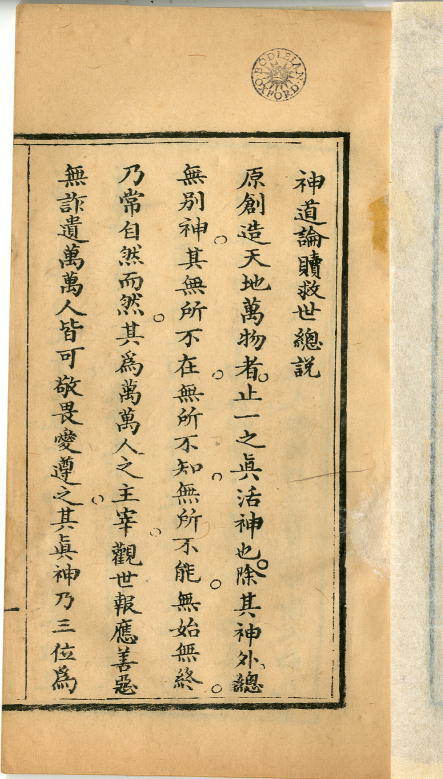
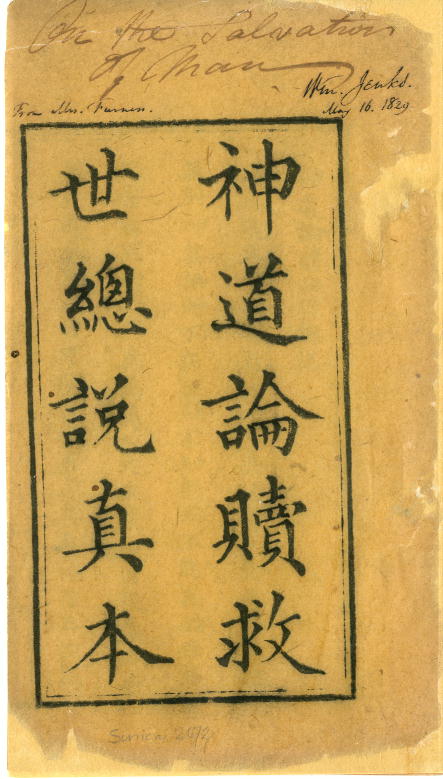
1. The tract.

I bought this from the now defunct booksellers Ad Orientem (St Leonard’s-on- Sea, Sussex) in 1982, and describe it thus in my catalogue:

神道論贖救世總說真本
[Canton?], [1810年代]
毛裝1冊(6頁) ; 19.9公分
By Robert Morrison
Front cover (title-page) inscribed “On the Salvation of Man”, and in a different hand “Wm. Jenks. May 16. 1829. From Mrs. Furness”
Sinica 2672

s01006 s01005

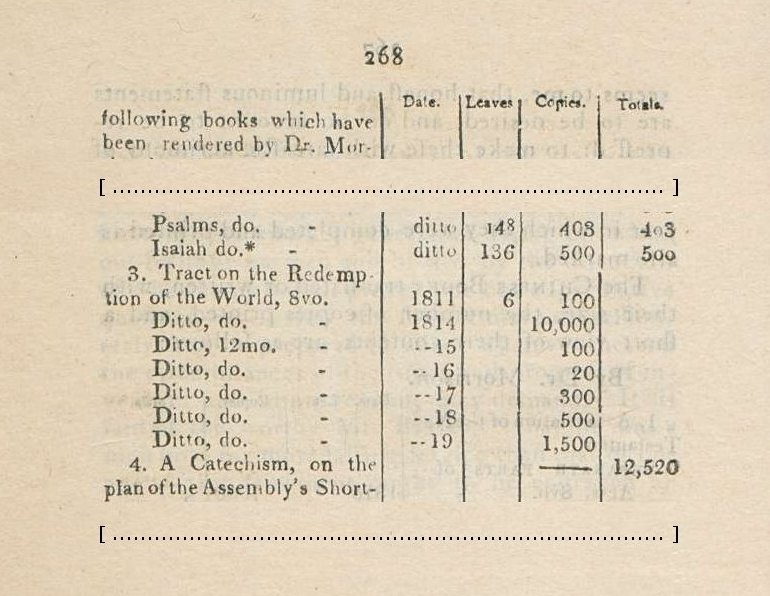
William Milne’s Restrospect of the first ten years of the Protestant Mission to China (Malacca, 1820, and digitised by the Staatsbibliothek zu Berlin among others) contains a List of books written and printed by the members of the Ultra-Ganges missions (pp.267-287). Although this is an invaluable guide to the earliest Protestant publications in Chinese, and is in some respects very detailed (for example in giving the number of copies printed), it doesn’t say where the editions were printed, nor does it seem to be complete; it makes no mention for example of Lassar and Marshman’s gospels and Bible described below, and it omits at least one of Morrison’s tracts.

Sinica 2672 is listed under the works by “Dr. Morrison”, as “Tract on the redemption of the world, 8vo.” (p.268); here is an image of the entry:

MilneList

I’m inclined to think that most of the dates mentioned refer to printings, and not editions, as it is scarcely credible that new blocks were cut for printing as few as 20 copies (in 1816). I think we are dealing with two sets of blocks only: the first cut in 1811, and the second in 1815, after the printing of 10,000 copies in 1814 had worn out the earlier blocks.

In the absence of an imprint, how are we to know the date of our copy? If Milne’s account is accurate, we should at least be able to identify it on the basis of size. But the terms “octavo” and “duodecimo” of course are not strictly applicable to Chinese books, and even in the west, are not as precise as the measurements in centimetres which we now use, as they are terms which relate to the size of a single large sheet, itself subject to variation. Most likely, Milne was simply pointing out that the later edition was smaller than the earlier one. Unfortunately, the size of our copy is what I would describe as “middling” for a tract of this kind – many are bigger, many are smaller.

I have found seven copies of the tract in the world’s libraries, none of them in East Asia: the Harvard-Yenching Library (two copies), the Australian National Library, the Bavarian State Library, Leiden University Library, Glasgow University Library, and our own library, the Bodleian. None of these copies has an imprint, and the cataloguers have only guessed their date, but they clearly fall into two groups:

24/25cm. 4 leaves. 7行20字. (Harvard, Australia, Glasgow).
19cm. 6 leaves. 5行20字. (Harvard, Bavaria, Leiden, Oxford).

I have photocopies of both the Harvard copies, and the Australian copy has been digitised. The larger Harvard copy is from the same blocks as the Australian copy, and the smaller one is from the same blocks as ours, supporting my belief that only two editions were made. The question is, which is which? Were the blocks recut in smaller format, so that 6 leaves were required rather than 4, or in bigger format, so that only 4 leaves were required rather than 6? Milne’s information cannot be correct, as he lists the larger octavo edition as having 6 leaves – it is the reverse of what the surviving copies suggest. And the picture is further confused by the number of copies printed – over 10,000 in the case of the earlier edition, but fewer than 2,000 in the case of the later one.

Wylie (Memorials, 4) lists only one edition (“6 leaves, Canton, 1811”), which does not get us any further forward. I have therefore hedged my bets in the catalogue by giving the date of our edition as 「1810年代」- “the 1810s”.

2. The scripture.

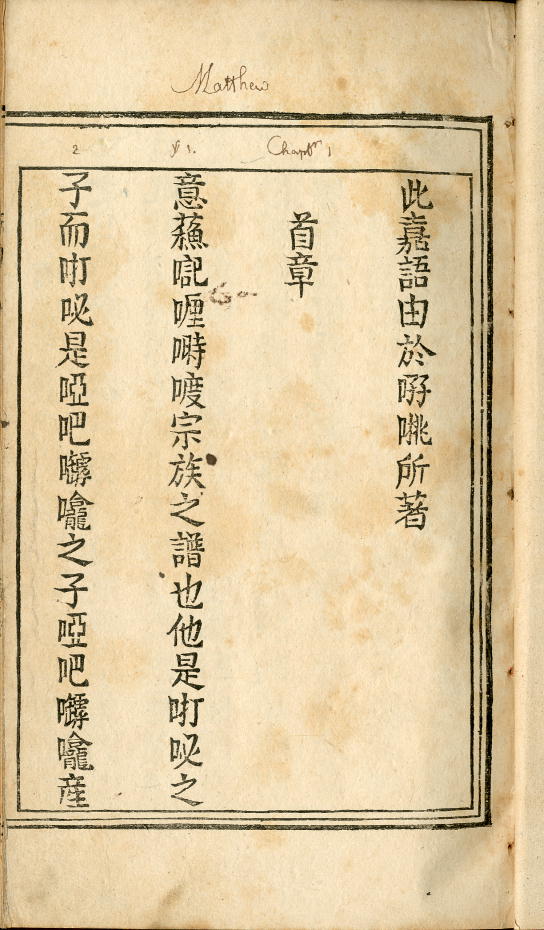
This is more straightforward to explain: we have the gospels of Matthew and Mark translated by Joshua Marshman and his teacher, the Chinese-born Armenian Joannes Lassar. The two parts were originally printed separately (from blocks), but are printed together in the Bodleian copy.

此嘉語由於𠲚{口挑}所著
此嘉音由𠲚嘞所著
[Serampore], [1810]
洋裝1冊(原線裝3冊, [95], [56]頁) ; 24.7公分
Tr. by J Lassar & J Marshman
Sinica 4020

There are two copies of St Mark only in Regent’s Park College.

s01017 s01015

Not only is the calligraphic style of the printing rather odd, but so is the terminology used by the translators, who invented many characters to transcribe the sounds of proper names in the text, including the names of Matthew and Mark, as indicated above.

In the largest character dictionary that I know of, (中华字海, first published in 1994 and containing 85,568 characters), the first character in both names (𠲚) is given the pronunciation yi, but here it may have been independently created by Lassar and Marshman from 口 and 孖, which is pronounced ma in both Mandarin and Cantonese.

The character {口挑} is not yet encoded in Unicode, and the second element is pronounced tiao in Mandarin and tiu in Cantonese

The character 嘞 is pronounced lei in Mandarin, and laak in Cantonese.

It therefore seems clear that Lassar and Marshman were using the Cantonese rather than the Mandarin sound values for these characters to transcribe the names of the first two evangelists:

𠲚{口挑} matiu = Matthew
𠲚嘞 malaak = Mark

Marshman arrived in Serampore in October 1799, and began his study of Chinese in 1805, under Lassar. As he never set foot in China, the distinction of being the founder of the Protestant mission to China goes to Robert Morrison, who began his study of Chinese in London in 1806, and arrived in Canton in September 1807. He produced a translation of Acts which was printed from blocks in 1810, but slightly later than Lassar & Marshman’s gospels.

The Bible Society collection has copies not only of all these things, but also of several more partial translations by Marshman and Morrison in this initial period of activity. The first complete New Testament was produced by Robert Morrison and published at Canton in 1813 (Sinica 101), quickly followed by a second edition in smaller format in 1815 (N.T.Chin.e.1, Sinica 1296, and three later printings from the same blocks).

The first complete Bible was Lassar and Marshman’s version published serially in Serampore, starting with the Pentateuch in 1817, the whole Bible being completed in 1822 with the publication in that year of the New Testament and the Old Testament books Joshua-Esther; the Library has two impressions of the complete work (Bib.Chin.d.1 and Bib.Chin.d.8).

I bought our copy of Lassar & Marshman’s Matthew and Mark from Han-Shan Tang (London) in 2004. They had acquired it from Bristol Baptist College. Actually, that organisation was only ten minutes’ walk from the school I attended between 1961 and 1968. How strange that then, as now, I should be living in such close proximity to this book!

New Phonetic Character

10 December 2012

We have a very large collection of Chinese Protestant missionary publications, consisting largely, but not entirely, of the Chinese books exhibited at two of the great nineteenth-century international exhibitions: the Centennial Exhibition of 1876 in Philadelphia (these books probably reached us through the agency of Alexander Wylie), and the International Health Exhibition of 1884 in London. So far, I have identified over 1,200 different editions, with many duplicate copies, and I reckon that we have at least one hundred more.

Putting the cart before the horse (because this corpus of materials demands a much bigger introduction), and at the risk of discrediting an immensely important resource, I will describe one small part of it, which although interesting and rare, is an intellectual and bibliographical dead end.

MacGillivray’s Century of Protestant missions in China (1807-1907) records (p.317):

“In 1852, Rev. and Mrs. T.P. Crawford and Dr. G.W. Burton re-inforced the [Southern Baptist Central China] Mission [in Shanghai], and early in 1853, Rev. and Mrs. A.B. Cabaniss arrived, but went back to America in 1860.”

and a footnote adds:

“Mr. Crawford invented a new phonetic character for Chinese, and at least four books were printed in it in Shanghai Dialect. Those interested can see the system in the Chinese Recorder, March, 1888.”

There indeed, Tarleton Perry Crawford explains his creation in an article entitled A system of phonetic symbols for writing the dialects of China (Chinese Recorder 19:3, 1888, 101-110), and gives the reason for it:

“The huge idiosophic characters have reached the limit of their capacity, and are rapidly sinking under the burden with which they are freighted … the common characters being already complete and crystalized around the thought of the past, and therefore unable to meet the requirements of the age, must inevitably be superseded by the living dialects of the land, as was the case in Europe. Chinese hieroglyphics, like their Egyptian predecessors, are doomed to the tomb and the antiquary.”

Needless to say, this is not quite what happened. While the Chinese script continues to flourish, the forgotten remains of Crawford’s efforts survive perhaps only in the form of a few publications in the Bodleian (all from the Philadelphia Centennial Exhibition) and one or two elsewhere. It is strange that when writing in 1888, more than twenty years after he had invented the script, and with only some half dozen books having been published in it, Crawford should continue to argue that his system might have a future.

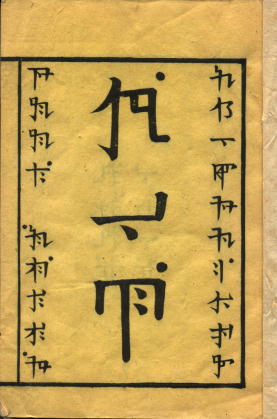
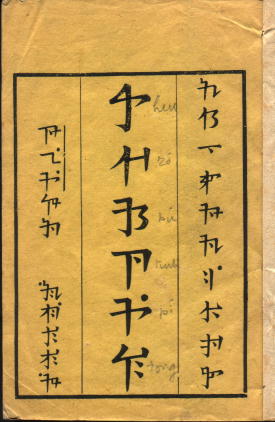
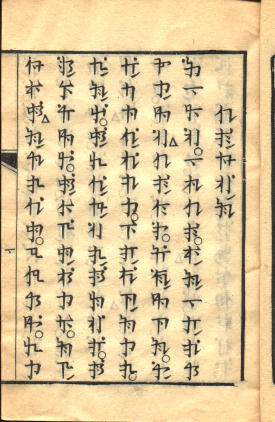
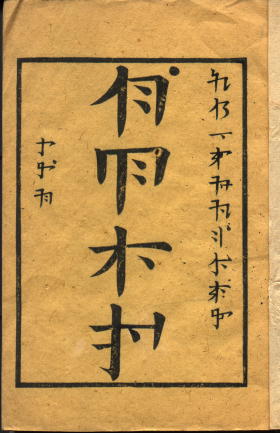
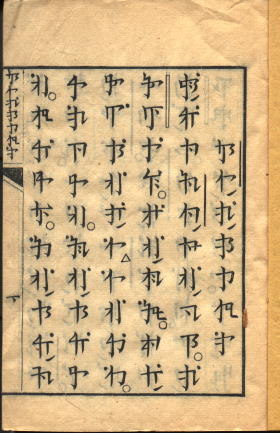
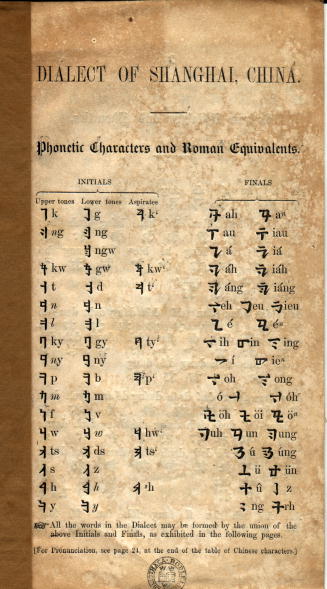
Here are my records for the books, perhaps the most egregious examples of my cataloguing so far. I have used the table in Sinica 1625 to transcribe them, but am not confident that the transcriptions are correct.

1.

s00102 s00104

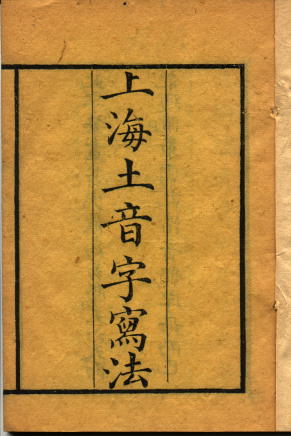
上海土音字寫法
[Shanghai], [1855]
線裝1冊(20, 2頁) ; 16.6公分
By T P Crawford
Explanation of New Phonetic Character for writing Shanghai dialect
Sinica 2073

The imprint is derived from Wylie (Memorials, 214).

2.

s00113 s00114

zen oh kyung / kah nyang nyang ting
ya su ih ty’ien pah pah ng zeh lah nyien [1856]
線裝1冊(3, 1, 71頁) ; 16.1公分
In Shanghai dialect written in New Phonetic Character
Chinese characters for title, author, and date are 「善惡經」, 「郟娘娘」 (Mrs A B Cabaniss), and 「耶穌一千八百五十六年」
Sinica 1280

3.

s00188 s00189

hi so bu ku pi fong / ka e bi fun yi
ya su ih ty’ien pah pah ng zeh lah nyien [1856]
線裝1冊(2, 4, 72頁) ; 16.2公分
In Shanghai dialect, written in New Phonetic Character
Chinese characters for title, author, and date are 「伊娑菩個比方」, 「郟愛比」 (A B Cabaniss), and 「耶穌一千八百五十六年」
Sinica 1284

Aesop’s fables. There is a copy of this edition in the National Library of Australia, and it has been digitised. This copy has an English title-page which is lacking in the Bodleian copy. Someone has penned the title 「伊娑菩喩言」 on the front cover, and this title has worked its way into numerous web pages. However, plausible as it is, this title cannot be the equivalent of the New Phonetic Script syllables ku pi fong, which I had been unable to figure out until the blogger P’i-kou pointed out in his extensive and well-informed comment that ku is the Shanghai pronunciation of ke 個, which in Shanghai dialect can correspond to the genitive zhi 之 in classical Chinese or de 的 in Mandarin, in addition to its use as a measure-noun (exemplified in the title of work 8 below).

4a.

s00105 s00106

sung kyung tsih loh. di nyi pung
ya su ih ty’ien pah pah ng zeh ts’i nyien [1857]
線裝1冊(93頁) ; 16.5公分
By T P Crawford
In Shanghai dialect, written in New Phonetic Character
Chinese characters for title and date are 「聖經記略. 第二本」 and 「耶穌一千八百五十七年」
Sinica 1265/1

4b.
sung kyung tsih loh. di sun pung
ya su ih ty’ien pah pah ng zeh pah nyien [1858]
線裝1冊(74頁) ; 16.5公分
By T P Crawford
Chinese characters for title and date are 「聖經記略. 第三本」 and 「耶穌一千八百五十八年」
In Shanghai dialect, written in New Phonetic Character
Sinica 1265/2

The two works above are not properly recorded by Wylie, whether in his Memorials or his list of the works exhibited in Philadelphia (which appears as an anonymous appendix to the official catalogue of Chinese exhibits). Memorials describe only one volume, “Bible Stories. 93 leaves. Shanghae. 1857” (pp.214-215) , and the Philadelphia list has “Line upon line … 2 vols. …176 leaves … 1857” (no.849, p.33).

There is no conflict in the title, as the “Bible Stories” could well be those told by Favell Lee Mortimer in her Line upon line of 1837, which is still in print as a classic devotional manual. (Her Peep of day, or, a series of the earliest religious instruction the infant mind is capable of receiving of 1836 was also much used by the missionaries – we have twelve different Chinese editions of it in the collection, in several different dialects).

But Wylie does not seem to have known (perhaps because he did not trouble to figure out what the New Phonetic characters said) is that the volume he describes in his Memorials is only the second; the two in the Philadelphia Exhibition are the second and third; the first seems to be lost.

5.

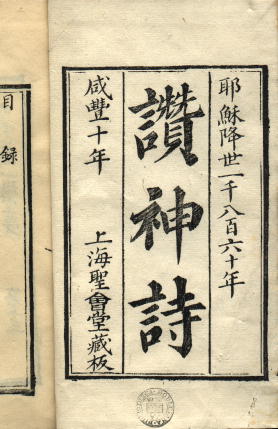
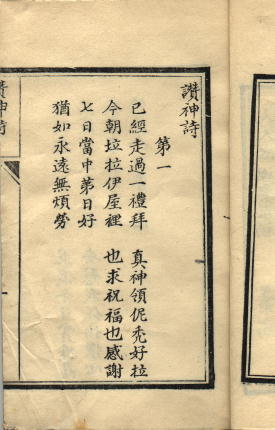
s00999 s00043

s01000 s00044

tsan sung sz
yan fung kyeu nyien [1859]
線裝1冊(3, 23頁) ; 21.3公分
By A B Cabaniss
In Shanghai dialect written in New Phonetic Character
Chinese characters for title and date are 「讚神詩」 and 「咸豐九年」
Sinica 1583

A hymnbook, which according to Wylie (Memorials, 220) contains 21 hymns and 3 doxologies translated by members of the mission and others. A version of the same text in Chinese characters (but still in Shanghai dialect) was published the following year, a sign, perhaps, that the system was not catching on as readily as envisaged. The Library also has a copy of this edition (Sinica 1264). The above illustrations show the two versions side by side.

6.

s00100 s00101

Dialect of Shanghai, China
[Shanghai], [1861?]
線裝1冊(8頁) ; 22.5公分
By B Jenkins
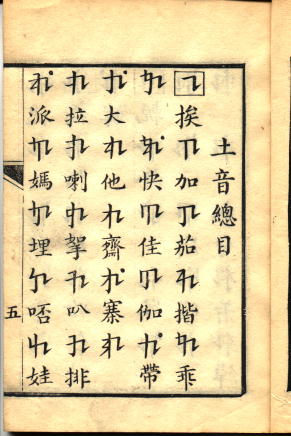
Contains two lists, “Phonetic characters and Roman equivalents” and “Roman syllables and phonetics”
Sinica 1625

Wylie refers to some more publications in New Phonetic Character of which we do not have copies, but which I will list to round the matter off; the romanisations are as given by him (I have constructed those above from Jenkins’ lists):

7.
“Vung keen loh. Scientific Manual. 15 leaves. Shanghae, 1856″. (Under Crawford, Memorials, 214).

8.
San kuh siau tsia. Three School Girls. 25 leaves. Shanghae, 1856″. (Under Mrs. Crawford, Memorials, 215).

9.
Loo ka zen foh yung zu. Luke’s Gospel. 106 leaves. Shanghae, 1859″. (Under Cabaniss, Memorials, 220).

This is a New Phonetic Character transcription of Cleveland Keith’s translation of St Luke’s Gospel into Shanghai dialect. According to Spillet’s catalogue of the Bible Society collection (Chinese scriptures, 1975), Keith’s translation was first published in Chinese characters in 1856, then in New Phonetic Character by Cabaniss in 1859, and finally in romanisation in 1860. The Bible Society collection (now in Cambridge University Library) has copies of all three editions.

Our earliest Chinese accession

29 November 2012

The earliest datable Chinese accession in the Bodleian Library is shelfmarked Sinica 2. It bears an inscription in Bodley’s hand with the date 1604, and its presence here at that time is evidence of two remarkable facts: that Chinese books were in the Library from its beginning, and that the Bodleian probably has a longer continuous history of Chinese book collecting than any other library, whether in the west or even China itself.

I have catalogued it thus:

新刻相臺分章旁註四書正文 殘三卷 / (明)蘇濬校
明萬曆中建陽書林陳心齋刊本
線裝1冊 ; 22公分
書名據卷五題
全書六卷, 殘卷四~六
Sinica 2

This edition is a down-market product of the late Ming commercial publishing industry. It is riddled with errors, and would never have found its way into the library of a scholar, which explains why this and many comparable editions in western libraries are quite unique. Even the publisher seems to be represented only by this copy.

The text

The text is that of the Four Books 四書 of Confucianism, arranged as follows in six juan of which only the last three are preserved:

翰林校正栢臺分章正文卷之四 (論語 11-20; 27 leaves)
新刻相臺分章旁註四書正文孟子卷之五 (孟子 1-7; 38 leaves)
新刊分章正文四書下孟卷之六 (孟子 8-14; 47 leaves)

We thus have the second half of the Analects and the whole of Mencius, and can infer from their arrangement that first two juan contained the Daxue 大學 and Zhongyong 中庸, and the third juan the first half of the Analects.

In the juan titles, Xiangtai 相臺 actually refers to the superb edition of the classics that was prepared by a certain Mr Yue of Xiangtai 相臺岳氏 during the Yuan dynasty at his family academy, Jingxi Jiashu 荆溪家塾. This edition was famous and much copied during the Ming and Qing dynasties, and there are two fine examples in the Backhouse Collection which I will write about presently. Here, the name is invoked to lend respectability to an edition which couldn’t be more different from that of Mr Yue. Indeed, it is so shoddy that even in the juan titles the simple character xiang 「相」 in Xiangtai is wrong in both places. In juan 4 the completely different character bai 「栢」 is used for it, and in juan 5 we find a non-existent character written with mu 「木」 on the left and ye 「頁」 on the right.

One of the juan titles also invokes the name of the Hanlin 翰林 Academy, whose members were responsible for setting the civil service examinations, in which success depended on an intimate knowledge of the classics. The attributions at the beginning of juan 4 continue the theme of lending respectability to the edition; it is said to have been instigated by Ji Cheng, whose official career as a censor had involved a tour to Fujian province 福建廵按吉澄發刊; and the text is said to have been edited by Su Jun, a graduate of 1577 and the well-known author of many scholarly works 丁丑進士蘇濬校正. It is of course highly doubtful whether either of these two highly placed people had anything at all to do with such a lowly edition (cf. the popular encyclopaedia attributed to Chang Pu described in an earlier blog entry).

The edition

The first half of Sinica 2 is missing,  so we are not able to learn anything from the title-page 封面 or other prefatory material that might have been present, nor do we know the title of the first juan, which is why I have derived the title for my catalogue entry from the most plausible among the juan that survive.

There is a printed colophon (paizi 牌子) at the end of the book bearing the words 「福河陳心齋梓」, indicating that it was printed by Chen Xinzhai from Fuhe. The words 「陳心齋重梓」 at the beginning of juan 5 corroborate this, but the different words 「石馬書林陳瑞齋刊」 at the beginning of juan 4, referring to Chen Ruizhai from Shima, introduce a complication. It is doubtful if we will ever know who either Chen Xinzhai or Chen Ruizhai were, or indeed if they were one and the same person, the publishers of the sole surviving copy of a worthless edition. Fuhe 福河 and Shima 石马镇 are small places to the northwest and southeast respectively of Longhai 龙海市, a town some 20km east of Zhangzhou 漳州 in the southern corner of Fujian province, but it is only a guess that the printer (or printers) may have originated there. Although these places are a long way from Jianyang, the centre of commercial book production during the Ming Dynasty, which in the northernmost part of the province, that the book was probably printed there is also evidenced by the reference to Ji Cheng at the beginning of juan 5, as described above.

We are on much firmer ground when it comes to dating the edition, which to judge from its appearance could be any time during the second half of the Ming. Conveniently, the reference at the beginning of juan 5 to Su Jun, the supposed editor of the text, includes the date of his graduation, 1577; and we know from Bodley’s inscription that the book was in the Library by 1604. So if we allow a few years for the date of Su Jun’s graduation to become known, and a few years for the book to get circulated, bought by foreigners, brought to Europe, and acquired by the Library, we can say with confidence that it was printed between 1580 and 1600.

The copy

The copy is a delight, as its markings paint a complete picture of how our earliest Chinese accessions have been handled from the time of their acquisition to the present day. In common with the other Chinese books that came to Europe at this time, the fascicle has been given a limp vellum binding. It is possible that this was done in Oxford, but equally possible that it was done in Amsterdam or London – we know little of how these books were distributed.  Here they are, explained one by one, starting with the earliest:

1.

“Donum Henrici Percey comitis Northumbriae A° 1604”, in the hand of Sir Thomas Bodley, inscribed upside-down on the back endpaper. In a letter to his librarian, Thomas James, dated 5 April 1603, Bodley notes that “my L. of Northumberland giueth one hundred poundes to the Librarie” (Letters of Sir Thomas Bodley to Thomas James, ed. by G.W. Wheeler, Oxford, 1926, no.78, p.83). Sinica 2 was bought with this money, but we do not know where, or from whom. Almost certainly it is one of the books that were brought back by the East India Company  at the beginning of the 17th century. These were split up, and sold by auction in Amsterdam. It is therefore quite possible that the first fascicle may be found one day in another European library.

2.

(3) Arch.A is the book’s first shelfmark, and it is inscribed on the front cover. “Arch.A” is the first cupboard on the left as one enters Duke Humfrey’s Library from the south staircase, and is the place where the Library’s Chinese books were first stored. That these were in a locked cupboard, rather than on open shelves, is an indication of their rarity and the value in which they were held at the time. The fascicles were numbered sequentially on the shelf, and this was the third. (It is now shelfmarked Sinica 2 rather than Sinica 3 because the first two fascicles on the shelf were different parts of the same copy, so that both are now shelfmarked Sinica 1. Bodley may well have acquired these before Sinica 2, but as they are not inscribed we shall probably never know.)

3.

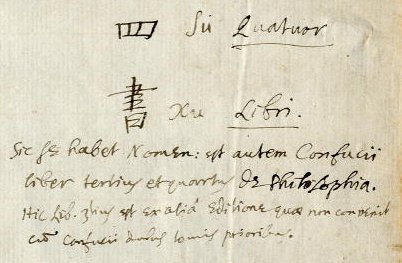
This inscription is found on the inside of the front cover, and was made in 1687 during the famous visit of Shen Fuzong, when the opportunity was taken of asking him to identify all the Chinese materials that were currently in the Library. Shen wrote the titles on to the items in Chinese characters, together with their romanised pronunciation. He then explained the books in Latin to Thomas Hyde (who was Bodley’s Librarian at the time) , and Hyde wrote it down. This inscription illustrates the process perfectly, clearly showing the different hands of Shen and Hyde. The inscription “四書 Lib.III.IV.” on the front cover was probably also made at this time.

Hyde was thus able to make a list of all the Chinese materials then in the Bodleian, which can be found among his papers at the British Library (MS Sloane 853). His descriptions are a summary of those written on to the books themselves at the time of Shen’s visit. They were later used almost unchanged in Edward Bernard’s Catalogi librorum manuscriptorum Angliae et Hibernae in unum collecti, cum indice alphabetico (Oxford, 1697) to describe the Libri sinenses in Arch.Bodl.A (p.149),  where what is now Sinica 2  appears as:

2786.3 Confucii lib. 3. & 4. dictus Sic-shu, de philosophia.

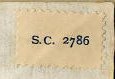
The printed label “S.C.2786” at the top right refers to the entry in F. Madan and H.H.E. Craster’s Summary catalogue of Western manuscripts in the Bodleian Library at Oxford, the first part of which is simply a new edition of the Bernard catalogue and preserves the same numbering. The entry is found in volume 2 part 1 (Oxford, 1922), p.539.

4.

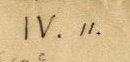
It appears that sometime during the latter part of the 18th century, the Chinese books were classified according to the scheme in Etienne Fourmont’s Linguæ Sinarum Mandarinicæ, hieroglyphicæ, grammatica duplex, Lat. &cum characteribus Sinensium. Item Sinicorum Regiæ bibliothecæ librorum catalogus which had been published in Paris in 1742. It is not known when we acquired our copy (shelfmarked G 6.11 Art). In his catalogue, Fourmont arranges the Chinese books in nine categories, of which Libri apud sinas sacri, aliàs Canonici, aliàs Classici is the fourth. And so Sinica 2 was assigned the number IV, and the II presumably means that it was the second book in that category. The number IV is also found on a small label pasted on to the spine.

5.

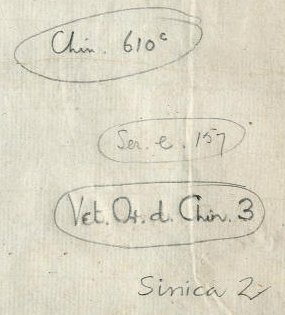
The pencilled shelfmarks in the lower half of the inside front cover show how the book has been referenced during the modern history of the Library, and the full details of the Chinese shelfmarking systems throughout that period will be the subject of a separate blog entry.

To put it briefly, Chin.610c is the number assigned to the book by James Legge, when as Oxford’s first Professor of Chinese he turned his attention to the Bodleian’s Chinese collection, probably during the late 1870s or early 1880s. It appears towards the end of his manuscript catalogue, which by that time had become little more than a simple handlist, and is described simply as “Portions of the Four Books”.

Ser.e.157 is the shelfmark assigned by A.F.L. Beeston and E.O. Winstedt when they re-arranged the unsized “Chin.” collection into the sized “Serica” collection in 1938 to 1939; the sizing system had been devised by E.W.B. Nicholson (Bodley’s Librarian) and came into use at the end of 1883, and the letter “e” denotes a book between 7 and 9 inches tall.

Norman Sainsbury devised many Baroque schemes as Keeper of Oriental Books between 1956 and 1976, among them the “Vet.Or.” collection, which was designed to accommodate the rarities then dispersed among the Library’s modern oriental collections. Thus did the book acquire the shelfmark Vet.Or.d.Chin.3.  (It may interest you to know that it was against Sainsbury’s wishes that Robert Shackleton appointed me in April 1976, a fact which Sainsbury made no effort to keep secret).

The present shelfmark of the book is Sinica 2. I created the Sinica Collection at the beginning of 1980 when it became clear that the number of pre-modern Chinese books in the Library was so large that they deserved their own autonomous sequence – Sainsbury had only abstracted the very earliest ones for his Vet.Or. Within the Sinica Collection, the books are arranged logically in order of acquisition, to the extent that this is possible, from the earliest times to the present. All old, rare, or otherwise valuable Chinese language accessions are added to it.

Tongwenguan publications

31 October 2012

The Tongwenguan 同文館 was one of two bodies that operated in late imperial China under the auspices of the Zongli Yamen, or to give it its full name, the Zongli Geguo Shiwu Yamen 總里各國事務衙門, literally “office for regulating dealings with the various nations”. (The other body, by the way, was the Inspectorate General of the Imperial Maritime Customs 大清皇家海關總稅務司, which operated under the control of westerners appointed by the government, notably Robert Hart, who served as Inspector-General from 1863 until his death in 1911.)

It was established in 1862 by the emperor’s uncle Yixin 奕訢 (1833-1898), better known as Prince Gong 恭親王, and its initial purpose was to provide instruction in foreign languages to Chinese diplomats. Its curriculum was later expanded to cover western science, law, and international relations. The Boxer Protocol of 1901 replaced the Zongli Yamen with the Waiwubu 外務部 (“Ministry of Foreign Affairs”), and in 1902 the functions of the Tongwenguan were taken over by the newly established Peking University, whose present School of Foreign Languages regards it as its direct ancestor.

A most important activity of the Tongwenguan was the translation of western books into Chinese, starting with W.A.P. Martin’s translation of Henry Wheaton’s Elements of international law, which it published in 1864 with the Chinese title Wanguo gongfa 萬國公法.


These books were produced to a high standard and distributed free throughout the empire. Although the Tongwenguan published far fewer titles than the Kiangnan Arsenal which was operating contemporaneously in Shanghai, they were probably more influential owing both to their subject matter (many of the Kiangnan Arsenal publications were on highly specialised technical subjects), and the close relation of the Tongwenguan with the Zongli Yamen and its highly placed officials in the heart of the capital.

I have found the following general sources of information on the Tongwenguan useful:

  • Martin, W. A. P.: The Tungwen College. Appendix F (pp.471-478) of H. B.  Morse’s International relations of the Chinese Empire, Volume 3 (London, 1918)
  • Biggerstaff, Knight: The T’ung Wen Kuan. In The Chinese social and political science review, 1934/1935 (pp.307-340).
  • 蘇精: 清季同文館. 台北, 民國68年[1979].
  • 陈向阳: 晚清京师同文館组织研究. 广州: 广州高等教育出版社, 2004.

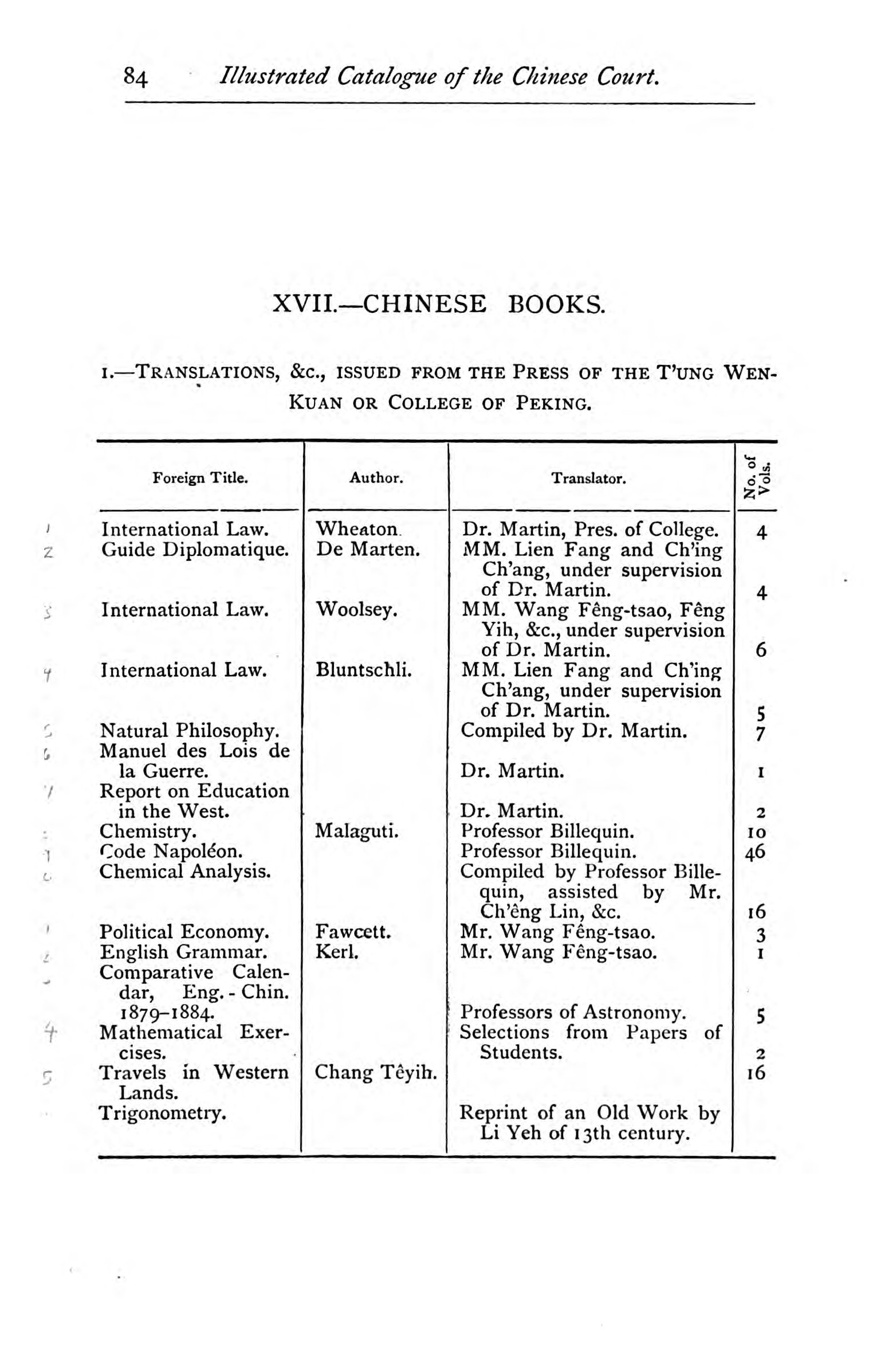
It remains difficult, however, to determine precisely how many western books were translated and published by the Tongwenguan. There is no definitive list such as that produced by the Kiangnan Arsenal cited in my earlier blog contribution on that subject. Su Jing lists 36 different publications (pp.208-213). Martin (Morse Appendix F p.478) lists 22, all of which are found in Su Jing’s list. Biggerstaff (pp.332-333, note 84) lists 21, of which 20 are found in the College’s calendar for 1888 and a further one in W.A.P. Martin’s A cycle of Cathay (London, 1896, p.235); all are also found in Su Jing’s list. The Illustrated catalogue of the Chinese collection of exhibits for the International Health Exhibition (London, 1884) referred to below lists only 16 (on  p.84), of which the last two are not found in Su Jing’s list, perhaps because they are not either translations or works by western writers, but simply Chinese works by Chinese writers, one of them being the work on trigonometry 測圓海鏡細草 by the 13th century writer Li Ye 李冶.

Some of the Tongwenguan publications were unusually influential, and have been the subject of detailed study. An excellent account of the very first one, Wheaton’s Elements of international law, is found in the website of an ambitious but apparently abortive project in the University of Erlangen – I have already alluded to the evanescence of what is found on the internet, and hope it hasn’t disappeared.

And a well-researched piece of work by Zhang Hao makes a detailed study of the contribution to the development of modern Chinese chemistry, and of chemical terminology, by Anatole Billequin, the College’s first Professor of Chemistry, evidenced in a number of Tongwenguan publications: 張澔: 畢利幹(Anatole Billequin) – 同文館第一位化學教習與近現代中國化學, in 中華科技史學會會刊, 8(2005:1), 33-42.

The Bodleian has eleven Tongwenguan editions, of which ten came with the collection of Chinese books (mostly Protestant missionary publications) exhibited at the International Health Exhibition in London in 1884 under the auspices of the Inspector General of Customs (whose connection with the Tongwenguan has been pointed out above). See Helliwell: Two collections of nineteenth century Protestant missionary publications in the Bodleian Library, in Chinese culture (Taipei) 31:4(1990) – a paper originally presented at the International Conference on Resources for Chinese Studies, Taipei, 30 November – 3 December 1988.

Here is an image of the page in the exhibition catalogue on which they are listed:

We did not receive all sixteen of those listed (it is inconceivable that we did receive them and subsequently lost them), and the first and most important of them, Wheaton’s Elements of international law, may be of a different provenance; I found it on the shelves in my room in 1977, the year after joining the Library.

Here is what we now have, as described as in my catalogue:

1.
萬國公法 四卷 / (美)惠頓撰 ; (美)丁韙良譯
清同治三年[1864]刊本京都崇實館存板
線裝4冊 ; 30公分
本書譯自 Henry Wheaton: Elements of international law (6th ed., Boston, 1855)
Sinica 2887

2.
星軺指掌 三卷續卷一卷 / (清)聯芳, (清)慶常仝譯
清光緒二年[1876]北京同文館聚珍版本
線裝4冊 ; 30公分
本書譯自 Karl Freiherr von Martens: Guide diplomatique
續卷摘譯美國領事則例
Sinica 2121

3.
公法會通 十卷 / (德)步倫氏撰 ; (美)丁韙良譯
清光緒庚辰[1880]北京同文館聚珍版本
線裝5冊 ; 30公分
本書譯自 Johann Caspar Bluntschli: Das moderne Voelkerrecht der civilisirten Staten
Sinica 2122

4.
化學指南 十卷 / 法國畢利幹著
清同治癸酉年[1873]京都同文館集珍版本
線裝10冊 ; 30公分
本書譯自 Faustin-Jovita-Marinus Malaguti: Leçons élémentaires de chimie
Sinica 2123

5.
法國律例 刑名定範四卷﹑刑律四卷﹑貿易定律六卷﹑園林則律二卷﹑民律二十二卷﹑民律指掌八卷 / (法)畢利幹口譯 ; (清)時雨華筆述
清光緒六年[1880]北京同文館聚珍版本
線裝46冊 ; 28公分
本書譯自 Code Napoléon
Sinica 2124

6.
化學闡原 十五卷 / (法)畢利幹口譯 ; (清)王鍾祥筆述
清光緒八年[1882]北京同文館聚珍版本
線裝16冊 ; 28公分
本書譯自 Carl Remigius Fresenius: Traité d’analyse chimique qualitative
Sinica 2125

7.
富國策 三卷 / (英)法思德撰 ; (清)汪鳳藻譯
清光緒六年[1880]北京同文館聚珍版本
線裝3冊 ; 30公分
本書譯自 Henry Fawcett: Manual of political economy
Sinica 2126

8.
英文舉隅 / (美)喀爾氏撰 ; (清)汪鳳藻譯
清光緒五年[1879]北京同文館聚珍版本
線裝1冊 ; 26公分
本書譯自 Simon Kerl: An elementary grammar of the English language (21st ed., New York, 1868)
Sinica 2127

9.
算學課藝 四卷 / (清)席淦, (清)貴榮編
清光緒庚辰[1880]北京同文館聚珍版本
線裝4冊 ; 30公分
Sinica 2128

10.
四述奇 十六卷 / (清)張德彝撰
清光緒癸未[1883]北京同文館聚珍版本
線裝16冊 ; 26公分
Sinica 2129

11.
測圓海鏡細草 十二卷 / (元)李冶撰
清光緒丙子[1876]北京同文館聚珍版本
線裝4冊 ; 26公分
Sinica 2130