Archive for the '17th century accessions' Category

Shen Fuzong and a letter writer

11 November 2018

An exhibition Shen Fuzong, the first Chinese visitor to Oxford is on display until 14 December at the China Centre in St Hugh’s College. The College’s puff describes it as “ground-breaking”, but Shen’s story has always been common knowledge.

I lost interest in it at the planning stage when it became clear that it was not to be shown in the Proscholium of the Old Library, only metres away from where the historic encounter of Shen Fuzong and Thomas Hyde (Bodley’s Librarian) took place, and where it would have been seen by countless visitors. Instead, it was to be shown in the middle of nowhere at St Hugh’s, apparently hopping to the tune of a benefactor, with the Library tagging along. But I’m always slow to see the positive side of apparently hopeless situations, and so it was on this occasion: if you visit the exhibition, you will enjoy the luxury of being alone with all the important materials relating to Shen and Hyde’s encounter.

The show is physically dominated by The Chinese convert, the life-size portrait of Michael Alphonsius Shen Fuzong made by Sir Godfrey Kneller in 1687, on loan from the Royal Collection. A series of smaller cases contain a selection of the Chinese works that Shen identified for Bodley’s Librarian Thomas Hyde (all listed in my page Chinese books in Europe in the 17th century), together with the notes (now in the British Library) on these and other things that Shen and Hyde discussed during Shen’s six-week stay in Oxford.

Shen_Fo-tsung

Shen Fuzong is the Bodleian’s first Chinese cataloguer. During the course of his stay in the autumn of 1687, he examined almost all the Chinese books in the Library’s collection at the time, well over one hundred, of which all but one are still there. He wrote down the romanised title of each book on the cover, and then explained what the book was in Latin to Thomas Hyde, who wrote the description down beside Shen’s romanisation. Later, Hyde shortened them and made a list of them (now among his papers in the British Library, Sloane Or. 853), and it is from this list that Edward Bernard copied almost unchanged the entries for the Chinese books in Oxford in his famous Catalogi librorum manuscriptorum Angliae et Hibernae in unum collecti, cum indice alphabetico, which was published posthumously in 1697, the year of his death. Bernard described the Chinese books elsewhere, which Shen did not see, as simply “Liber Chinensis”. I have transcribed all Bernard’s entries for the Chinese books in the Bodleian and provided their current shelfmark together with their number in Hunt and Madan’s Summary catalogue; my transcription can be seen here.

A selection of these books in the exhibition illustrates the modus operandi of Shen and Hyde perfectly. I will take one example which should have been in the exhibition, but isn’t. They put the wrong book out. The caption identifies it as “Tu xiansheng pingshi mou yeji [sic – for mouye ji] … collection of essays by the famous Ming poet and artist Wang Zhideng (1535-1612) … Sinica 27″.

Actually, Sinica 27 is not a bad choice, and perhaps it will have its own blog entry some time in the future. It is a unique surviving illustrated edition of selected yuefu 樂府 (a poetic genre), described thus in my catalogue:

新鍥梨園摘錦樂府菁華 十二卷 / (明)劉君錫輯
明萬曆庚子[1600]書林三槐堂王會雲刊本
洋裝(原線裝)1冊 : 圖 ; 27公分
本書為海內外孤本
Sinica 27

s00434 s00435 s00436

But it isn’t the book that should have been put out, which is Sinica 30, nor is Sinica 30 a collection of essays. The organisers of the exhibition were informed of this a month ago, but to no effect. I wonder what this tells us about the state of things.

Let’s turn to Sinica 30, and see what it actually is and how Shen and Hyde dealt with it. I have described it thus in my catalogue:

屠先生評釋謀野集 四卷 / (明)王穉登撰 ; (明)屠隆評釋
明萬曆中建陽書林熊體忠刊本
洋裝(原線裝)1冊 ; 27公分
Sinica 30

moyefm 
mouyetc 
moyefp 
moyelp

The book is a collection of Wang Zhideng’s correspondence, as a mere glance at the table of contents makes clear: it lists letters he sent, replies to letters received, and what in e-mail parlance we would call “conversations”.

Wang’s correspondence was first published by Yu Wenshu 郁文叔 in an edition prefaced 1588 (萬曆十六年序江陰郁氏玉樹堂刊本) which is not very common, and it has ten juan 卷. In his preface to this work, Feng Shike 馮時可 (himself a prolific writer) says that Yu decided to print Wang’s correspondence because he had a very high opinion of him, and that it was Yu who gave it the name mouyeji 謀野集. The term mouye 謀野 is difficult to translate, but I take it to mean “engaging with those in distant parts” – an elegant way of saying “corresponding”.

When Wang’s friend Tu Long 屠隆 got hold of this edition, he decided to select the finest letters and present them in four juan 卷, and to provide them with commentary and explanations for the convenience of his readers; that is, he turned it into a textbook. This was quite clear to Shen Fuzong, who first transliterates the words mouye (meuye in his native dialect), and then explains their meaning to Thomas Hyde who writes it down in Latin. A longer explanation follows:

meuye

Est nempe formularium epistolarum juvans excogitare materiam scribendam ad amicos distantes (“This book is actually a formulary of letters, dealing with material suitable for writing to distant friends”). In other words, it is a letter-writer.

The longer description of Mouyeji on the book itself becomes Liber Meu-ye, seu Formularium Epistolarum in Hyde’s manuscript list (where it is no.56), and almost unaltered as Lib. Meu-ye seu Formularium Epistolarum in the Bernard catalogue.

The letter-writer is one of two in my 17th century list, and unlike many items in that list, it is complete. It has been studied seriously, as evidenced by the manuscript notations on each leaf, clearly visible on the first page of text illustrated above – the circles and dots are used both to punctuate and as an equivalent to our underlining. The copy bears two seals:

seals2

These are not collectors’ seals, but are of the sort bought off the peg for decorative purposes and bear the whimsical sentiments si ru feng yun 思入風雲 “my thoughts enter the wind and clouds” and yin feng nong yue 吟風弄月 “singing of the wind and moon”.

This book has been used and valued by somebody, and bears clear evidence of its owner’s preoccupations.

Model answers

29 July 2014

Chinese books in Europe in the 17th century was one of my first attempts to take stock of our holdings and bring them to the attention of scholars. It was there that Robert Batchelor first noticed my rather primitive description of what we now know as the Selden map of China, and this is what led him to examine the map and to discover its unique importance.

I have still not catalogued all the items in this list, because they are mostly fragmentary, and very difficult both to identify and to describe in a satisfactory way. Our five fascicles of “model answers” are a case in point. I used one of them in the exhibition recorded in my previous blog entry without really knowing exactly what it was, except on the most superficial level. I never imagined that to identify and describe them would take me a fortnight’s work, and I’m still not entirely satisfied with the result.

Colleagues in the Faculty have occasionally suggested that it might be a good exercise for research students to take things from this corpus and work on them, perhaps even to the point of basing a dissertation on them. Glen Dudbridge did no less when he used a unique surving edition of Xiyouji (Sinica 35) for his doctoral dissertation in 1967.

Our “model answers” volumes have no proper title as they are an assemblage of over 900 leaves from various editions, as set forth below. So I have invented a descriptive title for them based on what often appears in the banxin of the leaves, model (程式) examination essays (墨卷) on the Four Books (四書), as follows:

四書程式墨卷 : 大學一卷中庸一卷論語二卷孟子二卷
彙編萬曆中建陽書林余氏刊「兩京傳鍥王家批選鄉會指南百家評林正式四書程墨會元全」等刊本散葉
線裝3冊 ; 27公分
Sinica 20
Sinica 21 1冊
Sinica 22 1冊

We need not spend too much time on their provenance. Like Sinica 2, they are among the Library’s earliest accessions, acquired by Bodley himself using money given by benefactors, their names being inscribed on the fascicles whose purchase they financed: Edward Michelborn (Sinica 20 and Sinica 22) and John Pory (Sinica 21). All five fascicles are paper bound, the covers of Sinica 20 and Sinica 21 being of very soft, coarse paper fairly light in colour, while those of Sinica 22 are of a smoother, darker paper. In the 1970s, in an act of rank antiquarianism the then Keeper of Oriental Books, Norman Sainsbury, had them bound in imitation 17th-century limp vellum bindings. Unfortunately, the vellum is very far from limp, and is gradually wrecking the contents it was supposed to protect.

In Edward Bernard’s famous catalogue of 1697 (for details of which see under Sinica 2), the fascicles appear as items 41-45 in the section LIBRI SINENSES (Arch.Bodl.A, p.149), and are described as “Libri Ven-chang, seu Pulchri libri, de Thematibus seu compositionibus & exercitiis studiosorum gradum ambientium”. He lumps the first four fascicles together, and describes the fifth as “Ejusdem libri pars aliqua imperfecta.”

Actually, all five fascicles are of a piece, being assemblages of leaves from different editions of model answers to examination questions, all concerned with passages from the Four books 四書. The question of which editions these leaves have been taken from is what has occupied me for much of the past fortnight, largely without success, but in all cases the internal division of the text is as given in my record, namely

大學一卷
中庸一卷
論語二卷
孟子二卷

I distinguish three separate copies among these five fascicles, because that is the only way to make sense of their contents. In the three fascicles of Sinica 21 they are distributed as follows: 1, title-page (feng mian 封面), da xue 大學, zhong yong 中庸; 2, shang lun 上論, xia lun 下論; 3, shang meng 上孟, xia meng 下孟, colophon (pai zi 牌子). And in the case of Sinica 21 and Sinica 22, these sections are all in a single fascicle, and the leaves are much fewer in number.

The first question is what editions these leaves are taken from. I can distiguish, but in most cases not identify, at least five, and there may well turn out to be more.

Edition 1.

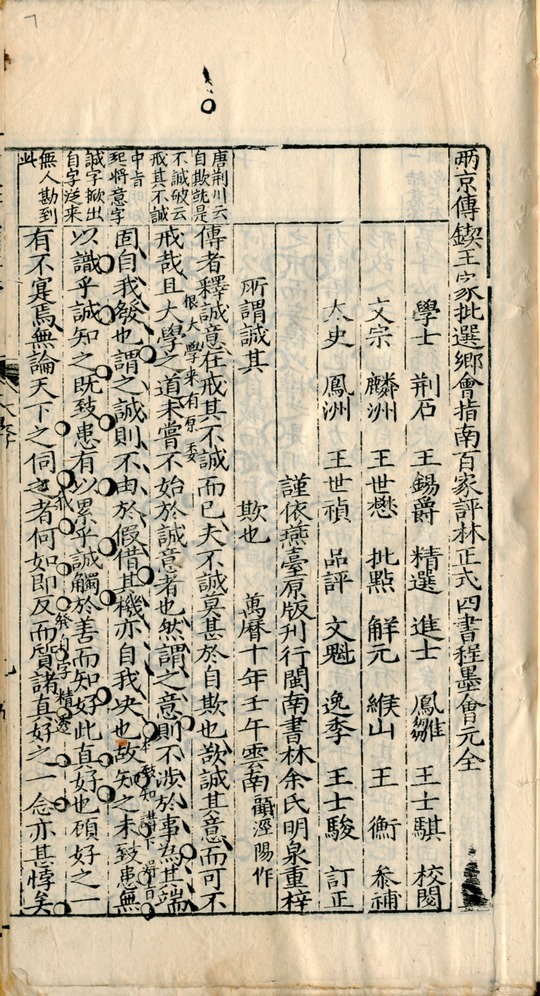
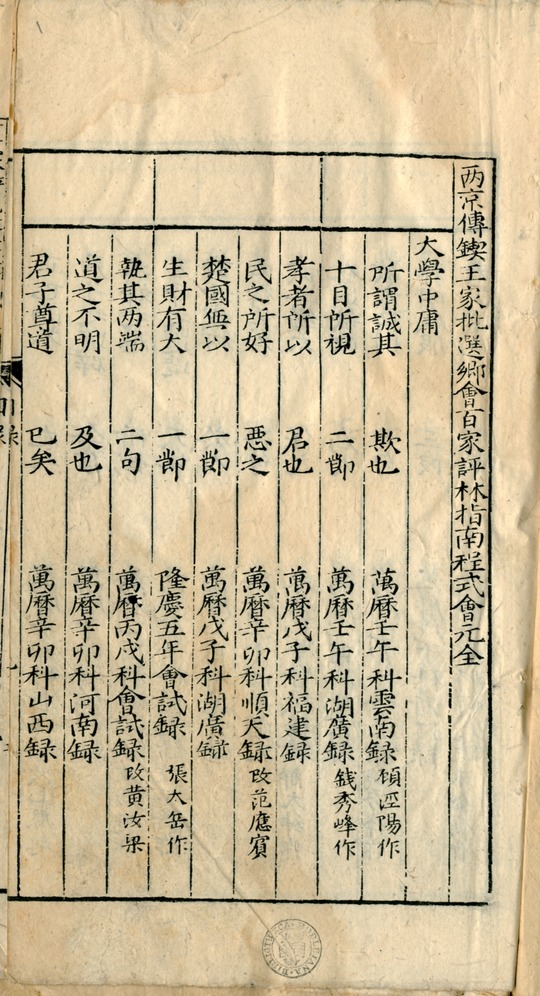
s01633 s01632

This is the first edition represented in the compilation. The table of contents and first leaf of text survive from three of the six sections: da xue 大學, zhong yong 中庸, and shang meng 上孟. In all cases the first essay corresponds with that listed in the table of contents, and the leaves are identical in format. The information given in these two pages, combined with the evidence of other surviving sections and our knowledge of the book’s provenance enable us to produce a reasonably precise description of the edition:

兩京傳鍥王家批選鄉會指南百家評林正式四書程墨會元全 : 大學一卷中庸一卷論語二卷孟子二卷 / (明)王錫爵精選
明萬曆中閩南書林余氏明泉重梓「甲」本

Edition 2.

s01645 s01644

At first sight, this edition is identical with the first one, and when catalogued would produce an identical entry. Luckily, two pages that correspond with those of the first edition (the table of contents and first page of the da xue 大學) are present, enabling us to see that not only are the blocks different, but also that the text consists of an entirely different set of essays. We can therefore label the editions “a” 甲 and “b” 乙:

兩京傳鍥王家批選鄉會指南百家評林正式四書程墨會元全 : 大學中庸一卷論語二卷孟子一卷 / (明)王錫爵精選
明萬曆中閩南書林余氏明泉重梓「乙」本

Edition 3.

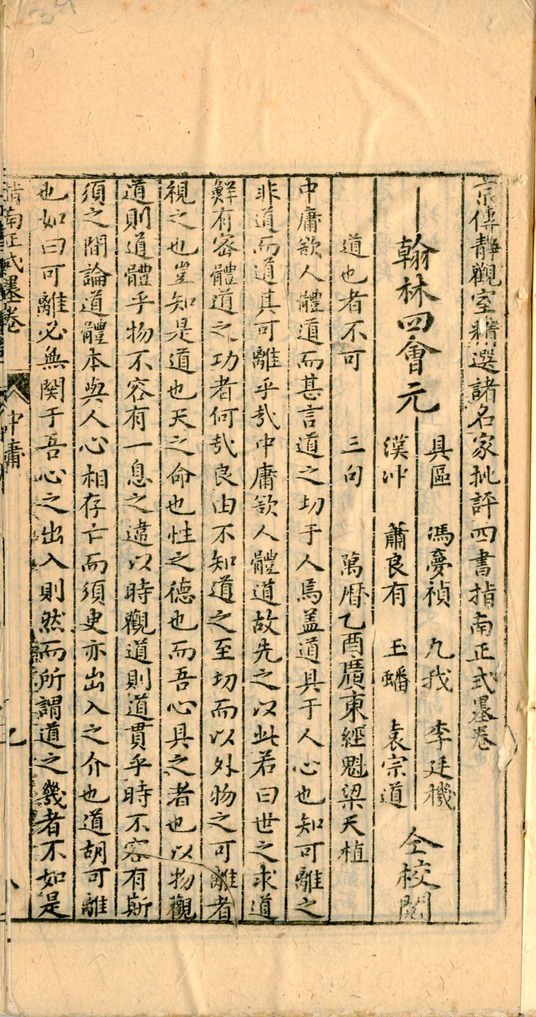
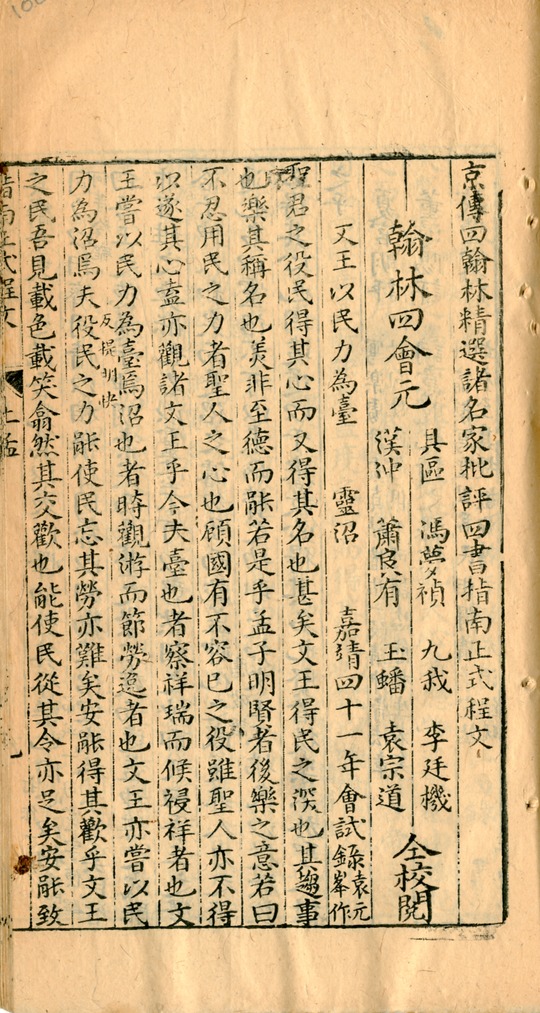
s01635 s01634

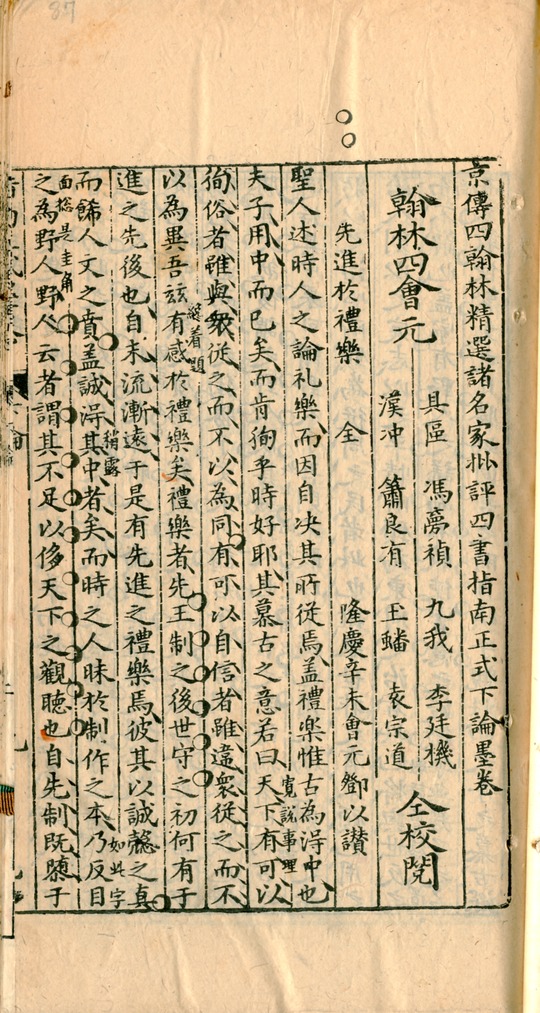
s01640 s01643

This set of pages is rather more difficult to deal with, as it is not clear whether one, two, or even more editions are represented. We have the first leaves from the da xue 大學, zhong yong 中庸, xia lun 下論, and shang meng 上孟 sections, but no corresponding tables of contents. The da xue and zhong yong sections bear the title 「京傳靜觀室精選諸名家批評四書指南正式墨卷」, whereas the xia lun and shang meng sections bear the title 「京傳四翰林精選諸名家批評四書指南正式墨卷」. This does not necessarily mean that two different editions are present, as it is quite common for the chapter titles in editions of this sort to vary in this way. Only the presence in the copy of different versions of the same leaves would confirm that more than one edition were involved. This would involve a detailed study of all the “inner” leaves of the assemblage, and to do the job properly, sooner or later someone must list them, arrange them in order, and compare them. But as there are over 900, this is a task which I’m going to leave to the dissertation-writer. Aside from the title, this and the editions below differ from (1) and (2) in their block format (the frame is not divided) and the thinner, yellower paper on which they are printed.

Edition 4.

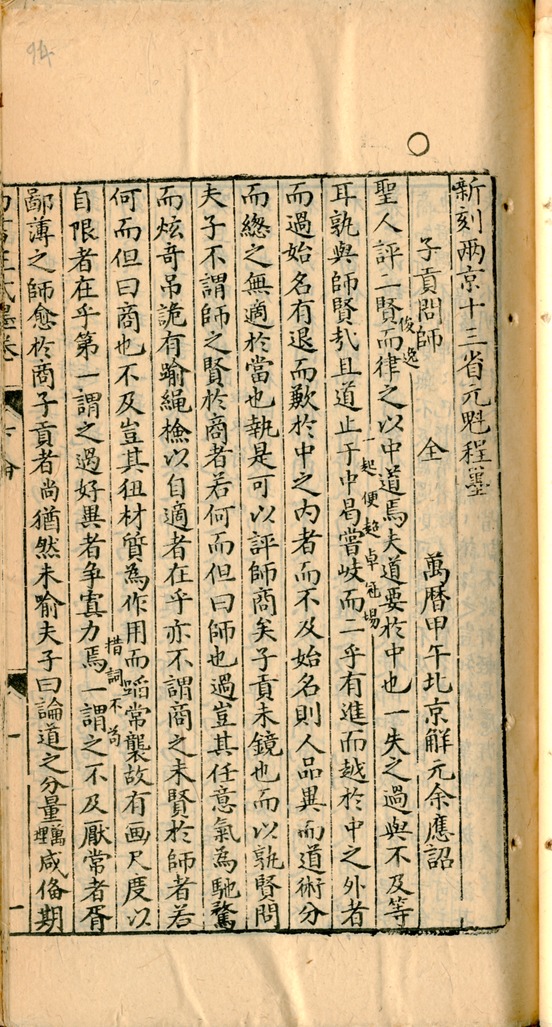
s01650 s01649

These two leaves are even more problematic. They are entitled 「新刻兩京十三省元魁程墨」 and 「新刊乙未科會試五魁墨卷」. Both are the first leaves of the xia lun 下論 section. Their format is different from that of any other leaf in the assemblage in that it has two yu wei 魚尾 (fishtails) in the central column of the block. Although it is possible that two different editions are present, it is equally possible that the leaves represent different sections of an unusually complex compilation.

Edition 5.

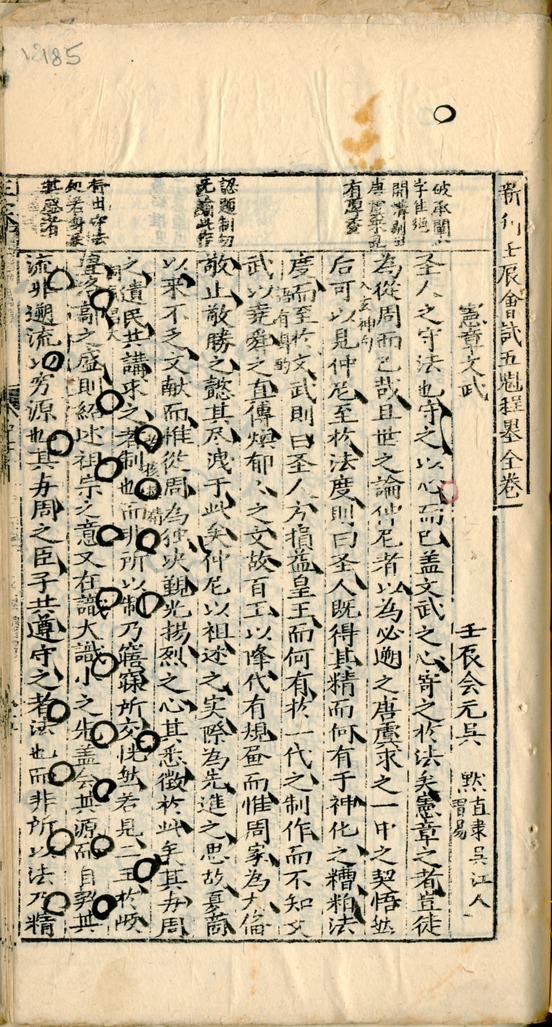
s01648

This is the only leaf I have discovered in the assemblage that has the title in a so-called “ear” (shu er 書耳) projecting from the side of the text frame: 「新刊壬辰會試五魁墨卷全卷」. The block format is identical with that of editions (1) and (2), and the paper is also the same, but if it is from one of those editions, it is odd that of the hundreds of pages present, it should be the only one to have an “ear”. Also, the title is very different, having more in common with edition 4. I’m therefore inclined to regard it as perhaps a fifth edition in the assemblage.

Title page.

s01630

The title-page (or shall we say a fengmian 封面) at the beginning of Sinica 20/1 is printed on the thinner bamboo paper, and so may be of a piece with editions (3) and (4). The text of the title-page is not very helpful.

Colophons

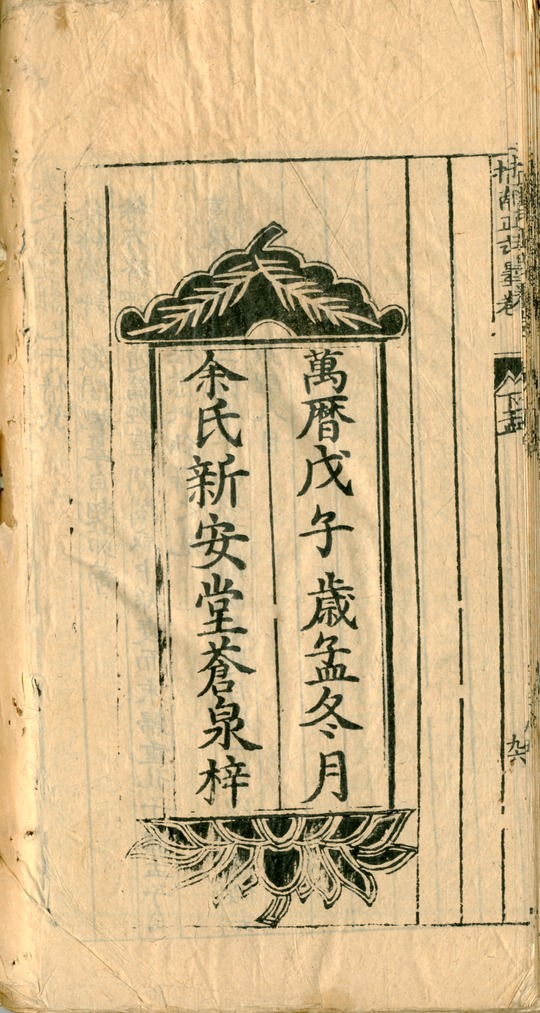
s01647 s01639

The block format of these two colophons, obviously both from the end of the xia meng 下孟 sections of their respective editions, suggests that they are from editions (3) or (4) above, but it is impossible to say which. Here again, a detailed analysis and comparison of the “inner” leaves might help, but without the tables of contents of these editions it is doubtful if any definite conclusion could be drawn. They do however give us some very useful information: the date 1588, and the names of Yu family members. So we know that at least three members of that prolific printing dynasty turned their hand to printing model answers: Yu Mingquan 余明泉 (editions 1 and 2), Yu Cangquan 余蒼泉 , and Yu Xiufeng 余秀峰.

A problem

s01631

This leaf comes right at the front of the first fascicle in the assemblage (Sinica 20/1), and presents a horrible problem as not only can it not be related to any of the contents, but in form it seems to combine elements of two different families of editions: the block format and whiter paper of editions (1) and (2), but the title of edition (3).

The various portions of the table of contents that survive of the various editions show that they were all arranged in the same way. Each of the essays examines a quotation from one of the texts, and the essays are presented in the order in which these passages appear in the text. Thus the first essay in the da xue section of Sinica 21 is on da xue zhi dao 大學之道, the opening words of the text, and the last is on the words meng xian zi yue 孟獻子曰, which comes at the end of the traditional commentary attributed to Confucius. Leaves from the various editions have been carefully intermingled to conform with this arrangement, so that inevitably there is a discrepancy between the table of contents, which obviously only applies to one edition, and what is present, which also comes from other editions which may have extra content. This, combined with manuscript punctuation and highlighting which occurs here and there throughout the copies, shows that they were no mere ornaments on the shelves of their owners, but have actually been used for serious study.

I have tried in vain to find copies of these editions in other catalogues, both printed and online. Is it possible that the leaves preserved in Sinica 20-22 are unique survivals? I also assumed that published sets of “model answers” would be very common, but I’m finding the opposite to be true. Am I looking in the wrong place, I wonder?

The clashing rocks

17 July 2013

What to call this blog entry was solved by an article in last week’s Independent (Tuesday 9 July 2013, 28-29) by David McNeill. Presumably the author found the image on the internet – I think I’ve found the one he used, which appears in numerous locations, and is rather good.

Asia Disputed Islands

The article concerns the Senkaku Gunto 尖閣群島, the uninhabited group of rocky islands situated in the East China Sea between Taiwan and Okinawa. I give the islands their Japanese name because the Japanese are currently their internationally accepted owners, backed by American interests in the area. They are however claimed by the People’s Republic of China and Taiwan, who know them as the Diaoyu islands 釣魚島 or Diaoyutai 釣魚臺.

The positions of all the claimants, together with their arguments, are set out comprehensively in the Wikipedia account of the dispute. And an interesting piece by Daniel Dzurek, written some while ago but rich in detail, is to be found here.

For sure, Diaoyutai is the earliest recorded name of the islands, and the reason the matter finds itself in this blog is because by an extraordinary coincidence, the first textual references to them appear in two documents of entirely different provenance in the Bodleian Library.

Both texts were discovered by Xiang Da (Hsiang Ta 向達) during his stay in Oxford from November 1935 until December 1936, which had been arranged by Yuan Tongli (Deputy Director of the National Library of Peiping), E.R. Hughes (recently appointed Reader in Chinese Philosophy and Religion at Oxford University), and Edmund Craster (Bodley’s Librarian) to enable him to catalogue the Library’s Chinese collections. Xiang Da’s stay in Oxford has been documented by Frances Wood in a recently published memorial volume for him (敦煌文獻‧考古‧藝術綜合研究 : 紀念向達先生誕辰110周年國際學術研討會論文集 / 樊錦詩, 榮新江, 林世田主編. – 北京 : 中華書局, 2011. – ISBN 978-7-101-08337-8). The original English text of her account can be seen here.

Xiang Da’s work in the Bodleian is particularly important for at least two reasons.

Firstly, he set up the first Chinese card catalogue in the Bodleian, and as described by Frances Wood, it was constructed along very sound lines which other libraries at the time would have done well to follow. I was still adding to this catalogue until it was closed in 1991, when automated Chinese cataloguing began.

And secondly, he wrote a lengthy article on the Bodleian’s historic Chinese collections, albeit with a few errors, in the journal of Peiping Library (as the National Library of China was then called) which introduced them to a wide audience in the Far East, and is still used to this day (瀛涯瑣誌 – 記牛津所藏的中文書, in 北平圖書館館刊 10:5, 1936, 9-44).

It is here (pp.30-33), I think, that the two rutters were introduced to sinology (and to politics) for the first time, although at the time the article was written, the ownership of the Diaoyu islands was not much of an issue, so there was no reason to mention to them, any more than to mention the numerous other locations referred to in the texts.

Twenty-five years later, Xiang Da published an account of the texts, with full transcriptions of them:

兩種海道針經 / 向達校注
北京 : 中華書局, 1961
平裝1冊(277頁) : 圖, 地圖 ; 18公分
(中外交通史籍叢刊)
附地名索引
統一書號 11018.142

As a result, the rutters became widely known in the Far East, and in recent years, they have become available on the internet in various locations.
Less freely available are original images of the texts, which have only just been made. It is planned to make them available in their entirety from the Serica interface in the near future, but for the convenience of those who might be interested in this matter right now, in a moment I will show scans of the four places (two in each text) where the mentions of Diaoyutai occur. But first, a few notes on the texts themselves.

The first is the so-called Laud rutter, described as follows in my catalogue:

順風相送 : 不分卷 / (明)佚名撰
明抄本
洋裝(原線裝)1冊 ; 26公分
MS.Laud Or.145

The title by which this book is known, Shunfeng xiangsong, appears only on its cover. It is undated, but Xiang Da strongly suspects that it was produced in the 16th century (p.4).

The ultimate Chinese provenance of the book is not known, and strange as it may sound, it hasn’t even been established how Laud got his hands on it. Xiang Da suggests that it came from “a European Jesuit university” (歐洲一所耶穌會大學), and indeed most of Laud’s manuscripts were of continental origin.

We know from western inscriptions on the book that it came into the Library in 1639:

s00269

and also that it was examined by Shen Fuzong and Thomas Hyde in 1687:

s00268

The second text is appended to a small collectaneum of military works, which as indicated by its shelfmark, is part of the famous Backhouse Collection which came to the Library in stages between 1913 and 1922:

兵鈐 : 內書八卷外書八卷 / (清)呂磻, (清)盧承恩編
附 指南正法 : 不分卷 / 佚名撰
清康熙乙卯[1675]序鈔本
線裝7冊 : 圖 ; 30公分
有「曾存定府行有恒堂」印記
Backhouse 578

This collectaneum never seems to have been printed, and although several manuscript copies of it are in existence (there is one complete copy and two incomplete copies in Peking University Library, another in Nankai University Library, and an incomplete copy in Princeton), only the Backhouse copy contains the vital appendix.

This seems to confirm Xiang Da’s view that although the preface to the book is dated 1675, our copy was actually written out rather later at the end of the Kangxi period, when the appendix was added.

I have only recently transcribed the single seal impression on the Backhouse copy, which informs us that it was formerly in the ownership of Zaiquan 載銓 (1794-1854), the fifth Prince Ding 定郡王, a great-great-grandson of Gaozong, the Qianlong Emperor. This I learned from a discovery on the internet, which even led me to the very bronze seal from which the impression was made, together with the help of Zheng Cheng 郑诚. If only identifying seals and their owners were always so easy! In view of the evanescence of things on the internet (to which I have referred before), for the sake of posterity, I have preserved the web-page in question here.

And here are the images of the passages concerning the Diaoyu islands. The leaves were originally unpaginated – my references are to the pencilled foliation done locally some decades ago.

順風相送, 13a:

sfxs-1

順風相送, 62a-63a:

sfxs-2

指南正法, 7b:

znzf-1

指南正法, 33b-34a:

znzf-2

Inevitably, I learned about these texts at a very early stage of my career, when my interest in our historic collections was developing in the late 1970s. But I did not know about the Senkaku Islands, nor the fact that their ownership was in dispute, until I received a letter from Kazuyoshi Umemoto, Second Secretary in the Japanese Embassy in London, dated 18 August 1981. The letter asked us to show Shunfeng xiangsong and any other related documents to Professor Toshio Okuhara, a specialist in international law and an authority on this matter. In the event, I don’t think Professor Okuhara ever came; I think it was Mr Umemoto himself, and he must have come at the approach of winter, because he had a pair of elegant leather gloves which he laid carefully on the desk before examining the manuscript. It is odd how irrelevant little details like this stick in one’s mind while one forgets more important things.

It may not be a coincidence that at the end of 1982, a year after Mr Umemoto’s visit, a second printing of Xiang Da’s book was produced. What had not been an issue in 1961 had clearly become one since, as evidenced in some small but significant changes to the text.

In glossing the island Huangweiyu 黃尾嶼 (p.168,n.1), the changes are as follows:

1961: 黃尾嶼為今尖閣群島之久場島. (“Huangweiyu is the present Kubashima in the Senkaku Islands.”)
1982: 黃尾嶼為我國臺灣省所屬島嶼. (“Huangweiyu is an island which belongs to our country’s Taiwan Province.”)

And in the place-name index (p.253) the entries for the alternative names of the islands have also been modified:

1961: 釣魚嶼 — 釣魚嶼為自臺灣基隆至琉球途中尖閣群島中之一島, 今名魚釣島, 亦名釣魚島. (“Daioyuyu — Diaoyuyu is one of the Senkaku Islands which lies on the way from Jilong in Taiwan to the Ryukus; its present name is Yudiaodao, and it is also called Diaoyudao.”)
1982: 釣魚嶼 — 釣魚嶼在臺灣基隆東北海中, 為我國台灣省附屬島嶼, 今名魚釣島, 亦名釣魚島. (“Diaoyuyu — Diaoyuyu is in the sea to the northeast of Chilong in Taiwan, and is an island belonging to our country’s Taiwan Province; its present name is Yudiaodao, and it is also called Diaoyudao.”)

1961: 釣魚臺 — 此指琉球群島中尖閣群島之魚釣島, 一般作釣魚嶼, 亦作釣魚臺. (“Diaoyutai — This refers to Yudiaodao in the Senkaku Islands in the Ryukus, and it is commonly called Diaoyuyu or Diaoyutai.”)
1982: 釣魚臺 — 此指臺灣基隆東北海上之釣魚島, 一般作釣魚嶼, 亦作釣魚臺. (“Diaoyutai — This refers to Diaoyudao in the sea to the northeast of Chilong in Taiwan, and it is commonly called Diaoyuyu or Diaoyutai.”)

Most recently, in September 2012, in a further attempt to cement their claim to the islands the Chinese published a large and detailed map of “The Peoples Republic of China’s Diaoyudao and associated islands” (ISBN 978-7-5031-7131-4); I remember buying a comparable map of the Falkland Islands in 1982 – how else was one to know where they were?

Apart from Mr Umemoto, to my knowledge the only other diplomat to examine the Laud and Backhouse manuscripts is Dr. Shen Lyushun, the Taipei Representative in London, who visited us on 30 November 2012.

I don’t know if any representative of the Chinese government has ever examined the manuscripts in the flesh, but some years ago a student told me he had been asked to look at them on their behalf.

By way of a postscript: it is ironic that Xiang Da, who discovered the documents which are now being seen by some as favouring his country’s claim to the Senkaku Islands, should have perished as a class enemy during the Cultural Revolution – and in that I suppose his visit to Oxford didn’t help. He was sent to labour in the countryside, and having a weak heart, died there almost immediately in 1966.

Sinica 41

28 March 2013

Descending into cliché, I think the time has come for me to say which book I would rescue if the Library were on fire and I could only save one.

Without doubt, it would be Sinica 41, described as follows in my catalogue:

新刊二十四孝故事 卷一 ; 新鍥重訂補遺音釋大字日記故事大成 卷二至八 / (明)佚名撰
明萬曆中鄭氏聚垣書舍刊本
線裝2冊 : 圖 ; 28公分
本書為海內外孤本
Sinica 41

s41-4

The note 「本書為海內外孤本」 indicates that the work is a unique surviving printed edition, and that alone would be sufficient reason for saving it if it were not in the company of so many other unique surviving editions in the Bodleian Library, and if it were entirely true. In fact, there is another extant copy, in the Bibliothèque nationale de France, Département des manuscrits, Chinois 1392, and this copy has been digitised. Comparison shows that the impression has been taken from the same blocks.

However, the Paris copy is rather defective, lacking the first juan in its entirety except for the last half-leaf, and also two more leaves and the last leaves of juan 8; this is the extent of the copy:

[1:1-6a missing] 1:6b-2:13a [2:13b missing] 3:1a-7:8b
[7:9 missing] 7:10a-8:7b [8:8-12 missing]

By contrast, the Bodleian copy is complete apart from a single leaf, 6:10, and the final leaf enables the work to be identified. It seems that the Oxford and Paris copies are not only unique surviving copies of the work, but also the unique surviving work of the publishing house that printed it:  鄭氏聚垣書舍. In fact, a Google search for the term 「聚垣書舍」will point only to the entry for this edition in my list of Chinese books in Europe in the 17th century (the Paris colleagues could produce a second hit by updating their catalogue entry on the basis of this information).

s41-6

As for its content, the work is a typical product of the late Ming commercial press, centred mainly in Jianyang 建陽 (in Fujian Province), but also in Jinling 金陵 (modern Nanking). The first juan is the well-known Tales of the twenty-four filial exemplars 二十四孝, but juan 2-8 are a series of more general historical morality tales.

s41-5

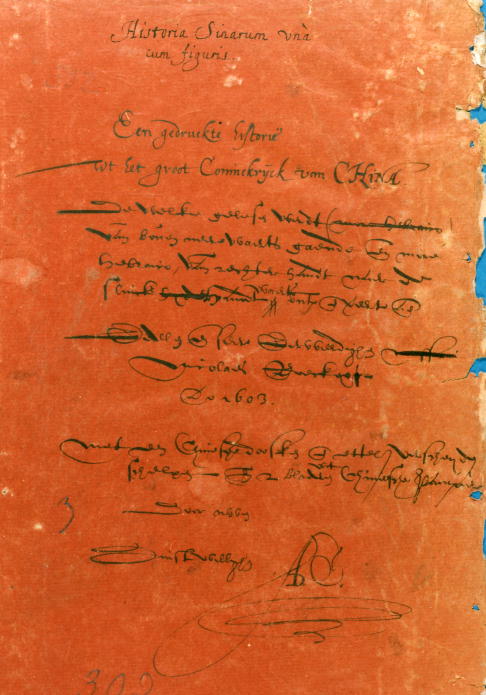
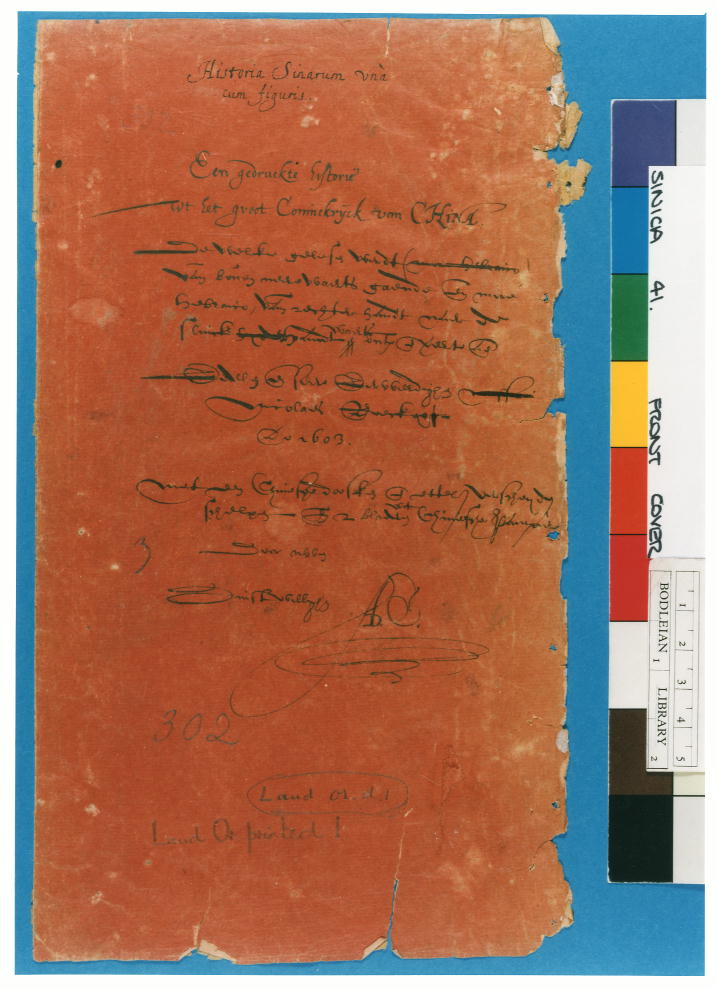
But the reason why I would rescue this book from the flames has nothing to do with either its content or its rarity. It is because of the inscription on its front cover, which is not only one of the very earliest western inscriptions on a Chinese book, but tells the story of how the first significant quantities of Chinese books came to Europe.

 s41-2

The inscription is in Dutch, and neither I nor even Piet van der Loon could read it. So Piet sent it to Professor P.G. Hoftijzer at the Sir Thomas Browne Institute in the University of Leiden, and he transcribed it as follows – I reproduce his transcription exactly as he sent it to Piet on 7 November 1992:

Transcriptie

Historia Sinarum una |
cum figuris. |

Een gedruckte historie |
wt het groot Coninckrijck van CHINA |
Dewelcke gelesen werdt [doorgestreept: (more hebraico)] |
vande boven neerwaerts gaende ende more |
hebraico, vande rechter handt naer de |
slincke [doorgestreept: sijde] Handt waerts [woord onleesbaar] ende vereert aen |

Edlen ende seer Eerweerdighen [woord doorsgestreept] |
Nicolaes [woord onleesbaar:  .oeck.o..] |
anno 1603. |

Met een Chinesche doosken ende ettelike verscheyden |
schelpen ende 2 bladen wit Chinesche pampier |

Door uwen |

Dienstwillighen A. [onduidelijke letter of combinatie van letters]. |

So we have quite a well-informed description of the book (few people at that time would know that Chinese was read top to bottom, right to left more hebraico), but what are we to make of the two lines that tell us that the book is accompanied by “a little Chinese box, various sea-shells, and two sheets of white Chinese paper”?

In fact this is the most vivid evidence we have of what can only be inferred from other sources: that this book, and others like it, was obtained by members of the Dutch East India Company from overseas Chinese traders in Southeast Asia (on whose tropical shores the sea-shells were gathered), and that it was sold as part of a job lot of curiosities at an auction in Amsterdam. That Chinese books were considered to be curiosities at that time is evidenced, for example, by the inclusion of two of them in the cabinet of curiosities of John Bargrave (1610‑1680), a canon of Canterbury Cathedral. Although this cabinet is still extant, the Chinese books have, alas, gone missing. [1]

The Dutch bibliographer Bert van Selm [2] has suggested that an important consignment arrived as a result of one specific trading expedition, in which two fleets of ships from Amsterdam companies set sail for the Indonesian archipelago on 23rd April 1601. Some of the ships returned to Holland with their goods in 1602, and it is quite possible that Sinica 41 was among them.

Other parts of the expedition returned in in the summer of 1604, the second in the spring of 1605. There followed an extraordinary sale of the cargo in Amsterdam in September 1605, which according to van Selm may be related to the publication in the same year and in the same city of a stock catalogue of Chinese books by Cornelis Claesz, the city’s leading bookseller.

The Parisian bibliographer Philippe Labbé (1607‑1670) gives the title of this catalogue as Chinensium variorum librorum Bibliotheca, siue libri, qui nunc primùm ex China seu regno Sinarum cum ipsorum atramento & charta admirandae magnitudinis aduecti sunt. Although there is sufficient evidence to show that the work actually existed [3], no copy has yet been discovered; this is unfortunate, as the catalogue is the earliest known printed list of Chinese books in Europe, and if found would represent a bibliographical source of the first importance. From time to time I search for the title on the internet – it is the Holy Grail of this subject, which has interested me for decades.

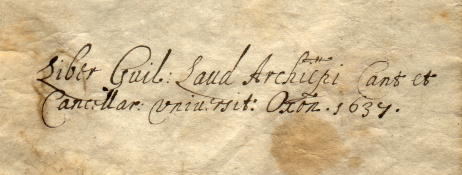
One final point – and it is an imortant one. Sinica 41 was in a grievous condition when I first encountered it. It was glued into a hard western binding that probably dated from the time when it was in the collection of William Laud, who used to own it, and whose elegant inscription is on the front endpaper:

s41-7

(One can’t help noticing that just as John Bargrave, a canon of Canterbury Cathedral, had Chinese books in his cabinet of curiosities, so the Archbishop himself possessed not only this one, but several more which are also in the Bodleian.)

The hard binding was pulling the thin paper of the book apart, and it suffered more damage whenever it was opened.

To enable our conservators to repair books like this, I conceived the idea of translating a little manual that I acquired shortly after its publication in 1980 [4], which had been written by the chief conservator in what we then called Peking Library. I worked on this intermittently during the 1980s and 1990s, and it was eventually published in 1998 – long after its completion – in Princeton’s East Asian library journal. [5]

From an earlier draft of this work, Robert Minte learned the techniques of the Chinese book conservator if not quite first-hand, certainly more authoritatively than in any English or even Chinese source than had existed hitherto. And I’m flattered that the illustrations which Chris Clarkson drew for me to illustrate some of the more unfamiliar procedures were lifted directly from my publication by Zhu Saihong without a word of acknowledgement; indeed, in her own work on Chinese book repair [6], my publication is the only one that she doesn’t include in the bibliography.

In particular, from my translation of Xiao Zhentang’s work Robert learned the technique of producing the “jade set in gold” 金鑲玉 binding, a sophisticated structure which enables the fabric of the original book to be preserved in its entirety whilst at the same time allowing it to be presented and handled as if it were new. He applied the technique to Sinica 41, and when the book had been pulled apart and the pages stabilised prior to binding, the work was photographed in its entirety, and it is from these photographs that the images in this blog entry have been produced – in 1992, when this work was done, digital imaging was still quite some way off.

Robert’s repair of this item must be considered a masterpiece by any standard, and he even went to the trouble of acquiring silk brocade from a friend in Hong Kong to cover the protective tao 套 with.

This, too, is why the book should be plucked from the flames.


1. D Sturdy & M Henig: The gentle traveller: John Bargrave, Canon of Canterbury, and his collection (Oxford, 1983), 2 & 14.
2. Cornelis Claesz’s 1605 stock catalogue of Chinese book, in Quaerendo 13:4(1983), 247‑259.
3. It is cited in Henri Ternaux-Compans: Bibliothèque asiatique et africaine, ou, Catalogue des ouvrages relatifs à l’Asie et à l’Afrique qui ont paru depuis la découverte de l’imprimerie jusqu’en 1700 (Paris, 1841), 106 (no.934).
4. 中國古籍裝訂修補技術 / 肖振棠, 丁瑜編著. – 北京 : 書目文獻出版社, 1980
5. The repair and binding of old Chinese books. In The East Asian library journal (Princeton), 8:1(1998).
6. 古籍修復技藝 / 朱賽虹著. – 北京 : 文物出版社, 2001.

Our earliest Chinese accession

29 November 2012

The earliest datable Chinese accession in the Bodleian Library is shelfmarked Sinica 2. It bears an inscription in Bodley’s hand with the date 1604, and its presence here at that time is evidence of two remarkable facts: that Chinese books were in the Library from its beginning, and that the Bodleian probably has a longer continuous history of Chinese book collecting than any other library, whether in the west or even China itself.

I have catalogued it thus:

新刻相臺分章旁註四書正文 殘三卷 / (明)蘇濬校
明萬曆中建陽書林陳心齋刊本
線裝1冊 ; 22公分
書名據卷五題
全書六卷, 殘卷四~六
Sinica 2

This edition is a down-market product of the late Ming commercial publishing industry. It is riddled with errors, and would never have found its way into the library of a scholar, which explains why this and many comparable editions in western libraries are quite unique. Even the publisher seems to be represented only by this copy.

The text

The text is that of the Four Books 四書 of Confucianism, arranged as follows in six juan of which only the last three are preserved:

翰林校正栢臺分章正文卷之四 (論語 11-20; 27 leaves)
新刻相臺分章旁註四書正文孟子卷之五 (孟子 1-7; 38 leaves)
新刊分章正文四書下孟卷之六 (孟子 8-14; 47 leaves)

We thus have the second half of the Analects and the whole of Mencius, and can infer from their arrangement that first two juan contained the Daxue 大學 and Zhongyong 中庸, and the third juan the first half of the Analects.

In the juan titles, Xiangtai 相臺 actually refers to the superb edition of the classics that was prepared by a certain Mr Yue of Xiangtai 相臺岳氏 during the Yuan dynasty at his family academy, Jingxi Jiashu 荆溪家塾. This edition was famous and much copied during the Ming and Qing dynasties, and there are two fine examples in the Backhouse Collection which I will write about presently. Here, the name is invoked to lend respectability to an edition which couldn’t be more different from that of Mr Yue. Indeed, it is so shoddy that even in the juan titles the simple character xiang 「相」 in Xiangtai is wrong in both places. In juan 4 the completely different character bai 「栢」 is used for it, and in juan 5 we find a non-existent character written with mu 「木」 on the left and ye 「頁」 on the right.

One of the juan titles also invokes the name of the Hanlin 翰林 Academy, whose members were responsible for setting the civil service examinations, in which success depended on an intimate knowledge of the classics. The attributions at the beginning of juan 4 continue the theme of lending respectability to the edition; it is said to have been instigated by Ji Cheng, whose official career as a censor had involved a tour to Fujian province 福建廵按吉澄發刊; and the text is said to have been edited by Su Jun, a graduate of 1577 and the well-known author of many scholarly works 丁丑進士蘇濬校正. It is of course highly doubtful whether either of these two highly placed people had anything at all to do with such a lowly edition (cf. the popular encyclopaedia attributed to Chang Pu described in an earlier blog entry).

The edition

The first half of Sinica 2 is missing,  so we are not able to learn anything from the title-page 封面 or other prefatory material that might have been present, nor do we know the title of the first juan, which is why I have derived the title for my catalogue entry from the most plausible among the juan that survive.

There is a printed colophon (paizi 牌子) at the end of the book bearing the words 「福河陳心齋梓」, indicating that it was printed by Chen Xinzhai from Fuhe. The words 「陳心齋重梓」 at the beginning of juan 5 corroborate this, but the different words 「石馬書林陳瑞齋刊」 at the beginning of juan 4, referring to Chen Ruizhai from Shima, introduce a complication. It is doubtful if we will ever know who either Chen Xinzhai or Chen Ruizhai were, or indeed if they were one and the same person, the publishers of the sole surviving copy of a worthless edition. Fuhe 福河 and Shima 石马镇 are small places to the northwest and southeast respectively of Longhai 龙海市, a town some 20km east of Zhangzhou 漳州 in the southern corner of Fujian province, but it is only a guess that the printer (or printers) may have originated there. Although these places are a long way from Jianyang, the centre of commercial book production during the Ming Dynasty, which in the northernmost part of the province, that the book was probably printed there is also evidenced by the reference to Ji Cheng at the beginning of juan 5, as described above.

We are on much firmer ground when it comes to dating the edition, which to judge from its appearance could be any time during the second half of the Ming. Conveniently, the reference at the beginning of juan 5 to Su Jun, the supposed editor of the text, includes the date of his graduation, 1577; and we know from Bodley’s inscription that the book was in the Library by 1604. So if we allow a few years for the date of Su Jun’s graduation to become known, and a few years for the book to get circulated, bought by foreigners, brought to Europe, and acquired by the Library, we can say with confidence that it was printed between 1580 and 1600.

The copy

The copy is a delight, as its markings paint a complete picture of how our earliest Chinese accessions have been handled from the time of their acquisition to the present day. In common with the other Chinese books that came to Europe at this time, the fascicle has been given a limp vellum binding. It is possible that this was done in Oxford, but equally possible that it was done in Amsterdam or London – we know little of how these books were distributed.  Here they are, explained one by one, starting with the earliest:

1.

“Donum Henrici Percey comitis Northumbriae A° 1604”, in the hand of Sir Thomas Bodley, inscribed upside-down on the back endpaper. In a letter to his librarian, Thomas James, dated 5 April 1603, Bodley notes that “my L. of Northumberland giueth one hundred poundes to the Librarie” (Letters of Sir Thomas Bodley to Thomas James, ed. by G.W. Wheeler, Oxford, 1926, no.78, p.83). Sinica 2 was bought with this money, but we do not know where, or from whom. Almost certainly it is one of the books that were brought back by the East India Company  at the beginning of the 17th century. These were split up, and sold by auction in Amsterdam. It is therefore quite possible that the first fascicle may be found one day in another European library.

2.

(3) Arch.A is the book’s first shelfmark, and it is inscribed on the front cover. “Arch.A” is the first cupboard on the left as one enters Duke Humfrey’s Library from the south staircase, and is the place where the Library’s Chinese books were first stored. That these were in a locked cupboard, rather than on open shelves, is an indication of their rarity and the value in which they were held at the time. The fascicles were numbered sequentially on the shelf, and this was the third. (It is now shelfmarked Sinica 2 rather than Sinica 3 because the first two fascicles on the shelf were different parts of the same copy, so that both are now shelfmarked Sinica 1. Bodley may well have acquired these before Sinica 2, but as they are not inscribed we shall probably never know.)

3.

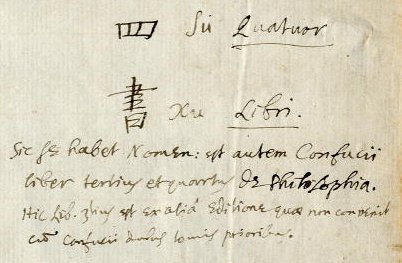
This inscription is found on the inside of the front cover, and was made in 1687 during the famous visit of Shen Fuzong, when the opportunity was taken of asking him to identify all the Chinese materials that were currently in the Library. Shen wrote the titles on to the items in Chinese characters, together with their romanised pronunciation. He then explained the books in Latin to Thomas Hyde (who was Bodley’s Librarian at the time) , and Hyde wrote it down. This inscription illustrates the process perfectly, clearly showing the different hands of Shen and Hyde. The inscription “四書 Lib.III.IV.” on the front cover was probably also made at this time.

Hyde was thus able to make a list of all the Chinese materials then in the Bodleian, which can be found among his papers at the British Library (MS Sloane 853). His descriptions are a summary of those written on to the books themselves at the time of Shen’s visit. They were later used almost unchanged in Edward Bernard’s Catalogi librorum manuscriptorum Angliae et Hibernae in unum collecti, cum indice alphabetico (Oxford, 1697) to describe the Libri sinenses in Arch.Bodl.A (p.149),  where what is now Sinica 2  appears as:

2786.3 Confucii lib. 3. & 4. dictus Sic-shu, de philosophia.

The printed label “S.C.2786” at the top right refers to the entry in F. Madan and H.H.E. Craster’s Summary catalogue of Western manuscripts in the Bodleian Library at Oxford, the first part of which is simply a new edition of the Bernard catalogue and preserves the same numbering. The entry is found in volume 2 part 1 (Oxford, 1922), p.539.

4.

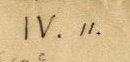
It appears that sometime during the latter part of the 18th century, the Chinese books were classified according to the scheme in Etienne Fourmont’s Linguæ Sinarum Mandarinicæ, hieroglyphicæ, grammatica duplex, Lat. &cum characteribus Sinensium. Item Sinicorum Regiæ bibliothecæ librorum catalogus which had been published in Paris in 1742. It is not known when we acquired our copy (shelfmarked G 6.11 Art). In his catalogue, Fourmont arranges the Chinese books in nine categories, of which Libri apud sinas sacri, aliàs Canonici, aliàs Classici is the fourth. And so Sinica 2 was assigned the number IV, and the II presumably means that it was the second book in that category. The number IV is also found on a small label pasted on to the spine.

5.

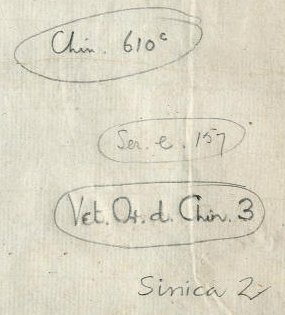
The pencilled shelfmarks in the lower half of the inside front cover show how the book has been referenced during the modern history of the Library, and the full details of the Chinese shelfmarking systems throughout that period will be the subject of a separate blog entry.

To put it briefly, Chin.610c is the number assigned to the book by James Legge, when as Oxford’s first Professor of Chinese he turned his attention to the Bodleian’s Chinese collection, probably during the late 1870s or early 1880s. It appears towards the end of his manuscript catalogue, which by that time had become little more than a simple handlist, and is described simply as “Portions of the Four Books”.

Ser.e.157 is the shelfmark assigned by A.F.L. Beeston and E.O. Winstedt when they re-arranged the unsized “Chin.” collection into the sized “Serica” collection in 1938 to 1939; the sizing system had been devised by E.W.B. Nicholson (Bodley’s Librarian) and came into use at the end of 1883, and the letter “e” denotes a book between 7 and 9 inches tall.

Norman Sainsbury devised many Baroque schemes as Keeper of Oriental Books between 1956 and 1976, among them the “Vet.Or.” collection, which was designed to accommodate the rarities then dispersed among the Library’s modern oriental collections. Thus did the book acquire the shelfmark Vet.Or.d.Chin.3.  (It may interest you to know that it was against Sainsbury’s wishes that Robert Shackleton appointed me in April 1976, a fact which Sainsbury made no effort to keep secret).
The present shelfmark of the book is Sinica 2. I created the Sinica Collection at the beginning of 1980 when it became clear that the number of pre-modern Chinese books in the Library was so large that they deserved their own autonomous sequence – Sainsbury had only abstracted the very earliest ones for his Vet.Or. Within the Sinica Collection, the books are arranged logically in order of acquisition, to the extent that this is possible, from the earliest times to the present. All old, rare, or otherwise valuable Chinese language accessions are added to it.