Archive for the 'ephemera' Category

Popular literature

29 March 2022

Since ceasing to be employed by the Bodleian some four and a half years ago, I’ve been trying my best to complete the cataloguing of the Library’s pre-modern and so-called “special” Chinese collections as a private scholar. Inevitably I’ve left the most difficult things until last.

These are some very down-market works of popular literature made by Piet van der Loon. I remember seeing some of them in his study in his house on Boars Hill on my frequent visits there, but never paid much attention to them. I think that he, too, had put them aside for dealing with one day in the future, which of course never came. There are several hundred of them, and I wouldn’t even have known what they were if he hadn’t tied them in bundles and labelled them.

They are extremely difficult to catalogue because they challenge the rules, which were drawn up for cataloguing regular publications, not casually produced ephemera. Again and again one is faced with the choice of either following the rules, or cataloguing the works in such a way as to show the reader what they are and to give access to them. The ideologues in our cataloguing departments often forget this, and would do well to conduct research using their own catalogues from time to time and see for themselves how difficult it often is to find things in them unless the rules are bent.

In these popular and very localised works, occasionaly rather strange alternative or dialect characters are used, and they are often difficult to identify and locate in the character set. My thanks to Andrew West for giving me much help in this area.

The three biggest collections, which I catalogued some time ago, are:

1. 閩南歌曲 (Fujian folk songs), Sinica 4028-4500
2. 廣州木魚書 (Cantonese “wooden fish books”), Sinica 4911-5234
3. 粵劇劇本 (Canton opera scripts), Sinica 5241-5700

A further hundred or so Cantonese “wooden fish books” were transferred from the Chinese Studies Library in 2014 (Sinica 6194-6295), and another two dozen came from Glen Dubridge in 2017 (Sinica 6751-6774), so that the total size of these three collections is currently:

閩南歌曲 – 480 editions
廣州木魚書 – 487 editions
粵劇劇本 – 461 editions

These are sizeable holdings by any standards.

I’m writing the present blog entry because I’ve recently catalogued three further groups of materials that Piet labelled, and which I’ve attempted to fit into my classification scheme, which is the Sibu 四部 system modified so that it will accept everything in our collection, at least after a fashion. They are (to use his terminolgy):

1.
“Canton dramas, genre unidentified”, Sinica 5806-5854, 57 editions.

Catalogued here.

2.
客家歌冊 (Hakka song books), Sinica 5855-5875, 25 editions.

Catalogued here.

When I first posted this blog entry I wondered why the term 廣東語 was set against each title if these are indeed Hakka song books. But Justin Leung posted a comment noting that all these editions were published in Taiwan during the Japanese colonial period, when Hakka was known as 廣東語.

3.
福州評話 (Fuzhou stories), Sinica 5876-5899, 26 editions.

Catalogued here.

If anyone with a knowledge of these things could tell me a better way of classifying this type of popular literature, I’d be extremely grateful.


More seventeenth-century finds

28 November 2020

Most of my latest blog entries have been concerned with the Chinese books that came to Europe in the 17th century, and so is this one. It’s beyond my control. People keep finding them, and when they do, if I can I like to provide some background information about them that it would be inappropriate to put in my simple list.

Pembroke College Cambridge

News of the first one came from Will Poole. Noel Malcolm had drawn his attention to an entry in the Benefactors’ Book of Pembroke College, Cambridge recording the donation of a Qu’ran by the London merchant Edward Tines, probably in the early 1630s, followed by a Chinese book in 1633. The Chinese book is an almanac for the year 1631. When I saw an image of it, I recognised it immediately because by a strange coincidence, earlier this year I’d re-examined another copy of the same work in Corpus Christi College in Oxford, which I catalogue as follows:

天星日子 不分卷有缺
明崇禎中刊本
洋裝(原線裝)1冊 ; 28公分
書名據封面題
封面有「郡庠生莊咏蓼致」字樣
本書爲崇禎四年辛未[1631]通書
Corpus Christi College MS 216

The discovery of the Pembroke copy is particularly fortunate, as its title-page (to use a misleading word, as there is no real English equivalent of the Chinese term fengmian 封面) is complete, whereas that of the Corpus copy lacks the top portion which bears the date of the almanac: 崇禎四年辛未歲 “4th year of the Chongzhen emperor, the year xinwei“, that is, 1631. I’d already established the date of the Corpus copy from the text, but to see it so prominently displayed on the title-page was nevertheless reassuring.

Something worth noting is that there are editions in the 17th century corpus that date to well before the first Dutch East India Company voyages. For example, several of the medical works date to the first decade or so of the Wanli 萬暦 period, so does the edition of the word-book described below. So they could have been bought at any time from the first voyage onwards, as works like these are permanently in demand and would have been available from booksellers at any time.

Almanacs on the other hand are very ephemeral, and would only have been sold around the time of the Chinese new year, which in 1631 fell on Saturday 1 February, if the website from which I found this out is any good. And the fact that at least two copies of this almanac came to Europe suggest that they were indeed bought at this time, when multiple copies were on sale. So it may be possible for somebody with a detailed knowledge of the early VOC voyages to identify the sailing on which these two almanacs – and maybe even more – came to Europe.

Universiteitsbibliotheek Utrecht

The second find was made by Koos Kuiper. It’s actually three finds, in Utrecht University Library. Koos told me about them last year, but I didn’t put them into my list until he reminded me about them a couple of weeks ago. Inexcusable.

1

Two of the finds clearly belong to editions which are already in the list. The first is four more juan 卷 of Zhou Shixian’s 周士顯 edition of the Four books 周會魁校正四書大全: 2, 4, and two copies of 10 (V OCT 855). They were given to the library by Willem van Cleeff in 1719, who Koos thinks is probably the Gulielmus van Cleeff who obtained a doctorate in Utrecht in 1706.

This work has 18 juan altogether. Most of the surviving examples are in Oxford, and apart from the recently discovered juan in Utrecht there are a few leaves from juan 18 in Trinity College Dublin on which I posted a blog entry at the beginning of last year, telling all that I know about the edition and its distribution. I have nothing to add to that, except to point out that as my catalogue aims to record all Chinese books in Oxford, not just those in the Bodleian, I have added the juan in Corpus Christi College to my catalogue entry – it was already in the list – so that the entry now reads as follows:

周會魁校正四書大全 殘十六卷 / (明)胡廣, (明)楊榮奉敕纂修 ; (明)周士顯校正
明萬曆中坊刊本
線裝18冊 ; 27公分
一名《周會魁刪定四書大全》
全書十八卷, 殘卷一~六﹑八﹑九﹑十一~十八, 有缺
Sinica 68
Sinica 69 殘卷一﹑三﹑十二﹑十四﹑十五﹑十八, 有缺. – 線裝6冊
Sinica 52 殘卷十二. – 洋裝(原線裝)1冊 ; 28公分
Sinica 43 殘卷十四. – 線裝1冊 ; 25公分
CCC MS 205 殘卷十七. – 洋裝(原線裝)1冊 ; 27公分

From this it can be deduced that Oxford has fascicles from at least three different copies (there are three copies of juan 14). But we have no copies of juan 10 – they went to Utrecht. The only part of this work of which no example has yet been found in Europe is juan 7.

2

The next Utrecht find is some leaves from a medical text of which the first three juan are in the Bodleian, and which someone told me is a unique survival; indeed, I’ve failed to find it in any catalogue whether printed or online, and a Google search for this title or even part of it will currently only lead to its entry in the Serica Project website. I catalogue it as follows:

刻馬玄臺先生註證脈訣正義 殘三卷 / (明)馬蒔撰
明嘉靖中(?)坊刊本
線裝2冊 ; 28公分
殘卷一~三(有缺)
書名據卷二題
卷三題名《刊馬玄臺先生註釋脉訣正義》
Sinica 11

But the discovery of the Utrecht fragment shows that at least a second copy must have come to Europe, as it duplicates the first of the Bodleian fascicles:


The only difference is that the Bodleian fascicle (left) preserves p.22-54, and the Utrecht fascicle (right) p.21-53. It is possible that owing to its length, the first juan may have been bound in two fascicles, but it is a strange coincidence that only the second of the two should have been preserved in both Oxford and Utrecht.

This, together with the fact that almost all of the European 17th-century acquisitions are incomplete, makes me think that the complete books may never have been brought to Europe. The VOC merchants had no idea what they were buying, only that whatever it was, it had a curiousity value once it reached Amsterdam. So they might simply have bought (or been given) odds and ends by the Chinese they were trading with.

3

The third Utrecht find was at first rather difficult to identify, because the surviving leaves lack the juan 卷 beginnings and endings where a title would normally be found, nor is there a title in the banxin 版心, the central column of the block. Koos had studied the text and established that whereas it was clearly a word-book with phonetic glosses arranged according to radicals, the radicals were not in the familiar order of any of the well-known dictionaries such as the Shuowen 說文 or Zihui 字彙. As in the Yupian 玉篇, the radicals were arranged in categories denoting similar things, not in the order of their stroke count.

He then sent me some images, so that I was able to compare them with word-books in our own collection. The most promising was one having twenty juan, which I would have catalogued as follows if complete:

翰林重考字義韻律大板海篇心鏡 二十卷 / (明)劉孔當校
明萬曆二十四年[1596]建陽書林葉天熹刊本

There are 6 fascicles of this work in the Bodleian representing three distinct printings.

Sinica 14 is the earliest printing, and the blocks have a so called heikou 黑口 or “black mouth”, that is, the central column of the block is uncarved, so that a thick black band runs down the centre of the leaf. (The word “mouth” is used because when the leaves are bound, that column is at the point where the book opens.) There are two fascicles of this printing, in which juan 2, 3, and 18 are preserved (below left).

There are two fascicles in Utrecht, and they are clearly of a piece with this edition (below right). The fascicles are both incomplete copies of juan 19 (pp.2b-30a and pp.1b-28a, 29a). It’s rather strange that again, Utrecht should have two copies of a juan which is not represented in a work of which the Bodleian has more extensive holdings.

In Sinica 15, the “black mouth” has been excised, so that the blocks now have a baikou 白口, or “white mouth”. This copy also has two fascicles, preserving juan 18 and 20. This is most fortunate, as juan 18 can be compared with the juan 18 in Sinica 14, showing that it is indeed from the same blocks; and juan 20 is the last fascicle, at the end of which there is a magnificent paizi 牌子 which tells us all we need to know about the edition:

The Bodleian also has two fascicles from what appears to be a third distinct printing, Sinica 73, preserving juan 13 and 14. This may be a later printing from the “black mouth” version before the central column was excised, but as these juan are not represented in the other copies, it can’t be proved one way or the other.

That three printings of this edition should have been on sale when the Dutch merchants picked them up is scarcely surprising. The nature of the Chinese script is such that anyone who can read it needs a dictionary by their side at all times. My colleagues and I have worn out several copies of Xinhua zidian 新华字典 during the course of our careers, and someone once told me that this dictionary is the best selling book of all time, including the Bible.

eBay

I’ve long thought that the most obvious places to look for other parts of the European 17th century corpus would be the smaller old-established libraries, which in England would be the libraries of Oxbridge colleges, cathedrals, country houses, or perhaps of the older private schools such as Eton College. The Pembroke almanac is a case in point.

It would never have occurred to me to look on eBay, but that is exactly where the last and probably most significant of the finds I’m describing was made last year. Andrew West told me about it.

It is a mid-19th century western leather binding containing juan 9-13 of the well-known and presumably unique surviving edition of the Shuihuzhuan which is already in my list, and of which other parts are in Copenhagen, the Bibliothèque Nationale de France, Stuttgart, and Oxford, where there is a single leaf:

There isn’t enough of the copy preserved to enable more than a rather vague description of the edition to be made: the opening juan and prefatory material are missing, as is the last juan, which may have had a paizi 牌子 at the end. So it isn’t even possible to say how many juan the complete edition would have had. But juan 21 (in Paris, the last of the preserved juan) begins with hui 回 102, so I reckon 120 hui in 24 juan might be a reasonable guess, and would tentatively catalogue the edition as follows:

新刻京本全像插增田虎王慶忠義水滸全傳 二十四卷一百二十回 / (明)施耐庵撰 ; (明)羅本編
明萬曆中建陽書林刊本

The eBay volume was offered for sale by a bookseller in Winchester who had no idea what it was or what it was worth. It was eventually sold for the sum of £18,100, and has been taken abroad. Although this is currently the only part of the 17th century corpus to be in private hands and therefore not able to be freely examined, it is apparently going to be published in facsimile next year. All the other extant parts of the copy have already been published either in print or online.

I don’t know why the fact that part of the 17th century corpus turned up on eBay amuses me, but it does. Illogical, because I’ve found equally recherché, if less valuable things on eBay myself. In fact I found a Chinese printing block there only a few weeks ago, which will be the subject of a future blog entry.


Notice of an epidemic

18 December 2017

From time to time people come to the Bodleian with something they have found in their attic. They say they want to know what it is, but what they really want to know is what it’s worth. I was usually able to identify what they brought in, but was not allowed to value it, even if I could.

The manuscript I’m about to describe was brought to me by a Mr Turner in the summer of 1979, just three years after I joined the Library. Although photocopiers had been invented at that time, I didn’t have one, and scanners weren’t even dreamed of, so I transcribed it by hand. At the same time I identified it and wrote a couple of paragraphs on it for the owner. When he returned to collect it I offered to buy it from him once he had got a valuation from commercial dealers, but he never came back and I never saw the document again.

But I kept my transcription together with a carbon copy of my identification, and came across it for the first time in nearly forty years when clearing out my room as instructed, prior to my dismissal (see my previous blog entry).

The manuscript is a piece of ephemera of the sort I have recently become rather interested in. And so have the Chinese, who have started publishing collections of it which they sometimes call guzhidui 故紙堆, or “piles of old papers”. Ephemera is notoriously difficult to catalogue and make accessible to readers, but is of immense value in putting flesh on the bare bones of historical fact. Mr Turner’s manuscript illustrates this perfectly.

It is a notice from the acting magistrates of Nanhai 南海 and Panyu 番禺, two towns near Canton. It is quite large, 55cm high. and 66cm. wide, and is one of several copies that would have been made to be posted on the city walls near the main gates. It is dated the 17th day of the 5th month of the 20th year of Guangxu, which in the western calendar is 20 June 1894. It bears two seals applied side by side over the characters 「二十」 in the date. One is the official seal of Nanhai, and the other, which is illegible, is probably that of Panyu. The day of the month 「十七」 is written in red and would have been filled in after the rest of the document had been completed, just prior to its issue; and also written in red are the check marks and signature of the clerk who prepared it.

Here is my transcription of the manuscript, presented horizontally but preserving the text alignment and layout of the original (to see the vertical arrangement in PDF click here):

欽加同知銜署南海縣事候補縣
      正堂加十級紀錄十次楊
                  為
欽加運同銜署番禺縣事海陽縣
      正堂加十級紀錄十次杜

   曉諭事照得本年時疫流行歷更數月之久
 天降灾梫入宜戒惧乃聞外閒謠言妄謂病由洋
   教士放毒所致在明白事理者原不為其所
   愚觀香港洋人亦復一骵沾疫天行時癘感
   受非獨華民如果毒出外洋豈非自傷其類
   明係不法匪徒造言煽感希圖濨事誠恐安
   分良民誤信警疑除訪拏造謠之人從嚴惩
   究外合行出示曉諭為此示諭城厢內外人
   䓁知𢘻現在時疫已漸止息爾䓁正可安居
   作業靜迓
 天和勿得誤聽謠言致濨紛擾是為至要其各凜
   遵毋違特示

   光緒二十年五月十七日示

The 1911 edition of Nan hai xian zhi 南海縣志 records that in 1894 the magistrate was Yang Yinting 楊蔭廷 (9:1b) and that in this year there was a serious epidemic, the mention consisting of two characters only:「大疫」(2:69b). And the 1931 edition of Pan yu xian xu zhi 番禺縣續志 records that in 1894 the magistrate was Du Youbai 杜友白 (13:14a); the epidemic is not noted in the main chronological section (42:7b), but receives passing mention elsewhere (2:40a, 41a). (The editions of these two gazetteers are the first to have been published after the epidemic, and the links I have supplied lead to our catalogue entries of the reproductions I have used; both are in the recently published and very fine series Guang zhou da dian 廣州大典.)

It is immediately apparent that Mr Turner’s piece of ephemera tells us very much more than the laconic mentions in the gazetteers.

The epidemic has been troubling the region for several months. There is a rumour that it has been caused by poison planted by foreign missionaries, but this cannot be true as it has also affected the foreign residents of Hong Kong. The rumour has been put about by trouble makers with the object of causing a disturbance. The magistrates have posted the bill to inform people that the trouble makers have been arrested and punished, and that the epidemic is now abating so that they may go about their business as usual. They should pay no attention to the fabrications of trouble makers, and should obey the magisterial commands in fear and trembling.

If this text gets picked up by web crawlers and becomes searchable, and if this is the only form in which it survives, which it probably is, I will feel that my blog entry will have served a useful purpose, if only a small one. And if we had the time and resources to treat the countless pieces of ephemera in our libraries similarly, surely that would be a job worth doing.

Chü jên papers

11 June 2014

I was shocked to discover that my previous blog entry was written almost exactly five months ago. My silence is not due to lack of interest, much less of things to write about, but because I have had to modernise our Chinese catalogue, something which would merit its own blog entry if it were a little less off-message.

So here at last is a brief account of the set of three papers that were used in the provincial examination at Nanchang in 1902. They were exhibited together with related materials in the Proscholium of the Old Library between 22 February and 6 April. I will present the exhibition online as my next blog entry.

But first to the papers themselves. I have called them Chü jên papers not out of antiquarianism, but because on the spine of the small yellow folder in which the papers were kept, presumably made shortly after their acquisition in September 1910, are the words

3 CHÜ JÊN EXAMINATION PAPERS

They are described as follows in my catalogue, and may be seen here.

光緒二十八年壬寅補行庚子恩科並辛丑正科江西鄉試題 第壹、贰、叁場 / (清)光緒二十八年[1902]官撰
刊
3張 ; 58 x 90, 58 x 87, 54 x 86公分
Sinica 3043

Also in the folder were two letters from Arnold Foster. The first is dated 22 June 1910; it says what the papers are and offers a set to the Library. The second is dated 2 September 1910 and encloses the papers; it was evidently written in response to a reply from the Library. There are also two copies of a printed single-sheet description of the papers, with blanks where the names of the city and province should be written. These have been completed in manuscript, to read:

“… in the Examination Cells of Nan-chang Fu the Capital of the Province of Kiang-si …”

I’m grateful to my Cambridge colleague Charles Aylmer for drawing to my attention the work Arnold Foster : memoir, selected writings, etc. (London Missionary Society, 1921), which gives evidence of the provenance of these examination papers. I will quote the relevant paragraph (pp.44-45) in full, as it also sheds light on the dissemination of missionary publications:

“During the Manchu Dynasty, Triennial examinations were held in all the provincial capitals, and students, who had already obtained their B.A. degree, came from all parts of the province to sit for the examination. Out of the five or six thousand who go in for it only seventy or eighty could pass, but as this was the only door to official life, large numbers always competed. This was felt to be a unique opportunity for reaching the student class. In September, 1902, Mr. Foster and representatives from all Protestant Missions in the three cities, with Chinese Christian helpers, waited at the gate of the examination hall with packets of books to give to the students, as they left the building. Thirty-two hampers full of books were given late in the evening and very early the next morning. This was an occasion when Mr. Foster believed in free distribution. As a rule, he thought it much wiser to sell books, as being paid for, they would be valued and read. He regretted that free distribution had revived in later years, so making sales more difficult.”

It must surely have been during the course of this book distribution that Foster obtained copies of the examination papers. We are not told the names of the cities in which these exchanges of materials took place, but in his letter of 22 June 1910, Foster says he got sets of papers from “each of six or seven of the Provincial Capitals of China”, and that in addition to Oxford, he was making “a similar offer to the British Museum, to the Cambridge University Library, & to one other English library only.”

foster1

Arnold Foster (1846-1919) was a graduate of St. John’s College and President of the Cambridge Union (1870). Accordingly, he gave what is probably the finest set of papers to his alma mater. These are from Nanking, the capital of Kiangsu Province, which had the largest examination complex in China with 20,644 cells. This set has been described by Charles Aylmer on the CUL website.

The only other set I have seen is ours, which is from Nanchang, the capital of Kiangsi Province. I suppose the set given to the British Museum (assuming they accepted Foster’s offer) is now in the British Library – I will try and find out. What is the “other English library”, I wonder, and what happened to the other two or three sets that Foster said he had acquired?

Like ours until earlier this year, they are probably lying undiscovered on a library shelf or in someone’s office. It is therefore impossible to say whether such sets of papers are rare. I can only say that the only two copies known to me are those in Oxford and Cambridge. A Google search for the title (or more sensibly, elements of the title such as “恩科”, “正科” “鄉試題”) does not reveal any more copies of the papers themselves, but plenty of published reports and lists of candidates, notably in the Toyo Bunko and other Japanese libraries.

The Promotion Chart

10 January 2014

Ephemera is notoriously difficult to describe and thus bring to the attention of scholars. It is even difficult to know what things are, because scholars are normally concerned with scholarship, and not the tiny details of daily life and work to which ephemera almost exclusively relates. And when all who might remember these details are long dead, so that there is nobody to ask, the difficulties are often insuperable.

I aim to describe all our Chinese ephemera in due course, and to identify it as best I can with the help of others.

In my second blog entry over two years ago, I described a rather high-brow piece of ephemera, the Red Decree. The subject of the current blog entry is rather different. I catalogue it as follows:

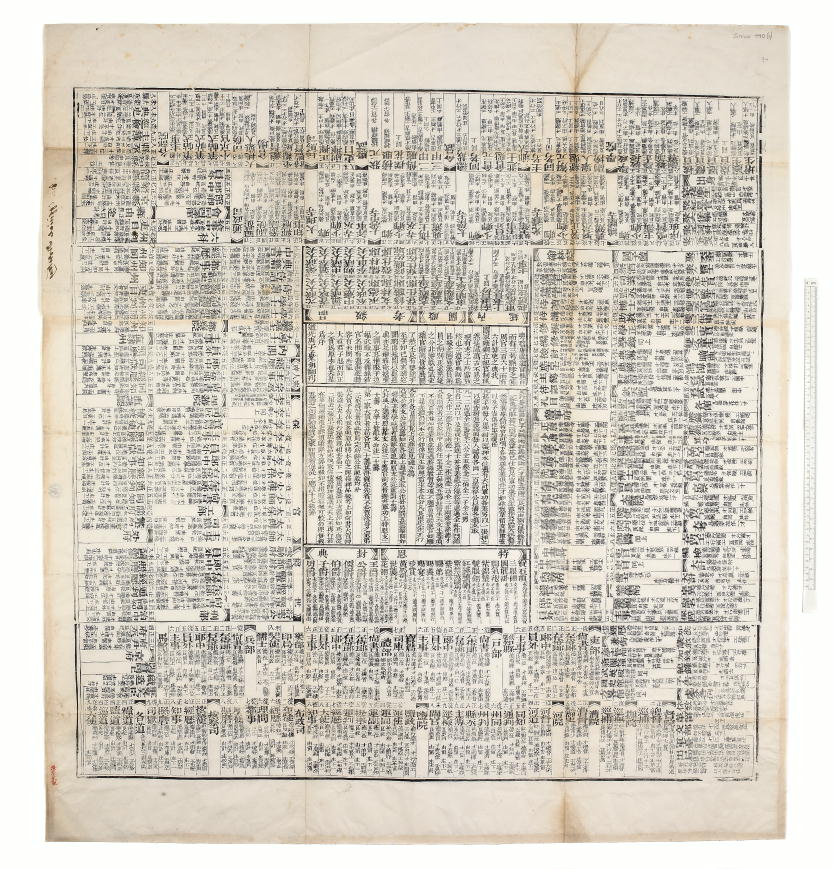
陞官圖 / 舊題(明)倪元璐作
清道光庚子[1840]廣東刊
1張 ; 82 x 75公分
有「張隆盛製」朱文印記
Sinica 440/2

This is a large single-sheet item, bearing no title, so the title is simply a statement of what the item is, and was assigned to it by Xiang Da so that it could be included in his card catalogue. The “promotion chart” is simply an English translation of this description.

pc1

The above image is too small to be legible – I reproduce it only to show what the chart looks like; the full image can be seen and examined here.

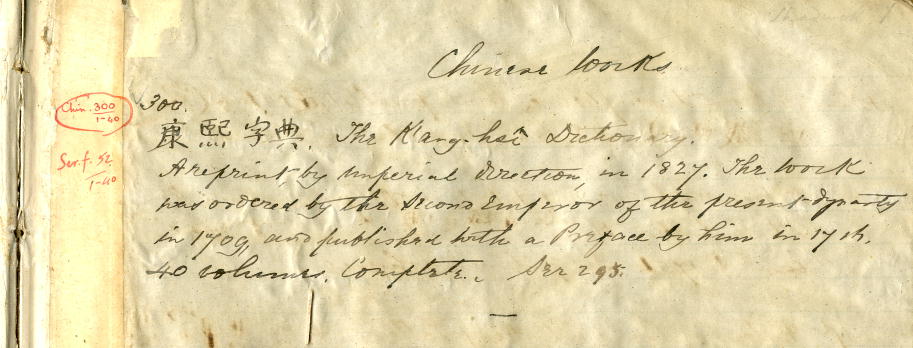
The chart was among the books given to us in 1877 by General Lawrence Shadwell,who had served in the 98th (Prince of Wales) Regiment of Foot which had been sent to Hong Kong in 1842. His books are the first to be listed in James Legge’s manuscript continuation of Joseph Edkins’ printed catalogue of Chinese books in the Bodleian, which appeared in 1876 and contains 299 entries. Legge’s list therefore starts at number 300, and I reproduce the first entry to give a flavour of this document, which is surprisingly crude, and to introduce it to readers of this blog:

pc2

Unfortunately, there is no individual entry for the chart, which is found under number 321, “Extracts from Peking Gazette, Treaties, &c.”, and in fact it is only because of later annotations to this entry that we know that this batch of materials comprised 3 printed volumes, 19 manuscript volumes, and 4 printed sheets, of which one was discarded as a duplicate in 1939 by EOW (Eric Otto Winstedt, who was keeper of the Oriental collections at the time). Let’s hope it wasn’t a duplicate of the chart!

pc3

And here is the description of the chart “written on the back” as Legge’s entry suggests, and in his own hand:

pc4

However, it is wrong. Although the chart does indeed depict the structure of the contemporary Chinese bureaucracy, it is not a directory, but a game.

This, together with almost everything else I now know about the chart, I learned from Puk Wing Kin when he visited me in Oxford in 2009. Most important to me as a cataloguer, he pointed out that certain characters in the chart are represented by simplified forms which are only homophonous in Cantonese. For example: you 由 is used for rou 柔 (both are pronounced yau in Cantonese), and zhuang 庄 is used for zang 贓 (in Cantonese both are pronounced jong). I was thus able to say with some certainty where the map was printed in my catalogue entry, rather than merely infer it from its provenance; the date of 1840 道光庚子 is clearly printed in the central panel.

Puk Wing Kin came to Oxford in 1995 to pursue doctoral research under David Faure; his subject was the Ming salt monopoly, and he gained his D.Phil. in 2007. He had been introduced to the chart as an M.Phil student at Hong Kong Baptist University in the early 1990s. He is now a history professor in the Chinese University of Hong Kong specialising in the socio-economic history of Ming and Qing China, and is thus well qualified to understand the complexities of the game. He has written a book about it, which was published in 2010, with a second edition in 2011:

遊戲官場 : 陞官圖與中國官制文化 / 卜永堅著
再版
香港 : 中華書局, 2011
平裝1冊(96頁) : 圖, 表 ; 23公分 + 圖2張
ISBN 978-962-8931-75-0

The two charts reproduced in large format in the book are facsimiles of ours and one printed in Shanghai in the Republican period.

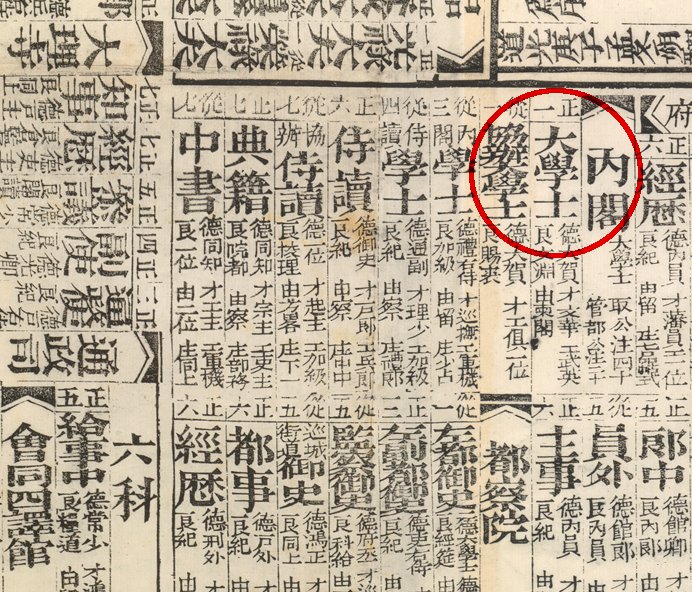
The book discusses the history of the game, which originated in the Tang and achieved its present form in the Ming. The details of the chart change from time to time, according to the contemporary structure of the Chinese bureaucracy. The book also explains the rules of the game. They are very complex, and I will not pretend to understand the details, but the aim is quite simple: to achieve high government office, which means reaching the post of Grand Secretary 大學士 in the Grand Secretariat 內閣, encircled in red in the following image:

pc5

This involves a long series of promotions and demotions, as set forth in the small print in each of the rectangular panels, all determined by the roll of dice and the movement of counters. As in life, much depends on where one starts from, which in the game is again determined by the roll of dice.

By playing the game, much can be learned about the bureaucratic structure of imperial China and how officials rose and fell within it, for which reason Wing Kin told me that he sometimes plays the game with his students.

Although on one level the game is a very sophisticated form of snakes and ladders, perhaps its nearest western equivalent is Monopoly, which leads to a comparison of the two. While both are aleatory – games of chance depending on the roll of dice – whereas the aim of one is to attain the highest office in the land through virtuous conduct, that of the other is to become rich by bankrupting one’s neighbours. Food for thought here, don’t you think?

I’m going to describe another piece of printed ephemera in my next blog entry, as it’s closely related. Appointment to any of the posts represented in the promotion chart depended on passing the official examinations that were periodically held at local, provincial, and metropolitan levels. We have a set of three papers that were used in the provincial examination at Nanchang in 1902 which I’d like to bring to your attention. They will be exhibited in the Proscholium of the Old Library for a few weeks from mid-February, the aim of the display being to illustrate the traditional Chinese preoccupation with success in examinations as the path to fame and fortune.