Archive for the 'Uncategorized' Category

The last flowering

22 August 2013

In May 2006 Christer von der Burg sold me a copy of what will probably prove to be the last major Chinese book to have been printed by woodblock. I have just catalogued it as follows:

里堂道聽錄 : 四十卷 / (清)焦循撰
附 焦里堂先生年譜 : 一卷 / 江蘇廣陵古籍刻印社輯錄
辛已年[2001]揚州廣陵書社校刊南京江蘇廣陵古籍刻印社發行本
線裝40冊 ; 29公分
Sinica 6044

The book is a collection of short philological pieces by the prolific Qing Dynasty scholar and philosopher Jiao Xun (1763-1820), a native of Yangzhou. The original manuscript is in the National Library of China, and was photolithographically reproduced in the 1990s (the publication is undated) in its series of rare editions in its own collections (北京圖書館古籍珍本叢刊 – the National Library of China was then still called Peking Library, and its publishing house was called Shumu Wenxian Chubanshe 書目文獻出版社).

According to the information supplied by Christer, the edition took twenty years to produce, during which time two scribes and ten different block-cutters worked on it. In the Serica entry for the work I have presented many images from this book for the obvious reason that the edition will probably be the last of its kind, and readers may be curious to know what it looks like. Here is one of the images, the first page of text:

Litang

Although the blocks appear to have been finely cut, the quality of the impression is not at all good. There is a fuzziness which should not be present given that only one hundred copies had been taken from the blocks when we received ours – I have crystal-clear specimen impressions from blocks that were cut centuries before these, among them leaves from the Manchu Tripitaka and the Tetsugen Tripitika at Mampukuji near Kyoto. I think the reason might be partly due to the use of unsuitable paper.

Owing to this extraordinarily small print run, the book is not widely distributed, and it may be that ours is the only copy in Europe. WorldCat shows eight copies in the United States, one in Taiwan, and one in Hong Kong. The only other copy I have found is in the National Library of China. It is very odd that none can be found in Japan.

The National Library of China gives the imprint as 「南京 : 江蘇古籍出版社, 2001」. In WorldCat we find that nine of the ten libraries represented express the imprint as 「南京市 : 江蘇古籍出版社, 2001」 and one as 「揚州 : 廣陵書社, 2001」.

It is depressing indeed that librarians continue to follow slavishly rules that were written on the back of an envelope (see John Joliffe’s work on the subject) rather than tell readers what an edition actually is. AACR and MARC were devised primarily for cataloguing modern printed books in English; traditionally produced Chinese books are about as far removed from that as it is possible to be.

For this reason, I follow the traditional Chinese practice of expressing the edition of a book in a single sentence of classical Chinese. Thus, my statement for this edition tells the reader exactly how the book was produced and distributed; the WorldCat and NLC records do neither, and only one refers to Yangzhou – the whole point of the edition, as it was produced in homage to one of that city’s most famous scholars!

The clashing rocks

17 July 2013

What to call this blog entry was solved by an article in last week’s Independent (Tuesday 9 July 2013, 28-29) by David McNeill. Presumably the author found the image on the internet – I think I’ve found the one he used, which appears in numerous locations, and is rather good.

Asia Disputed Islands

The article concerns the Senkaku Gunto 尖閣群島, the uninhabited group of rocky islands situated in the East China Sea between Taiwan and Okinawa. I give the islands their Japanese name because the Japanese are currently their internationally accepted owners, backed by American interests in the area. They are however claimed by the People’s Republic of China and Taiwan, who know them as the Diaoyu islands 釣魚島 or Diaoyutai 釣魚臺.

The positions of all the claimants, together with their arguments, are set out comprehensively in the Wikipedia account of the dispute. And an interesting piece by Daniel Dzurek, written some while ago but rich in detail, is to be found here.

For sure, Diaoyutai is the earliest recorded name of the islands, and the reason the matter finds itself in this blog is because by an extraordinary coincidence, the first textual references to them appear in two documents of entirely different provenance in the Bodleian Library.

Both texts were discovered by Xiang Da (Hsiang Ta 向達) during his stay in Oxford from November 1935 until December 1936, which had been arranged by Yuan Tongli (Deputy Director of the National Library of Peiping), E.R. Hughes (recently appointed Reader in Chinese Philosophy and Religion at Oxford University), and Edmund Craster (Bodley’s Librarian) to enable him to catalogue the Library’s Chinese collections. Xiang Da’s stay in Oxford has been documented by Frances Wood in a recently published memorial volume for him (敦煌文獻‧考古‧藝術綜合研究 : 紀念向達先生誕辰110周年國際學術研討會論文集 / 樊錦詩, 榮新江, 林世田主編. – 北京 : 中華書局, 2011. – ISBN 978-7-101-08337-8). The original English text of her account can be seen here.

Xiang Da’s work in the Bodleian is particularly important for at least two reasons.

Firstly, he set up the first Chinese card catalogue in the Bodleian, and as described by Frances Wood, it was constructed along very sound lines which other libraries at the time would have done well to follow. I was still adding to this catalogue until it was closed in 1991, when automated Chinese cataloguing began.

And secondly, he wrote a lengthy article on the Bodleian’s historic Chinese collections, albeit with a few errors, in the journal of Peiping Library (as the National Library of China was then called) which introduced them to a wide audience in the Far East, and is still used to this day (瀛涯瑣誌 – 記牛津所藏的中文書, in 北平圖書館館刊 10:5, 1936, 9-44).

It is here (pp.30-33), I think, that the two rutters were introduced to sinology (and to politics) for the first time, although at the time the article was written, the ownership of the Diaoyu islands was not much of an issue, so there was no reason to mention to them, any more than to mention the numerous other locations referred to in the texts.

Twenty-five years later, Xiang Da published an account of the texts, with full transcriptions of them:

兩種海道針經 / 向達校注
北京 : 中華書局, 1961
平裝1冊(277頁) : 圖, 地圖 ; 18公分
(中外交通史籍叢刊)
附地名索引
統一書號 11018.142

As a result, the rutters became widely known in the Far East, and in recent years, they have become available on the internet in various locations.

Less freely available are original images of the texts, which have only just been made. It is planned to make them available in their entirety from the Serica interface in the near future, but for the convenience of those who might be interested in this matter right now, in a moment I will show scans of the four places (two in each text) where the mentions of Diaoyutai occur. But first, a few notes on the texts themselves.

The first is the so-called Laud rutter, described as follows in my catalogue:

順風相送 : 不分卷 / (明)佚名撰
明抄本
洋裝(原線裝)1冊 ; 26公分
MS.Laud Or.145

The title by which this book is known, Shunfeng xiangsong, appears only on its cover. It is undated, but Xiang Da strongly suspects that it was produced in the 16th century (p.4).

The ultimate Chinese provenance of the book is not known, and strange as it may sound, it hasn’t even been established how Laud got his hands on it. Xiang Da suggests that it came from “a European Jesuit university” (歐洲一所耶穌會大學), and indeed most of Laud’s manuscripts were of continental origin.

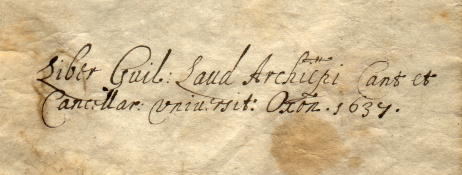
We know from western inscriptions on the book that it came into the Library in 1639:
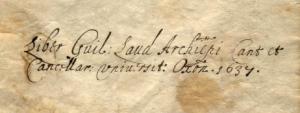
s00269

and also that it was examined by Shen Fuzong and Thomas Hyde in 1687:
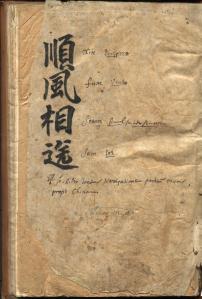
s00268

The second text is appended to a small collectaneum of military works, which as indicated by its shelfmark, is part of the famous Backhouse Collection which came to the Library in stages between 1913 and 1922:

兵鈐 : 內書八卷外書八卷 / (清)呂磻, (清)盧承恩編
附 指南正法 : 不分卷 / 佚名撰
清康熙乙卯[1675]序鈔本
線裝7冊 : 圖 ; 30公分
有「曾存定府行有恒堂」印記
Backhouse 578

This collectaneum never seems to have been printed, and although several manuscript copies of it are in existence (there is one complete copy and two incomplete copies in Peking University Library, another in Nankai University Library, and an incomplete copy in Princeton), only the Backhouse copy contains the vital appendix.

This seems to confirm Xiang Da’s view that although the preface to the book is dated 1675, our copy was actually written out rather later at the end of the Kangxi period, when the appendix was added.

I have only recently transcribed the single seal impression on the Backhouse copy, which informs us that it was formerly in the ownership of Zaiquan 載銓 (1794-1854), the fifth Prince Ding 定郡王, a great-great-grandson of Gaozong, the Qianlong Emperor. This I learned from a discovery on the internet, which even led me to the very bronze seal from which the impression was made, together with the help of Zheng Cheng 郑诚. If only identifying seals and their owners were always so easy! In view of the evanescence of things on the internet (to which I have referred before), for the sake of posterity, I have preserved the web-page in question here.

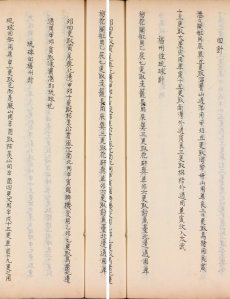
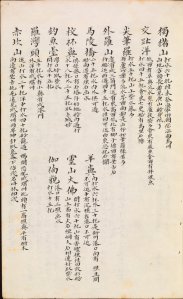
And here are the images of the passages concerning the Diaoyu islands. The leaves were originally unpaginated – my references are to the pencilled foliation done locally some decades ago.

順風相送, 13a:
sfxs-1

順風相送, 62a-63a:

sfxs-2

指南正法, 7b:

znzf-1

指南正法, 33b-34a:

znzf-2

Inevitably, I learned about these texts at a very early stage of my career, when my interest in our historic collections was developing in the late 1970s. But I did not know about the Senkaku Islands, nor the fact that their ownership was in dispute, until I received a letter from Kazuyoshi Umemoto, Second Secretary in the Japanese Embassy in London, dated 18 August 1981. The letter asked us to show Shunfeng xiangsong and any other related documents to Professor Toshio Okuhara, a specialist in international law and an authority on this matter. In the event, I don’t think Professor Okuhara ever came; I think it was Mr Umemoto himself, and he must have come at the approach of winter, because he had a pair of elegant leather gloves which he laid carefully on the desk before examining the manuscript. It is odd how irrelevant little details like this stick in one’s mind while one forgets more important things.

It may not be a coincidence that at the end of 1982, a year after Mr Umemoto’s visit, a second printing of Xiang Da’s book was produced. What had not been an issue in 1961 had clearly become one since, as evidenced in some small but significant changes to the text.

In glossing the island Huangweiyu 黃尾嶼 (p.168,n.1), the changes are as follows:

1961: 黃尾嶼為今尖閣群島之久場島. (“Huangweiyu is the present Kubashima in the Senkaku Islands.”)
1982: 黃尾嶼為我國臺灣省所屬島嶼. (“Huangweiyu is an island which belongs to our country’s Taiwan Province.”)

And in the place-name index (p.253) the entries for the alternative names of the islands have also been modified:

1961: 釣魚嶼 — 釣魚嶼為自臺灣基隆至琉球途中尖閣群島中之一島, 今名魚釣島, 亦名釣魚島. (“Daioyuyu — Diaoyuyu is one of the Senkaku Islands which lies on the way from Jilong in Taiwan to the Ryukus; its present name is Yudiaodao, and it is also called Diaoyudao.”)
1982: 釣魚嶼 — 釣魚嶼在臺灣基隆東北海中, 為我國台灣省附屬島嶼, 今名魚釣島, 亦名釣魚島. (“Diaoyuyu — Diaoyuyu is in the sea to the northeast of Chilong in Taiwan, and is an island belonging to our country’s Taiwan Province; its present name is Yudiaodao, and it is also called Diaoyudao.”)

1961: 釣魚臺 — 此指琉球群島中尖閣群島之魚釣島, 一般作釣魚嶼, 亦作釣魚臺. (“Diaoyutai — This refers to Yudiaodao in the Senkaku Islands in the Ryukus, and it is commonly called Diaoyuyu or Diaoyutai.”)
1982: 釣魚臺 — 此指臺灣基隆東北海上之釣魚島, 一般作釣魚嶼, 亦作釣魚臺. (“Diaoyutai — This refers to Diaoyudao in the sea to the northeast of Chilong in Taiwan, and it is commonly called Diaoyuyu or Diaoyutai.”)

Most recently, in September 2012, in a further attempt to cement their claim to the islands the Chinese published a large and detailed map of “The Peoples Republic of China’s Diaoyudao and associated islands” (ISBN 978-7-5031-7131-4); I remember buying a comparable map of the Falkland Islands in 1982 – how else was one to know where they were?

Apart from Mr Umemoto, to my knowledge the only other diplomat to examine the Laud and Backhouse manuscripts is Dr. Shen Lyushun, the Taipei Representative in London, who visited us on 30 November 2012.

I don’t know if any representative of the Chinese government has ever examined the manuscripts in the flesh, but some years ago a student told me he had been asked to look at them on their behalf.

By way of a postscript: it is ironic that Xiang Da, who discovered the documents which are now being seen by some as favouring his country’s claim to the Senkaku Islands, should have perished as a class enemy during the Cultural Revolution – and in that I suppose his visit to Oxford didn’t help. He was sent to labour in the countryside, and having a weak heart, died there almost immediately in 1966.

Taboo characters

30 May 2013

This is the first of what I hope will develop into a series of entries in which I would like to illustrate the avoidance of taboo characters as a means of dating editions from examples in our own collections. Inevitably this will mean waiting not only until I discover them, but also until I have a better understanding of the process.

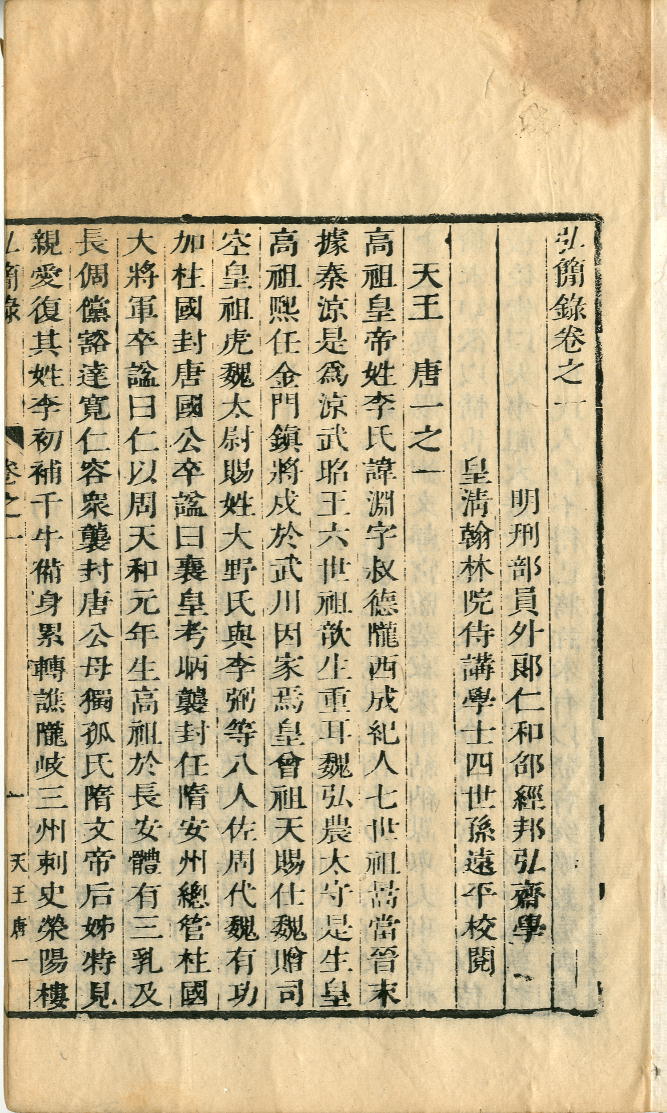
I will make a start with two copies of of Hongjianlu 弘簡錄 which I catalogued a while ago. This is a very large work in the “separate histories” 別史 category written and published by the Ming dynasty scholar Shao Jingbang (1491-1565). According to his entry in Goodrich and Fang’s Dictionary of Ming biography, the endeavour “cost him one thousand taels of silver, which, he emphasized, he had saved through thirty years of simple living” (p.1165). A shorter sequel was written a century later by his grandson Shao Yuanping (a jinshi of 1664). The combined edition was finished in the mid-Kangxi period, and I have catalogued it as follows:

弘簡錄 二百五十四卷 / (明)邵經邦撰
續弘簡錄元史類編 四十二卷 / (清)邵遠平撰
清康熙二十七年[1688]續錄三十八年[1699]邵遠平刊後印本
線裝100冊 ; 29公分
Backhouse 536
Sinica 716 (線裝80冊 ; 25公分)

hjl2   hjl1

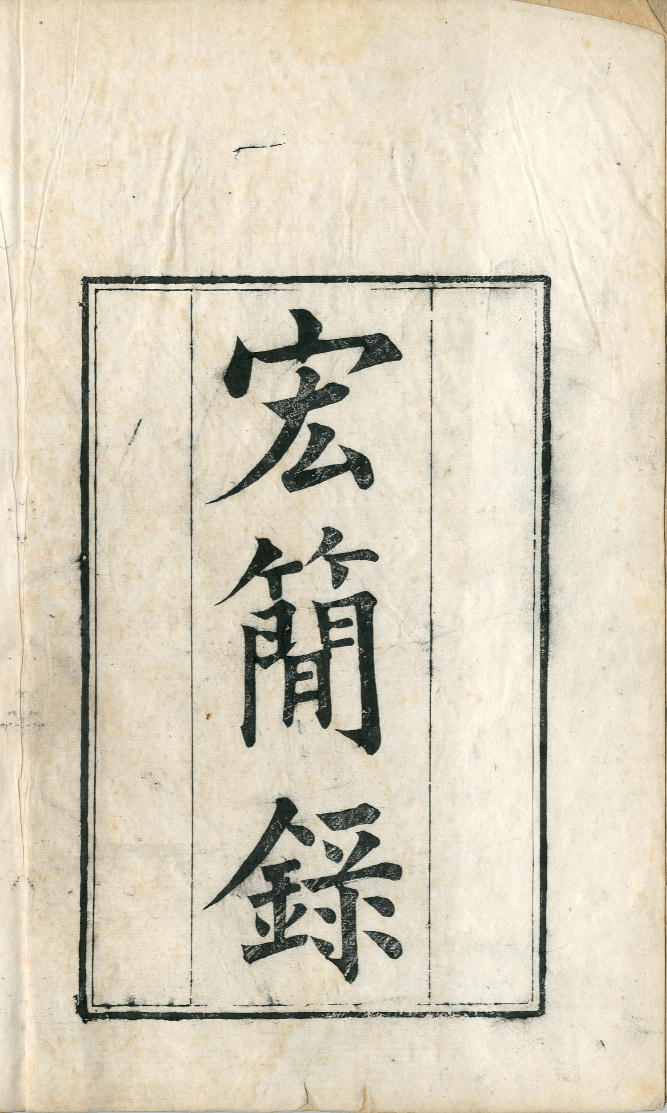
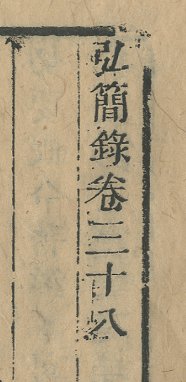
It is usually possible to establish the date when the blocks of an edition were cut, and therefore the date when it was first possible to print it. But it is more difficult to establish the date of printing, given that printing blocks could last for decades and even centuries after they were produced. Sometimes (but rarely) a preface or so called “title-page” will give us specific information. But in the case of our copies of Hongjianlu, it is the avoidance of taboo, that is, the characters in the personal name of the Qianlong 乾隆 emperor, Hongli 弘曆.

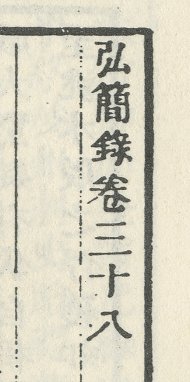
On the title-page of the book (illustrated above) we can see one of the ways in which the taboo was avoided  – the substitution of the taboo character with a homophone, in this case the character hong 宏. And in the text of the book we can see another method – the omission of the final stroke of the taboo character. The illustrations below show an example from our Backhouse copy (left), and alongside it, the same example from the copy reproduced in Xuxiu siku quanshu 續修四庫全書 (right):

hjl3  hjl4

It is already clear from the degradation of the printing block that our copy was printed much later than the copy from which the reproduction was made, but the avoidance of taboo in the first character of the title by excising the final stroke from the printing block enables us to be a little more precise about how much later the impression was made. And it is not quite as simple as the difference between 1699, when the blocks were finished, and 1736, when the Qianlong emperor ascended the throne.

The avoidance of taboo did not always take effect immediately, so to use it as a means of dating we have to establish when it became mandatory. I recently discovered a very concise and useful source of this information in the following work:

清代內府刻書圖錄 / 翁連溪編著
北京 : 北京出版社, 2004
pp.64-66: 清代內府刻書中的避諱制度

There we learn that the avoidance of taboo was not strictly applied at the beginning of the Qianlong period. Only in the thirteenth year (1748) was the order given to omit the last stroke of the character. And the use of either that method or the substitution of the character with a homophone was later still, with the order first being given in the twenty-fifth year (1760).

While it may not be hugely significant that our impression was taken sixty years after the blocks were carved, it is better to have the information than not to have it, and at least it enables me to add the qualification 「後印」 to my description with some certainty.

Sinica 41

28 March 2013

Descending into cliché, I think the time has come for me to say which book I would rescue if the Library were on fire and I could only save one.

Without doubt, it would be Sinica 41, described as follows in my catalogue:

新刊二十四孝故事 卷一 ; 新鍥重訂補遺音釋大字日記故事大成 卷二至八 / (明)佚名撰
明萬曆中鄭氏聚垣書舍刊本
線裝2冊 : 圖 ; 28公分
本書為海內外孤本
Sinica 41

s41-4

The note 「本書為海內外孤本」 indicates that the work is a unique surviving printed edition, and that alone would be sufficient reason for saving it if it were not in the company of so many other unique surviving editions in the Bodleian Library, and if it were entirely true. In fact, there is another extant copy, in the Bibliothèque nationale de France, Département des manuscrits, Chinois 1392, and this copy has been digitised. Comparison shows that the impression has been taken from the same blocks.

However, the Paris copy is rather defective, lacking the first juan in its entirety except for the last half-leaf, and also two more leaves and the last leaves of juan 8; this is the extent of the copy:

[1:1-6a missing] 1:6b-2:13a [2:13b missing] 3:1a-7:8b
[7:9 missing] 7:10a-8:7b [8:8-12 missing]

By contrast, the Bodleian copy is complete apart from a single leaf, 6:10, and the final leaf enables the work to be identified. It seems that the Oxford and Paris copies are not only unique surviving copies of the work, but also the unique surviving work of the publishing house that printed it:  鄭氏聚垣書舍. In fact, a Google search for the term 「聚垣書舍」will point only to the entry for this edition in my list of Chinese books in Europe in the 17th century (the Paris colleagues could produce a second hit by updating their catalogue entry on the basis of this information).

s41-6

As for its content, the work is a typical product of the late Ming commercial press, centred mainly in Jianyang 建陽 (in Fujian Province), but also in Jinling 金陵 (modern Nanking). The first juan is the well-known Tales of the twenty-four filial exemplars 二十四孝, but juan 2-8 are a series of more general historical morality tales.

s41-5

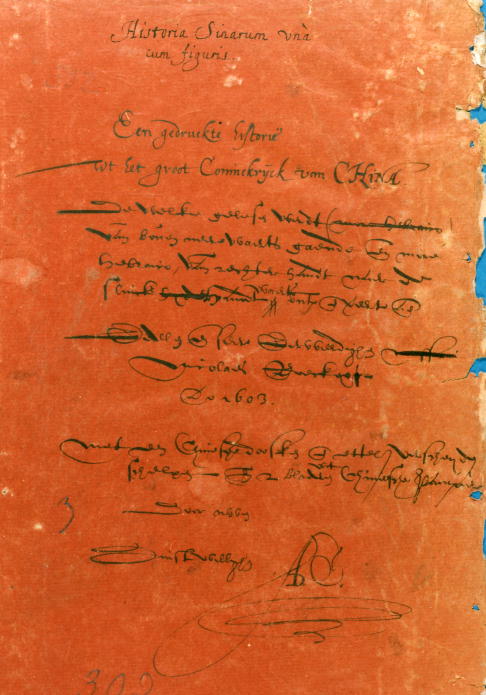
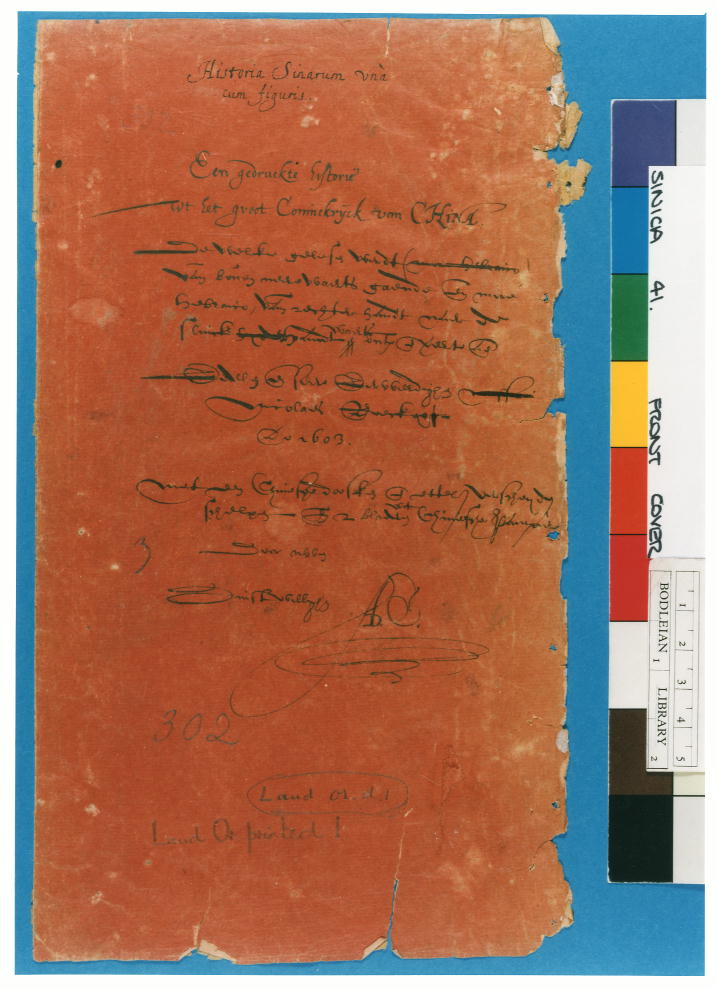
But the reason why I would rescue this book from the flames has nothing to do with either its content or its rarity. It is because of the inscription on its front cover, which is not only one of the very earliest western inscriptions on a Chinese book, but tells the story of how the first significant quantities of Chinese books came to Europe.

 s41-2

The inscription is in Dutch, and neither I nor even Piet van der Loon could read it. So Piet sent it to Professor P.G. Hoftijzer at the Sir Thomas Browne Institute in the University of Leiden, and he transcribed it as follows – I reproduce his transcription exactly as he sent it to Piet on 7 November 1992:

Transcriptie

Historia Sinarum una |
cum figuris. |

Een gedruckte historie |
wt het groot Coninckrijck van CHINA |
Dewelcke gelesen werdt [doorgestreept: (more hebraico)] |
vande boven neerwaerts gaende ende more |
hebraico, vande rechter handt naer de |
slincke [doorgestreept: sijde] Handt waerts [woord onleesbaar] ende vereert aen |

Edlen ende seer Eerweerdighen [woord doorsgestreept] |
Nicolaes [woord onleesbaar:  .oeck.o..] |
anno 1603. |

Met een Chinesche doosken ende ettelike verscheyden |
schelpen ende 2 bladen wit Chinesche pampier |

Door uwen |

Dienstwillighen A. [onduidelijke letter of combinatie van letters]. |

So we have quite a well-informed description of the book (few people at that time would know that Chinese was read top to bottom, right to left more hebraico), but what are we to make of the two lines that tell us that the book is accompanied by “a little Chinese box, various sea-shells, and two sheets of white Chinese paper”?

In fact this is the most vivid evidence we have of what can only be inferred from other sources: that this book, and others like it, was obtained by members of the Dutch East India Company from overseas Chinese traders in Southeast Asia (on whose tropical shores the sea-shells were gathered), and that it was sold as part of a job lot of curiosities at an auction in Amsterdam. That Chinese books were considered to be curiosities at that time is evidenced, for example, by the inclusion of two of them in the cabinet of curiosities of John Bargrave (1610‑1680), a canon of Canterbury Cathedral. Although this cabinet is still extant, the Chinese books have, alas, gone missing. [1]

The Dutch bibliographer Bert van Selm [2] has suggested that an important consignment arrived as a result of one specific trading expedition, in which two fleets of ships from Amsterdam companies set sail for the Indonesian archipelago on 23rd April 1601. Some of the ships returned to Holland with their goods in 1602, and it is quite possible that Sinica 41 was among them.

Other parts of the expedition returned in in the summer of 1604, the second in the spring of 1605. There followed an extraordinary sale of the cargo in Amsterdam in September 1605, which according to van Selm may be related to the publication in the same year and in the same city of a stock catalogue of Chinese books by Cornelis Claesz, the city’s leading bookseller.

The Parisian bibliographer Philippe Labbé (1607‑1670) gives the title of this catalogue as Chinensium variorum librorum Bibliotheca, siue libri, qui nunc primùm ex China seu regno Sinarum cum ipsorum atramento & charta admirandae magnitudinis aduecti sunt. Although there is sufficient evidence to show that the work actually existed [3], no copy has yet been discovered; this is unfortunate, as the catalogue is the earliest known printed list of Chinese books in Europe, and if found would represent a bibliographical source of the first importance. From time to time I search for the title on the internet – it is the Holy Grail of this subject, which has interested me for decades.

One final point – and it is an imortant one. Sinica 41 was in a grievous condition when I first encountered it. It was glued into a hard western binding that probably dated from the time when it was in the collection of William Laud, who used to own it, and whose elegant inscription is on the front endpaper:

s41-7

(One can’t help noticing that just as John Bargrave, a canon of Canterbury Cathedral, had Chinese books in his cabinet of curiosities, so the Archbishop himself possessed not only this one, but several more which are also in the Bodleian.)

The hard binding was pulling the thin paper of the book apart, and it suffered more damage whenever it was opened.

To enable our conservators to repair books like this, I conceived the idea of translating a little manual that I acquired shortly after its publication in 1980 [4], which had been written by the chief conservator in what we then called Peking Library. I worked on this intermittently during the 1980s and 1990s, and it was eventually published in 1998 – long after its completion – in Princeton’s East Asian library journal. [5]

From an earlier draft of this work, Robert Minte learned the techniques of the Chinese book conservator if not quite first-hand, certainly more authoritatively than in any English or even Chinese source than had existed hitherto. And I’m flattered that the illustrations which Chris Clarkson drew for me to illustrate some of the more unfamiliar procedures were lifted directly from my publication by Zhu Saihong without a word of acknowledgement; indeed, in her own work on Chinese book repair [6], my publication is the only one that she doesn’t include in the bibliography.

In particular, from my translation of Xiao Zhentang’s work Robert learned the technique of producing the “jade set in gold” 金鑲玉 binding, a sophisticated structure which enables the fabric of the original book to be preserved in its entirety whilst at the same time allowing it to be presented and handled as if it were new. He applied the technique to Sinica 41, and when the book had been pulled apart and the pages stabilised prior to binding, the work was photographed in its entirety, and it is from these photographs that the images in this blog entry have been produced – in 1992, when this work was done, digital imaging was still quite some way off.

Robert’s repair of this item must be considered a masterpiece by any standard, and he even went to the trouble of acquiring silk brocade from a friend in Hong Kong to cover the protective tao 套 with.

This, too, is why the book should be plucked from the flames.


1. D Sturdy & M Henig: The gentle traveller: John Bargrave, Canon of Canterbury, and his collection (Oxford, 1983), 2 & 14.
2. Cornelis Claesz’s 1605 stock catalogue of Chinese book, in Quaerendo 13:4(1983), 247‑259.
3. It is cited in Henri Ternaux-Compans: Bibliothèque asiatique et africaine, ou, Catalogue des ouvrages relatifs à l’Asie et à l’Afrique qui ont paru depuis la découverte de l’imprimerie jusqu’en 1700 (Paris, 1841), 106 (no.934).
4. 中國古籍裝訂修補技術 / 肖振棠, 丁瑜編著. – 北京 : 書目文獻出版社, 1980
5. The repair and binding of old Chinese books. In The East Asian library journal (Princeton), 8:1(1998).
6. 古籍修復技藝 / 朱賽虹著. – 北京 : 文物出版社, 2001.

A Zhouyi edition

11 February 2013

When every Chinese book has been catalogued digitally, and according to consistent standards, it will be much easier to take a global view of Chinese literature in the imperial period. At present, we must rely on what is printed, and in my view the most useful tools by far (and they appeared at much the same time) are Shanghai Library’s congshu index (中國叢書綜錄), which was first published in 1959, and the two printed catalogues of the Chinese collection in Kyoto University’s Institute for Research in Humanities.

The first edition of the Kyoto catalogue (京都大學人文科學研究所漢籍分類目録) was published in 1963, and within it, the contents of congshu are classified; it thus corresponds with the second volume of the Shanghai work. But in the second edition (京都大學人文科學研究所漢籍目録), which appeared in 1979, the congshu contents are not classified; it thus corresponds with the first volume of the Shanghai work.

These two monumental bibliographies give us what the computer screen never will: conspectus, and a three-dimensional view of their contents. Simply by counting the pages devoted to each subject in the classified volumes we can  discover how much was written, and about what, and say with some certainty what interested traditional Chinese scholars.

I have just looked at the “classics” division of each of them, and confirmed what has long been my impression, that the greatest number of individual works is to be found in the yijing 易經 section. This is not surprising in view of the primacy of that text, which has always come first in the traditional Chinese classification systems from the time that they were first devised, over two thousand years ago.

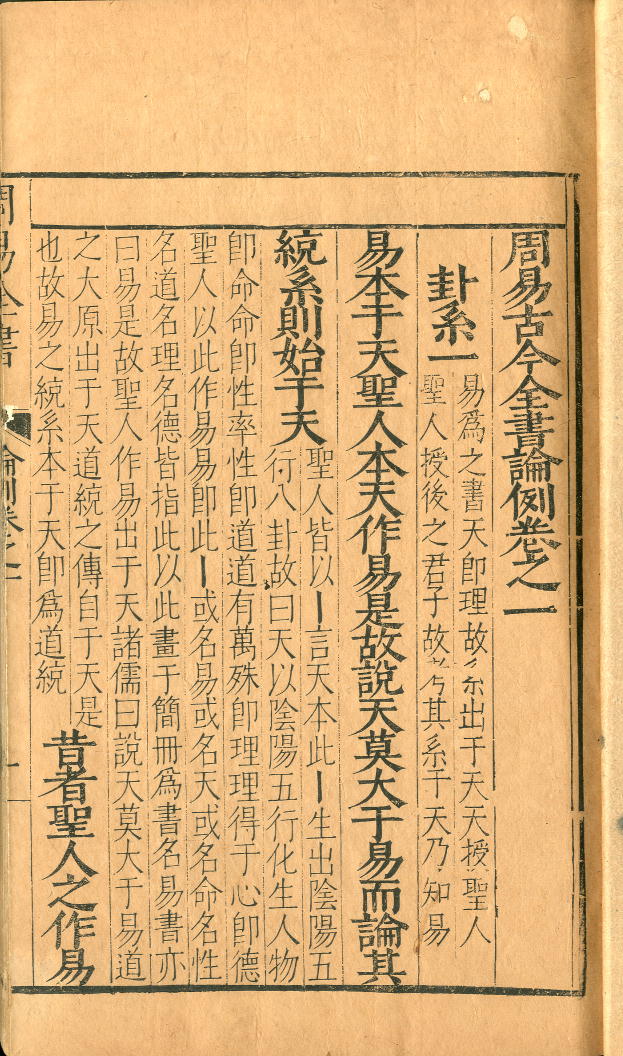
A good example of the voluminous traditional scholarship in this area is an edition in the Backhouse collection which I first encountered in the late 1970s, and which has long fascinated me. It is a collectaneous work by the Ming dynasty scholar Yang Shiqiao (明)楊時喬, a jinshi 進士 of 1565 (嘉靖44), who as part of the conservative reaction to the ideas of Wang Yangming 王陽明 (1472–1529) sought to reaffirm the orthodox interpretation of the Yijing by the brothers Cheng Hao 程颢 (1032–1085) and Cheng Yi (1033–1107), and Zhu Xi 朱熹 (1130-1200).

I have catalogued the edition as follows:

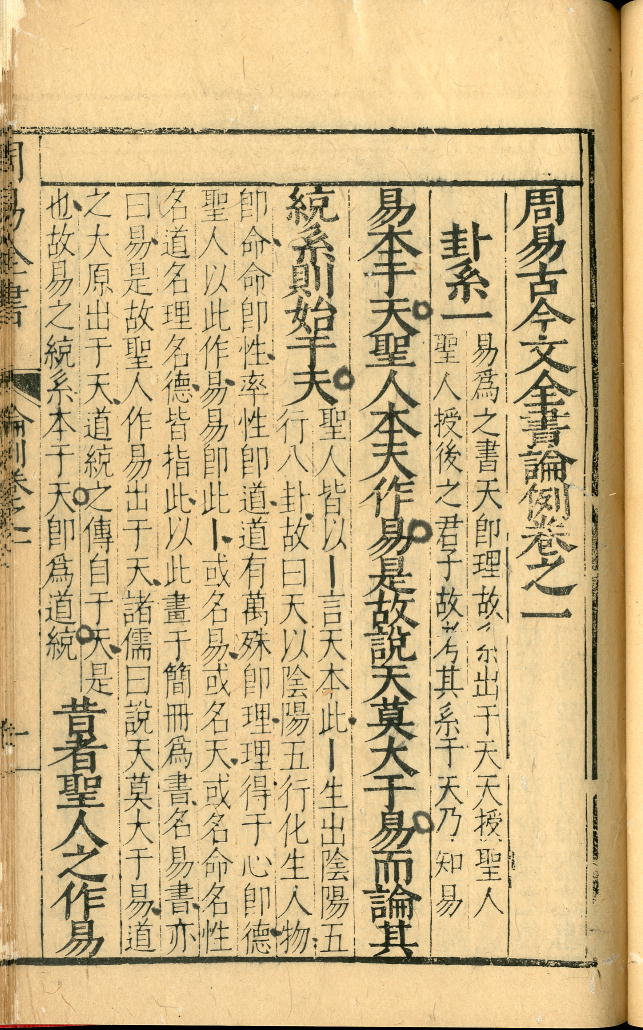
周易全書 / (明)楊時喬撰
明萬曆中初刊本
線裝32冊 ; 28公分
書名據版心題
內容:
周易古今全書論例 : 二卷
周易全書古文 : 二卷
周易全書易學啟蒙 : 五卷
Backhouse 276

At much the same time as I was examining this edition, another example came to my notice, for sale in the catalogue of Tsi Ku Chai in Hong Kong. The contents of the Tsi Ku Chai copy were tantalisingly different, and as I had already decided to develop our pre-modern collections so as to demonstrate the nature and variety of Chinese book production during the last two dynasties (building on very considerable strengths), I bought it.

The book reached us in spring 1979, and cost HK$2,000, then worth £195. It was in rather bad condition, and had to be repaired. This was done by Judy Segal, extraordinarily well in view of the fact that the only English guide to the structure of Chinese books available to her was the famous photographer Hedda Morrison’s article Making books in China (Canadian geographic journal 39, 1949, 234-45) – Xiao Zhentang’s 肖振棠 manual on Chinese book restoration 中國古籍裝訂修補技術, which I later translated for Robert Minte, hadn’t even appeared in Chinese at this time (it was published in Peking in 1980). I now catalogue this copy as follows:

周易全書 / (明)楊時喬撰
明萬曆中刊修補本
線裝20冊 ; 27公分
書名據版心題
內容:
周易古今文全書論例 : 二卷
周易全書古文 : 殘一卷. – 全二卷, 殘卷一
周易古今全書傳易考 : 二卷
周易全書龜卜考 : 一卷
Sinica 2642

The edition was published over a period of nine years in the 1590s, and not many complete copies survive. The reproduction in Siku quanshu cunmu congshu (四庫全書存目叢書, 經部8-9) has been pieced together from partial copies in Peking University Library, the Chinese Academy of Social Sciences Library, and the National Library of China. There is a complete copy in the Harvard-Yenching Library which has been described by Shen Jin 沈津 (美國哈佛大學哈佛燕京圖書館中文善本書志, 1999, 14-15).

The cunmu congshu copy, the Harvard copy, and the Sinica copy all have a general preface 周易古今文全書總序 dated 1590 (萬曆18). The total number of works that were ever included is as follows:

周易古今文全書論例2卷
周易全書古文2卷 — 萬曆20(1592)序
周易全書今文9卷 — 萬曆24(1596)序
周易全書易學啟蒙5卷 — 萬曆20(1592)序
周易古今全書傅易考2卷 — 萬曆23(1595)序
周易全書龜卜考1卷 — 萬曆27(1599)序

The cunmu congshu copy also has a general table of contents, which must be contemporaneous with the publication of the final work in 1599:

zyqscontents

I will try to make some sense of this jumble of evidence.

Everyone who has catalogued this book to date has treated it as a single work, with one title, so that the complete work (and of these there are very few extant examples) is treated something like this:

周易古今文全書論例二卷古文二卷今文九卷易學啓蒙五卷傳易考二卷龜卜考一卷

But for a number of reasons, I regard the work not as a single entity, but as a congshu. The titles within it were printed and circulated at different times, and indeed are often found individually in library collections.

In his general preface, Yang says that he started to work on the contents in 1570 (隆慶庚午), and that they were to be known collectively as Zhouyi quanshu 周易全書. This is the collective title used in the general table of contents (illustrated above), and it also appears in the banxin 版心 of every single leaf. And most interestingly, the Backhouse copy, which I will presently describe in detail, shows that even if the work is to be taken as a single entity, the standard title (by convention taken from the first juan 卷) is in any case doctored.

I also have a small quibble with Shen Jin’s description of the edition as having been made by Wang Qiyu 王其玉, one of Yang Shiqiao’s followers (門人). He does this on the basis of evidence found only in two later and relatively small sections of the work (傅易考2卷, 1595; 龜卜考1卷, 1599) – there is no evidence that Wang was responsible for the entire thing, although it is quite possible that he might have been.

The Backhouse impression is very fine. As indicated above, the three sections present (論例二卷﹑古文二卷﹑易學啟蒙五卷) were all cut in 1592 – the rest followed three or more years later. In fact, the quality of the impression is so fine that we can reasonably infer that it was made soon after the blocks were cut, and that at the time of printing, the edition was complete (in a catalogue it would be incorrect to describe such a copy as incomplete simply because more blocks were cut subsequently).

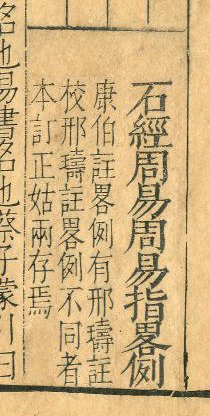
But one thing in particular confirms that the Backhouse copy is probably the earliest surviving impression of this edition. This is the title of the first work to be cut, which is 周易古今全書論例. In all the other copies, the title is 周易古今文全書論例 (that is, with the addition of the character wen 文).

When we compare the Backhouse copy with the Sinica copy, it is clear that they are both from the same blocks, but that the characters 全書論例 in the former have been excised and replaced with 文全書論例 in the latter, as well as all other surviving copies. But as ever, when doctoring blocks, they never do it properly, so that in all the later impressions, the old title survives without the wen 文 at the end of juan 2.

s01059 s01066

We can only guess why the character wen 文 was inserted. At first I thought it might have been done after the cutting of the jinwen 今文 section in 1596, to make it quite clear that the work is concerned specifically with the “old text” and “new text” versions of the Yijing, and not with the general history of the Yijing throughout the ages. However, the general preface also bears the longer title, and it is dated earlier than any of the other works in the set, perhaps being contemporary with the lunli 論例 section, which is the only work to have no preface of its own.

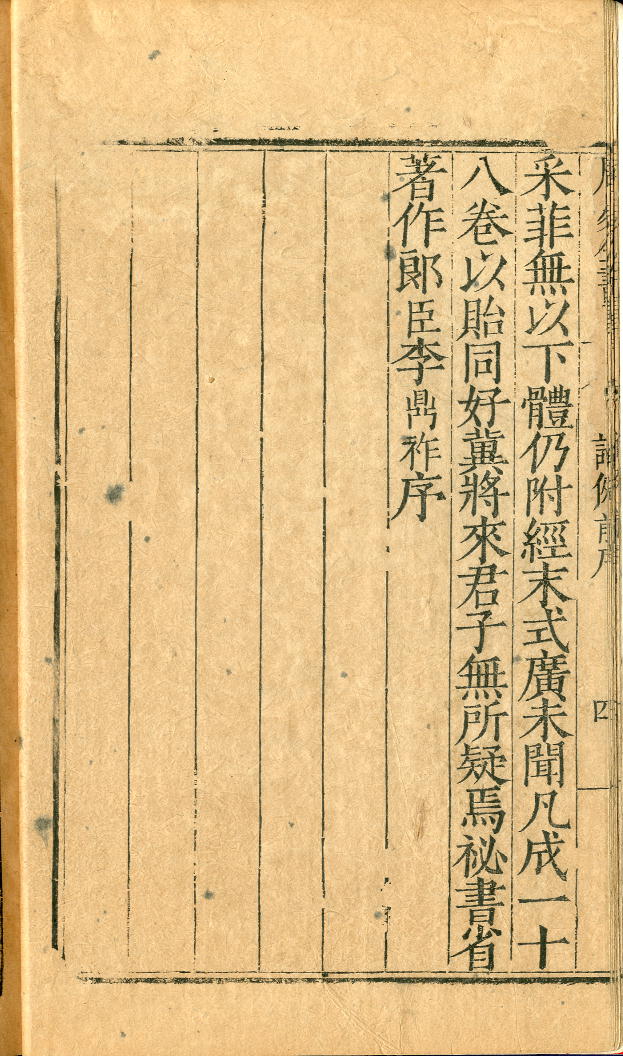
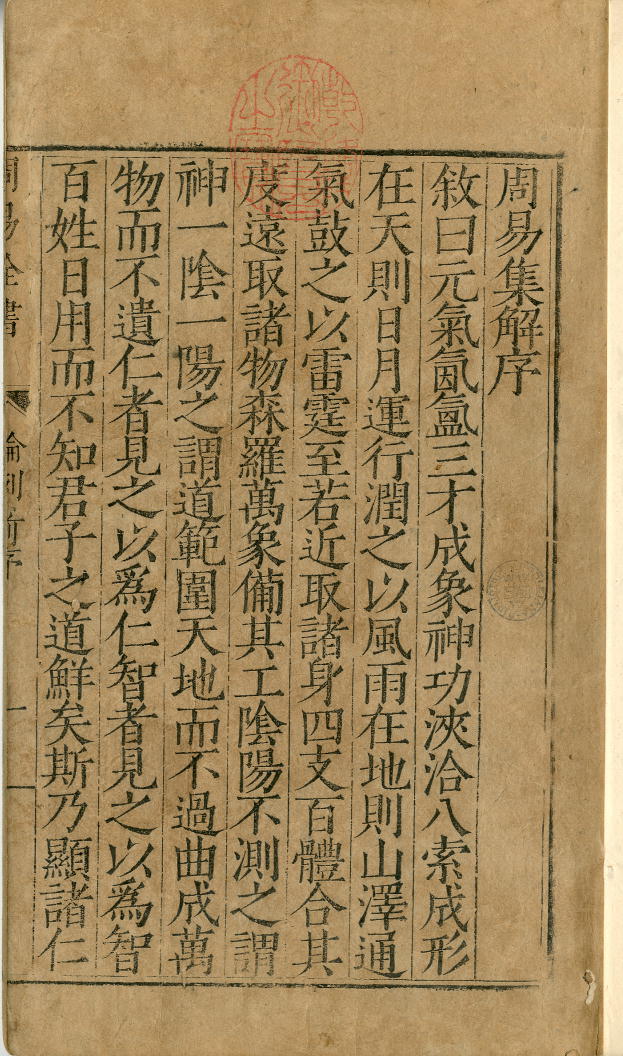
The blocks of the Backhouse edition may well be an undoctored and unique survival, but the same cannot be said of the copy. Like so many books in Chinese collections, it has passed through the hands of a dealer who has tried to pass it off as something else. When I was first teaching myself about the tricks of this particular trade, I was puzzled by the preface, which is the Tang dynasty scholar Li Dingzuo’s 李鼎祚 preface to his commentary on the Yijing entitled Zhouyi jijie 周易集解. The preface has four leaves, but in the banxin of each are found the title of Yang’s work 周易全書 (I didn’t know that Yang had written his own prefaces to each of the sections until I bought the Tsi Ku Chai copy; they are in a more rounded calligraphic style than the text).

s01058 s01057

The large-scale reproduction of historic editions in recent decades (not to mention my acquiring and cataloguing them for the Bodleian) has now enabled me to establish that this preface in the Backhouse copy is taken from a copy of the following edition:

周易集解 : 十七卷 / (唐)李鼎祚撰
明嘉靖三十六年[1557]朱氏聚樂堂刊本

It is from the same blocks (but later, and possibly themselves doctored) as the copy in what is now the National Library of China, which is the very first work to be reproduced in the series 北京圖書館古籍珍本叢刊 (Peking, 1988).

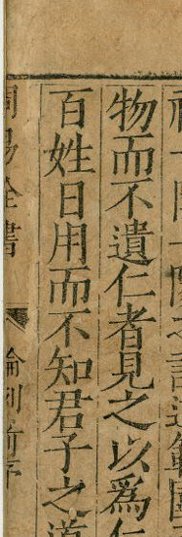
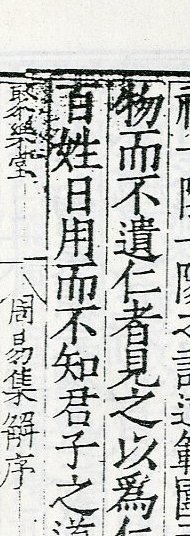
Taking a closer look at Li’s preface in Backhouse 276, we find that the banxin of all four pages has been carefully doctored. The words 「聚樂堂」 in the upper banxin 版心 have been excised from the leaves, and replaced with 「周易全書」, undoubtedly taken from leaves removed by the dealer (along with Yang’s dated prefaces) in an attempt to pass the copy off as something earlier.

zyqsbanxin2  zyqsbanxin1

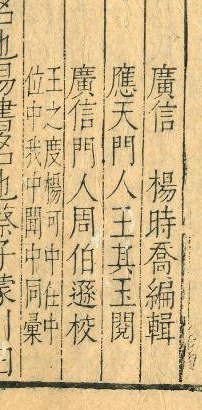
The detailed ascriptions at the beginning of the guwen 古文 section, which clearly identify Yang Shiqiao and other Ming dynasty personages involved in producing the book, have also been excised from the leaf in the Backhouse copy and replaced with something else (I don’t know where from) which might suggest an earlier date; they are present in the undoctored (but later) Sinica copy.

zyqsauthors2  zyqsauthors1

Gilding the lily, the dealer has also applied the seal 「乾隆御覽之寶」 (“imperially perused by Qianlong”) to the first leaf of each of the three sections, so that the first impression appears on the unrelated preface by Li Dingzuo that had been supplied to pass the book off as something earlier. It is inconceivable that the emperor would have examined such a copy, and the seal must clearly be considered a fake.

zyqsseal