Kiangnan Arsenal publications

30 April 2012

On Monday 16 April, we were visited by Li Changchun 李长春, Member of the Standing Committee of the Political Bureau of the Communist Party of China.

I doubt if even the most assiduous British follower of current events had the slightest idea of who Mr Li was, but in China the news was big. The following day a report of the visit appeared on page 3 of The People’s Daily, and it even made the CCTV news  – a friend in Nanking e-mailed me to say that he had seen me standing in the same room as Mr Li, and asked if I had actually spoken to him!

Indeed I had. In fact as usual with these visits, I had been asked to produce some Chinese objects for his delectation. The theme was sino-western contact, so one of the items I chose was a work translated and published by the Kiangnan Arsenal in Shanghai in the 1870s. It can be seen in this photograph in the bottom left corner:

Mr Li is in the centre of the picture, with the Osney copy of Magna Carta in front of him. I can be seen on the extreme right wearing a tie that had been presented to me on my last visit to the National Library of China – I thought I might produce it on this occasion, as Zhou Heping 周和平, its current director, was also present.

The Kiangnan Arsenal publication is described as follows in my catalogue:

器象顯真 四卷圖一卷 / (英)白力蓋輯 ; (英)傅蘭雅口譯 ; (清)徐建寅筆述
清同治十一年[1872]圖光緒五年[1879]上海江南製造局刊本
線裝3冊 : 圖 ; 30公分
本書由 Le Blanc 與 Armengaud 之《The engineer and machinist’s drawing book》 改編翻譯
本書為《江南製造局譯書》之一
Sinica 2162

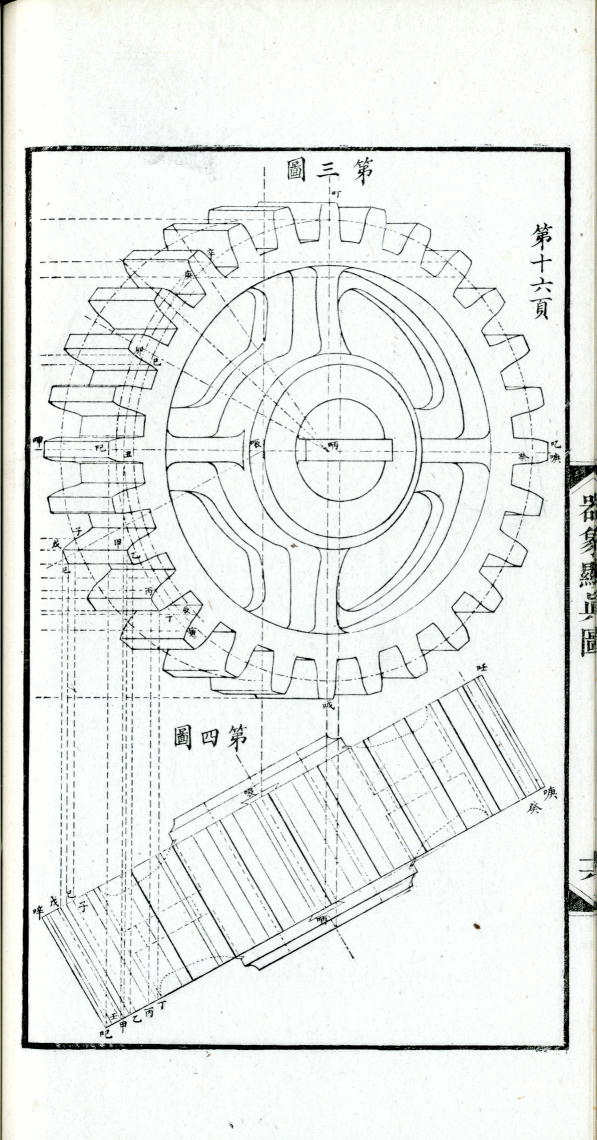
 

The work is a compilation based on works by three 19th-century French engineers, V Leblanc (c.1790-1846), Jacques-Eugène Armengaud (1810-1891), and his younger brother Charles (1813-1893). It was translated orally by John Fryer (傅蘭雅) and written out by his Chinese colleague Xu Jianyin, as detailed in the catalogue entry.

For a long time I was puzzled by the attribution of the work to the Englishman Bai Ligai 白力蓋, whose identity I was quite unable to discover. Then, when preparing to write this blog entry, I revisited WorldCat and found that all the editions of The engineer and machinist’s drawing book (eight in total) had been published by the Glasgow firm Blackie and Son between 1855 and 1881. It therefore seems that “Bai Ligai” (or rather “Bailigai”) is not a person,  but Blackie, the company that had organised the original translation and compilation from the French.

I chose to show this work to Li Changchun because of the exceptional quality of its illustrations. But it is actually one of many, printed in a uniform style and known collectively as Jiangnan zhizaoju yishu 《江南製造局譯書》, although this congshu title does not appear in any of the contents.

These works were produced by the translation bureau 翻譯館 of the Kiangnan Arsenal 江南製造局, of which the current online Encylopaedia Britannica says:

Jiangnan Arsenal, Chinese (Pinyin) Jiangnan Binggongchang or (Wade-Giles romanization) Chiang-nan Ping-kung-ch’ang, also called Kiangnan Arsenal,  in Shanghai, major Chinese centre during the 1860s and 1870s for the manufacture of modern arms and the study of Western technical literature and Western languages. It was opened in 1865 as part of China’s Self-Strengthening movement. Begun as an ironworks base with machinery purchased from abroad, the arsenal was developed primarily by Zeng Guofan and Li Hongzhang. During the 1860s and 1870s it was the most successful arsenal in East Asia and one of the greatest in the world. Westerners were initially employed to instruct the Chinese labourers in the manufacture and use of the arms. In 1868 the Jiangnan Arsenal produced the first modern Chinese steamship. Its translation bureau, directed by the Englishman John Fryer, translated more than 160 foreign works into Chinese. The arsenal was managed by Chinese and staffed at one time by some 3,000 Chinese workmen, who were paid four to eight times better than the average farmer or coolie labourer. In the early 20th century it gradually declined in productivity, chiefly because of apathy and incompetent leadership. The shipbuilding department became an independent boatyard in 1905, and the arsenal—renamed Shanghai Arsenal—remained in operation until the early 1930s.

A lengthy article on the work of the translation bureau by Fryer himself was published in the North China Herald for 29 January 1880 (pp.77-81). In this we are informed that as of that date, the bureau had published 98 works, a further 45 works had been translated buy not yet published, and 13 were in the course of translation, making a total of 156. “The statistics have been carefully arranged in three lists, which, however, are too cumbersome for insertion in the columns of a newspaper, but will be published shortly, together with this account, in the form of a pamphlet.” (p.81). Indeed they were, in Chinese, and the publication is as follows:

江南製造總局繙譯西書事略 不分卷 / (英)傅蘭雅撰
清光緒六年[1880]上海本局排印本
線裝1冊 ; 28公分
封面題名《譯書事略》
Sinica 2224

This work, like the 67 examples of the Arsenal’s publications which the Bodleian holds, was exhibited at the International Health Exhibition in London in 1884, and bears the characteristic yellow exhibition label.

Twenty-five years later, a lengthy account of the Arsenal (江南製造局記 十卷附錄一卷) was compiled by Wei Yungong 魏允恭, but the booklist (2:15-23) had grown to only 178 – the heyday of the translation bureau was the 1860s and 1870s. Original copies of this account, published in 1905 (清光緖31年), seem to be rather rare, but it has been reprinted a couple of times in recent decades.

The most complete collection of Kiangnan Arsenal translations I know of is in Kyoto University’s Institute for Research in Humanities 京都大学人文科学研究所, which holds 154 titles grouped together in their catalogue as a congshu with the title 《江南製造局譯書彙刻》 (see 京都大學人文科學研究所漢籍目錄, 上冊, 967-971).


Taiping yulan

28 March 2012

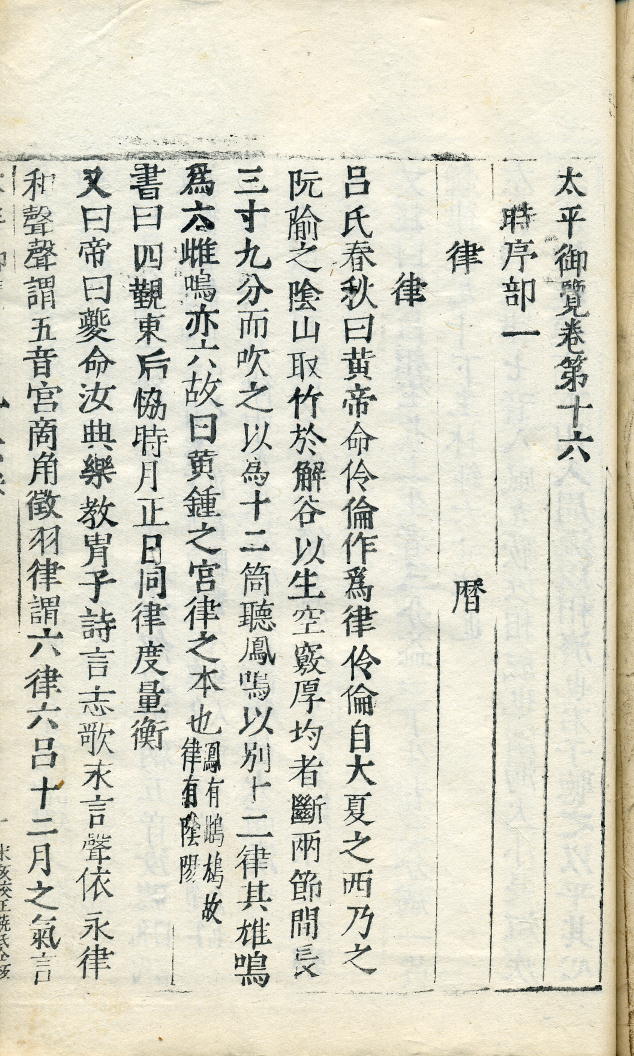
Two of the best known Chinese encyclopaedias date from the the reign of the second Song emperor, and bear the name of the Taiping period (976-983) in which they were compiled: the Taiping guangji 太平廣記 in 500 chapters, and the Taiping yulan 太平御覽 in 1,000 chapters. Both were compiled at imperial behest by the scholar Li Fang 李昉 working with a team of editorial assistants.

The Taiping yulan is the subject of this blog entry, in which I will describe two editions of it to be found in the Backhouse Collection, after a few words about each of the two encycopaedias by way of explanation.

The Taiping guangji 太平廣記 (guangji meaning “extensive record”), completed in 981, was compiled from informal, unofficial sources, such as histories written by private scholars and even accounts which we would regard as fairy tales. The compilation is derived from 475 different texts, of which one half are now lost, so that the Taiping guangji is now the most important source for early Chinese fiction. The Taiping yulan 太平御覽 on the other hand was a more general encyclopaedia, and was compiled from what at the time were regarded as more acceptable sources. As a repository for lost texts, it is even more impressive, for of the two thousand or so books and pamphlets from which it was compiled (of which 1,690 are listed in a prefatory chapter), three-quarters are no longer extant.

The Taiping yulan is not only bigger than any previous encyclopaedia, but at the time it was written also the biggest single Chinese work ever to have been compiled and published. It was completed in 983 and was first entitled Taiping leibian 太平类编 (leibian meaning “arranged in categories”), but it was then passed to the emperor, who examined three chapters a day during the course of almost an entire year, after which the second part of the name was changed to yulan, meaning “imperially perused”. This reminds us of the prototype Chinese encyclopaedia, the Huanglan 皇覽 (“for perusal by the emperor”), which was compiled for emperor Wen 文 of the Wei 魏 dynasty, who reigned from AD 220-227. This work is no longer extant, but some fragments quoted in other texts were pieced together by Sun Fengyi 孫馮翼 at the end of the 18th century. It was a collection of excerpts from the national literature, presented to the emperor in a way that was convenient for him to read, and is believed to have contained 120 chapters.

Between the Song and the Qing, only two editions of the Taiping yulan were made, and these appeared almost simultaneously in the Wanli period of the Ming. The first of the two examples of this work in the Backhouse Collection is a combination of both, and is described as follows:

太平御覽 一千卷經史圖書綱目一卷目錄十卷 / (宋)太平興國二年[977]李昉等奉敕撰.
明萬曆元年[1573]倪炳錫山刊本配補萬曆二年[1574]周堂銅活字印本
線裝160冊 ; 27公分
Backhouse 534

I have spent more time on this work than on any other in the Bodleian’s collections, because it has been necessary to examine every single leaf carefully – and there are over 12,000. I did this in the early 1980s when I was preparing my catalogue of the Backhouse Collection for publication. Then thirty years later, when I began to prepare this blog entry, I got out my old notes and started to transcribe details from them. Half way through, I stopped to do other things. The next day, the notes had disappeared. I searched high and low for them, and can only suppose that I accidentally put them in the recycling box, and that they have now been reincarnated as lavatory paper. So last week I had to examine every single leaf all over again.

Normally, one wouldn’t examine a large work in this way. But in this case, there were no evidences of any kind as to the imprint, whether of the block printed or moveable type editions – no prefaces or postfaces, no colophon, and no indications on the blocks; and also, I caught sight of one of the very distinctive leaves from the moveable type edition, which was rather exciting. It turned out to be from the well-known but extremely rare edition printed by Zhou Tang 周堂 in 1574 from engraved bronze moveable type.

I derive my information about this edition from K.T. Wu’s 吳光清 classic article Ming printing and printers (Harvard journal of Asiatic studies 7:3, 1943, 203-260), where it is described on p.220; and also Wang Zhongmin’s 王重民 description of two copies of the work on pp.355-357 of his equally classic Zhongguo shanben tiyao 中國善本書提要 (this work, by the way, was completed by others and published posthumously for the first time in Shanghai in 1983).

The rarity of Zhou Tang’s edition is probably due to the fact that only a hundred or so copies were ever printed, as evidenced by two pieces of information in the lower banxin 板心 of some (but very few) of the pages:

宋板校正饒氏仝板 / 活字印行壹百餘部
宋板校正閩游氏仝 / 板活字印一百餘部


According to K.T. Wu, Rao Shiren 饒世仁 and You Tinggui 游廷桂 were both professional printers in Fujian, who made the engraved bronze (仝 = 銅) types at Wusi. These were subsequently acquired by collectors there who used them to have the book published under the supervision of Zhou Tang 周堂, who wrote a preface dated 1574.

The Bodleian copy contains the following leaves from Zhou Tang’s moveable type edition:

卷16-25; 81:1,8; 83:1,2; 340:10; 361:1-5,7-11; 362-365; 366:1-4,8-13; 367:1,2,4-12; 368:2-10; 369; 370:1-5,7-10; 378:12 (this leaf has 「卷三百七十八」 in the banxin 版心 but 「卷第三百十八」 at the chapter ending 卷末); 387:1; 464:2; 573:7; 632:6; 691:1; 755:6; 812:8; 814:4; 816:2,5,6; 821:2,4; 824:7; 828:13; 981:1,3,4; 983:1,2.

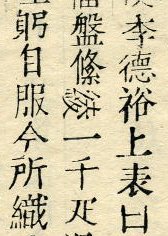
The edition displays all the characteristics of a Chinese moveable type edition: the variablity of the types, which were made individually and not mass-produced with punches and matrixes; the uneveness of the inking, as the types were held in place by wax and the impression made by hand, not with a press – in fact the forme was treated in exactly the same way as a conventional woodblock; and above all (and I was overjoyed when I found this example), by the occasional character that is upside down or on its side:

This occurs on leaf 816:6 (which happens to be mis-bound between pp.7 and 8).

Sometimes, moveable-type editions are less easy to identify, and the characteristics listed above may be largely absent – a good example being our second Backhouse copy of Taiping yulan described below, which has been printed to a very high technical standard. In a blockprinted edition, the lowest extremity of one character can, and frequently does, overlap with the highest extremity of the next; in a moveable-type edition, this is obviously impossible.

The main part of the Bodleian copy must be from Ni Bing’s 倪炳 block-printed edition of 1573, which is alike in format, and also rare. Outside the text of Taiping yulan, I have only been able to find the words 「江孔脩校錄」 which appear at the very end of juan 34.


Ni Bing’s edition has been produced rather carelessly.

For example, the banxin 版心 of juan 185:3 has 「卷一百八十四」, 325:9 has 「卷四百二十五」, and 451:6 and 7 both have 「卷四百五十二」; the chapter ending 卷末 of juan 281 has 「卷第二百八十二」; juan 964:1 has 「卷六十四」 at its beginning 卷端, and 「九百六十七卷」 in the banxin. In juan 742, the juan numbering is treated as page numbering, so that 742:7 has 「七百四十三卷」 in the banxin, and 742:8 has 「七百四十四卷」; order is restored at 742:9.

Some mistakes are of the sort one might expect to find in a typeset edition. Juan 73:4 has 「卷三十七」 in the banxin; 405:6 has 「卷四卷百五」; 825 has 「卷第八百五十二」 at its beginning 卷端, and 925 has 「卷第九百二五十」.

The careless approach evident in the block-cutting is also apparent in the collation of the printed leaves, so that for example there are two copies of 302:3, one in its correct place, and the other where 337:3 should be; and the collator of juan 351 must have been drunk, as 344:4 in inserted for 351:4, 310:6 for 351:6, and 342:8 for 351:8. Instances of missing leaves are legion.

One single leaf in the entire copy is supplied in manuscript: 26:1.

The latest date when the two editions were combined is evidenced by the manuscript alteration of the following characters (and doubtless others) on the leaves of both editions to avoid taboo:

玄, 弦, 𡊨, 昡, 泫, 炫, 畜, 絃, 蚿, 率, 曄 (188:8a)
(to avoid the personal name of the Kangxi 康熙 emperor, Xuanye 玄燁)

胤, (and the variant with 彳 on the left instead of 丿), 真
(to avoid the personal name of the Yongzheng 雍正 emperor, Yinzhen 胤禛)

弘, 泓, 曆, 歷
(to avoid the personal name of the Qianlong 乾隆 emperor, Hongli 弘曆)

The characters have been altered by deleting the final stroke with a yellow brush, except in the case of the characters li 曆 and li 歷, where the first stoke of the element he 禾 has been struck out. I wonder if the excessively pious individual who conducted this laborious operation really knew what he was about? The rules state that the character li 曆 may be replaced with li 歷, which is not itself taboo.

So the copy must have been put together by 1796 at the latest. The fascicles are contained in 20 tao (8 in each) which are covered in coloured silk brocade, fastened with red-stained bone pegs, and bearing manuscript labels. I suppose the tao are contemporary with the marriage of the two editions in the 18th century; some of them are in bad condition. There are no collectors’ seals.

The other copy of Taiping yulan in the Backhouse Collection is also a bronze moveable-type edition:

太平御覽 一千卷經史圖書綱目一卷目錄十卷 / (宋)太平興國二年[977]李昉等奉敕撰.
清嘉慶十一年[1806]揚州汪昌序銅活字印本.
線裝100冊 ; 29公分
Backhouse 306

This has much more integrity than Backhouse 534, and is a classic example of a scholarly edition. There is no “title” (or “cover”) page 封面: the book starts with a series of prefaces, starting with the preface relating to the edition 太平御覽叙, by Yi Bingshou 伊秉綬, and dated 1806 (嘉慶十一年). Yi Bingshou was prefect of Yangzhou 揚州, and tells us that Wang Changxu 汪昌序 owned a copy of the Ming moveable-type edition, and decided to reprint 120 copies of it, again in moveable-type.

There follow the preface and postface (後序) to Zhou Tang’s edition (on which Wang’s was based), and then two Song postfaces (後序). The table of contents is in 10 juan, like Ni Bing’s printed edition. This is strange, as in Zhou Tang’s edition, the table of contents is in 15 juan.

There are also significant textual differences between the two moveable type editions.

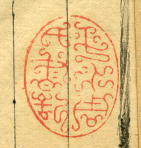
There is a single seal 「平水周氏書記」 showing that the book was once owned by a certain Mr. Zhou from Pingshui, now a town (镇) in Shaoxing county 绍兴县, Zhejiang province 浙江省.


Seals

27 March 2012

I need help with reading seals.

The internet has made the process a little quicker, in two ways.

Firstly, it is usually possible to read some of the characters on a seal, and if there are sufficient consecutive ones, a phrase-search in Google or Baidu will sometimes produce the answer – usually in an auction site, where another book bears the seal in question.

Secondly, I’m soliciting the help of interested parties by drawing their attention to my embryonic list of all the seals to be found in the books in our collections, starting with Backhouse:

http://www.bodley.ox.ac.uk/users/djh/seals/

I believe the fashionable term for this process is “crowd sourcing”.

I hope it works – I’ve wasted enough time with seal-script dictionaries.


A Shijing fragment

28 February 2012

It is very frustrating when something in the collection defies all attempts to catalogue it, especially when it is probably unique. This morning I dealt rather unsatisfactorily with a Shijing 詩經 fragment, and after quite some work, could only establish the following:

詩經 殘卷六第七~二十葉
明萬曆中(?)書坊刊本
精裝(原線裝)1冊 ; 15 x 15公分
Sinica 122

It is part of the Daya 大雅 section, with some of the banxin 版心 bearing the title Shijing 詩經, some Daya 大雅, and some both: 詩經大雅. The fascicle is square, like the so-called “sleeve” editions (xiuzhenben 袖珍本) that were made to smuggle into examination cells, but seemingly not quite small enough for that purpose. However, faint traces of vermilion punctuation indicate that the book has indeed been used for study.

I suppose it was printed sometime during the Wanli period; it was certainly brought to Europe in the 17th century, and might even be one of the very earliest imports by the Dutch East India Company. An inscription tells of its immediate provenance:

Almae Matri Academiae Oxoniensi Nathaniel Palmer de Fairfeild [sic] in Comitatu Somerset, Armiger, D.D.

Arch.C.33. Liber sinicus.

Nathaniel Palmer was born in Fairfield in Somerset in 1660, and died in 1718. He was educated at Winchester and Trinity College, having matriculated on 22 March 1678 at the age of 17. He was a Member of Parliament.

This chronology makes it possible that the book came to the Library before Shen Fuzong’s visit in 1687, and the leaves are bound in a style characteristic of that time. However, it lacks the inscriptions by Shen Fuzong and Thomas Hyde (Bodley’s Librarian) on all the Chinese books that Shen Fuzong examined, nor is it in the list of these which Hyde compiled and recorded with their shelfmarks at the back of what is now MS Sloane 853 in the British Library. So it must have arrived after 1687.

The main part of the inscription may be in the hand of the donor, but the shelfmark is in the hand of Thomas Hyde (and I’m grateful to Will Poole for confirming this), who left office in 1701 and died in 1703. So we have a 13-year window in which the book came to the Bodleian, and can confidently count it among our remarkable corpus of 17th century Chinese accessions.

It is possible that other parts of this book are elsewhere in Europe, and it would be fortunate indeed if the first or last sections could be found, or at least a juan beginning, so that we could identify the edition properly.


Atlas of Guangdong Province

15 February 2012

It is unfortunate when something famous and well-known in a library overshadows the existence of other objects which are also deserving of attention, and in some cases more so.

In the Bodleian therefore, we must not let the recent discovery of the Selden Map blind us to the existence of other pre-modern Chinese maps in our collections that are also of considerable interest. Admittedly our collection of such maps is small – only 10, by contrast with the huge collection of over 500 in the British Library – but all of them are unusually interesting in one way or another, and a few are unique surviving copies.

Some of them were included in Li Xiaocong’s 李孝聪 bilingual Descriptive catalogue of pre-1900 Chinese maps seen in Europe (Peking, 1996) made largely on the basis of trips here during the early 1990s. I must have been away when he visited Oxford, or I would have ensured that he saw all ten of our maps, and not just the six that are included in his catalogue. In fact I made a list of them very soon after my arrival in the Library in 1976, as it was clear that most of them needed conservation work of one sort or another.

Here are the maps in Li’s catalogue:

歷代分野輿圖古今人物事跡, 1679, Sinica 92 (p.157).
廣東全省圖, 清乾隆中, Sinica 2733 (p.331).
乾隆今古輿地圖, 清乾隆中, Sinica 113 (p.169).
大清萬年一統天下全圖, 1767, Sinica 2734 (p.173).
大清萬年一統天下全圖, 1814, Sinica 2731, (p.193).
黃道中西合圖 北極﹑南極 (二幅), 1834, Sinica 875, (p.136).

and here are the ones that he did not see:

[東西洋航海圖], 1620s. MS.Selden supra 105.
皇輿地圖考 ; 通華經緯圖考 (二幅), 清康熙中. Sinica 123.
京板天地全圖, 清乾隆中. Sinica 2111.
廣東全省經緯地輿圖, 清嘉慶中. Sinica 2730.

The first of these, MS.Selden supra 105, is the newly famous Selden Map of China. It has no title, and I have taken its Chinese name from one of the articles that have recently appeared on it. And Sinica 2111 is not identical with a map of the same name listed by Li (p.186).

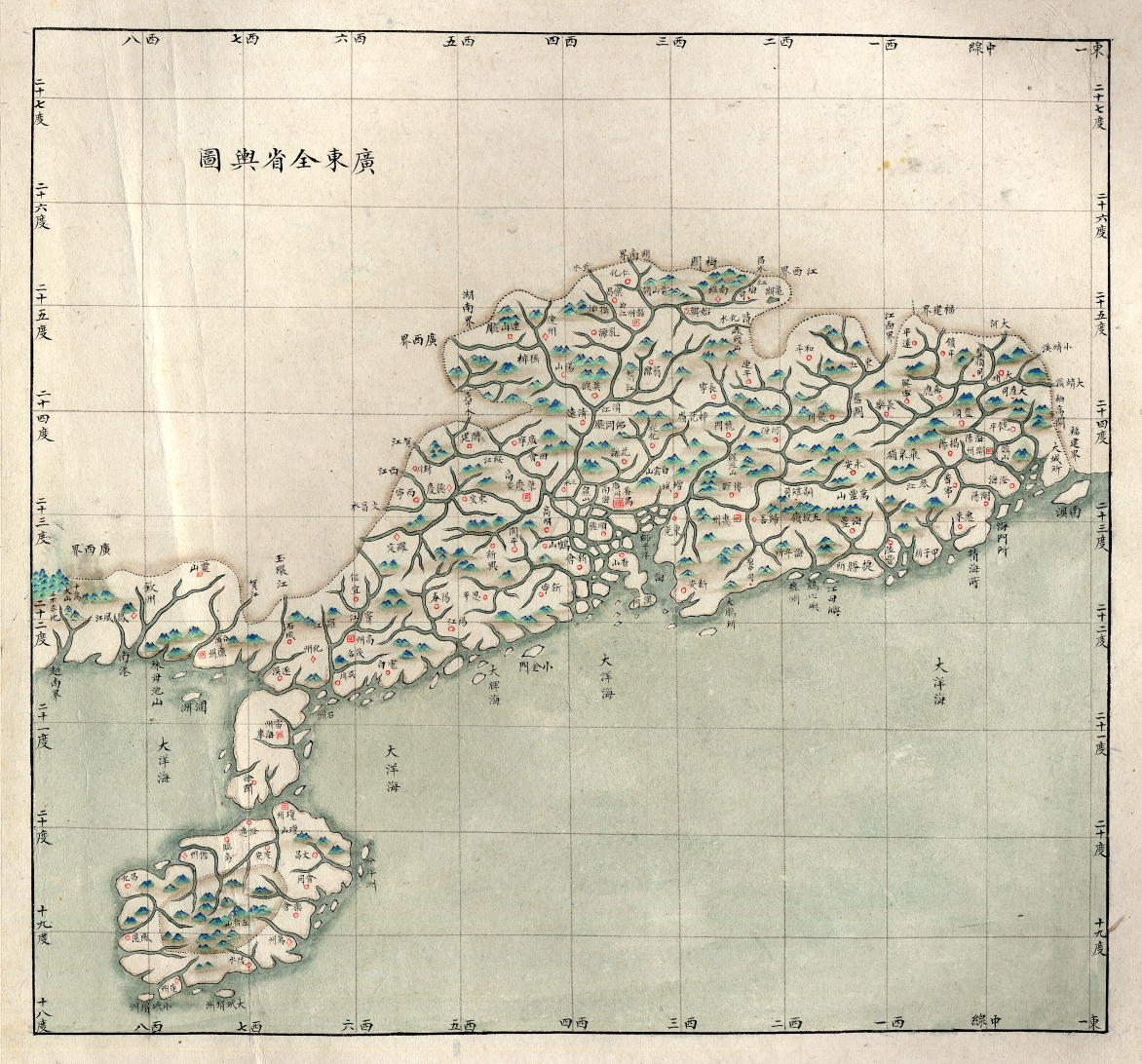
If my blog continues for long enough, I hope to have something to say about each of our maps. For now I will discuss only the last in the list, the atlas of Guangdong province. Apart from the Selden Map, this is the one that I have had most to do with recently, as a couple of years ago I chose it as one of the objects to show to the visiting Governor of Hainan, a province that was created as recently as 1988. Until then, the island had been part of Guangdong province, and from 1944 was known as Hainan Dao 海南島. Before that it was called either Qiongzhou 瓊州 (after its ancient name of Qiong 瓊, meaning a special sort of jade), or Zhuya 珠崖 (after the pearls that abound on its northern shores).

The atlas is a luxurious product, its leaves mounted on stout cards bound “album” style between wooden boards covered with silk brocade. It has a very high aesthetic appeal, evidenced in the depiction of mountains, precisely and in vibrant shades of blue and green; the use of subtle colour wash; and the precision of the calligraphy, which is sometimes almost unbelievably small.

It was scarcely possible to show the atlas to a visitor without knowing its date, and so I set about finding it. If the truth be told, my main interest in this document was simply in cataloguing it as accurately as possible in the absence of any names or dates in the text.

Although Li Xiaocong did not see this atlas, he described a printed map with the same title in the British Library,  Maps 61670(1), (p.335-336). It seems that this and other maps described in the Guangdong section of Li’s catalogue and the Bodleian atlas are somehow related, as they all reproduce a major error in the depiction of the Leizhou Peninsula 雷州半島, showing it cut off from the mainland by a strait just south of Suizhou 遂州.

Like the map in the British Library, the Bodleian atlas can be dated by the following three criteria: the presence of Lianshansuiyaoting 連山綏瑤廳, which was created in 1816; the presence of the character ning 寧 which was replaced by ning 甯 in the Daoguang period to avoid taboo; and the absence of Hong Kong. I have therefore catalogued it as follows:

廣東全省經緯地輿圖
清嘉慶末年彩色繪本
折裝1冊 ; 35公分
Sinica 2730

No meaningful terminus post quem non can be established by the date of its accession, as we can tell from its original shelfmark (Chin.c.3) that it must have entered the Library only in or shortly after 1885.